Welcome to YouChoose, a blog where we explore ways of living sustainably. This week I would like to share the first steps we can take towards sustainable gardening. There are many topics to be discussed on this subject and I plan to share several postings about my journey to achieve a 100% sustainable backyard.
The focus of this post is motivation. It is important to be confident that our efforts make a difference. My experience bears witness to this fact: I have seen my backyard quickly transform from a lawn wasteland to an ecosystem full of life.
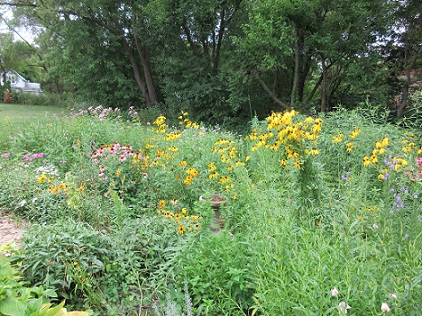
Here is just a quick overview, we’ll go into the details in future posts.
QUICK TIPS TO START – STEPS to DO
- Be motivated and be sure that your efforts make a difference
- Don’t be overwhelmed; small steps go a long way
- Remove invasive plants (if any)
- Reduce the amount of lawn in the yard
- Plant native forbs and shrubs
- Provide wildlife with places to live and shelter
- Plant native trees
- Provide water
QUICK TIPS TO START – things to AVOID
- Being obsessed with lawn appearance
- Being afraid of making mistakes
- Using herbicides or pre-emergent chemicals
- Using pesticides
- Collecting and disposing of leaves
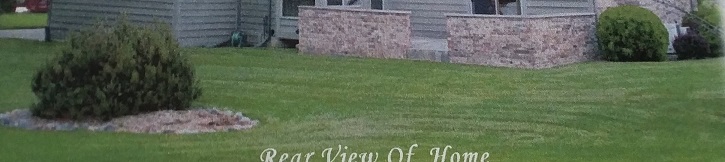
My neighborhood is a typical Midwest suburban neighborhood with single family homes surrounded by yards landscaped with lawn (a lot of it) and mulched areas planted with evergreens, roses, and plants readily available at general home improvement stores or nurseries. As a foreigner in a foreign land my initial efforts were devolved to maintaining what was found. Therefore, I joined the chorus, hired a lawn maintenance company to take care of the lawn and visited local nurseries or whatever was nearby to purchase familiar plants: roses, azaleas, peony, etc. Plant diseases or parasites were treated with chemicals recommended by the nurseries and, occasionally, a mosquito treatment kept the yard free of bugs.
It is likely that my experience mirrors the one of many homeowners. It was only later that I realized that the weed-free, picture-perfect look of the suburban homes is achieved at a very high environmental cost. The perfect lawn is maintained by pouring herbicides and fertilizers, in addition to constant mowing. The weed-free mulched areas are loaded with pre-emergent chemicals, and the bug-free backyard requires the use of non-selective pesticides that have repercussions on the entire food chain of the creatures living (or better trying to survive) in our backyards.
The eye opener for me came one day when I was going for a walk in the neighborhood and came across a road that was developed on one side and undeveloped on the other. The developed side had new homes surrounded by a luscious lawn of an intense green. The mulched areas were planted with flowers of almost a neon color that matched some of the house details, nothing was out of place, the whole view was studied to the detail. The undeveloped side in the front was filled with milkweed and other tall grasses and had the messy look of the summer prairie. When I stopped and listened, the developed part was dead silent, not a buzz to be heard, not a bug to be seen; the undeveloped side was a concert of sounds and voices of creatures living there. This was when the realization came to me, that my move into a suburban acre was forcing all the other creatures living there to move out or die. I was depriving many species of food and shelter and was poisoning the soil and water.
Since that day my yard has changed very much and it is still an ongoing effort. I have also become addicted to bugs and can’t stop taking pictures of them and being amazed at their shapes and colors.


Are you ready to start the transition? Don’t wait and don’t be afraid of the messy look, there are wonderful native plants that are perfect for the front yard. My only regret is that I didn’t start earlier. It takes about 3 growing seasons to go from nothing to an initial blooming backyard.
In a next post we’ll discuss the first step: How to identify and remove invasive plants.
Do you want to share your motivation for starting a native gardening? Send me an email at info@choosesustainable.org
 You Choose