Welcome to ChooseSustainable.org where we discuss sustainable choices. In this post I would like to talk about the winter garden.
One of the wonderful rewards of switching to native and sustainable gardens is that there are no dead seasons. In the traditional suburban gardening the fall season is the time to tidy up the yard and leave everything cut and clean, waiting for spring. A lot of effort goes into vacuuming, blowing, cutting, and shredding. All this cleaning up however does nothing but deprive wildlife of the food and shelter needed to survive the winter.
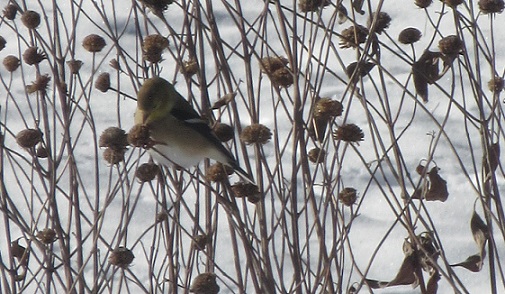
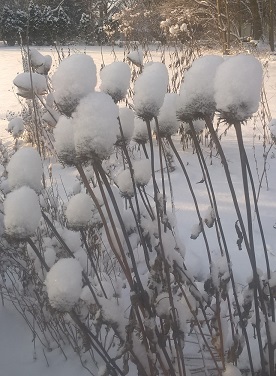
In a sustainable garden the fall season is the time when Nature provides everybody with the means to survive the winter. The fallen leaves are used by larvae and small insects to hibernate, the flowers produce abundant seeds that birds can use as winter food, dead trees and rotting wood provide shelter from the cold for insects and small mammals, dry twigs provide winter food for herbivores that don’t hibernate. Coneflowers, sunflowers, and goldenrods produce much appreciated seeds when left untouched until spring.
Besides providing for wildlife, untouched grasses and forbs add beauty and character to the winter garden.

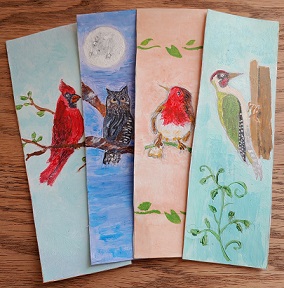
Chickadees, dark eye juncos, gold finches, a pair of red cardinals that I think have been together for a few years, woodpeckers, and of course, owls inhabit my backyard in winter. Now that I am mostly working from home I love watching them come and go. Actually I have never seen the owl, but I hear it at night. They are so attractive that, in spite of the fact that I never held a brush in my hand until now, I couldn’t resist painting them in small pieces of scrap paper and make bookmarks from up-cycled pizza boxes to give to family as gifts. If you are thinking of starting a wildlife garden I’ll be happy to send you a hand-painted bookmark as a thank you gift. You can check them out here.

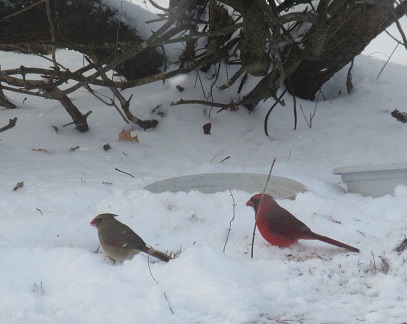
Sometime I hear that we shouldn’t feed birds so they don’t become dependent on us. In my opinion this would be true if we had left their original habitat intact. Certainly the best thing is to leave native plants and grasses uncut until at least the end of February and also provide additional seeds during the harshest months from December to March. I do my part and place the seeds under a shrub or a tree with tall grasses around to provide shelter from predators.
Providing water during the winter months is challenging. Usually the bird bath can stay outside until the end of November, but it needs to come inside after that. From December to March a black plastic saucer can be used for water, however in the absence of a water heater the water freezes quickly. One of the benefits of working from home is that in the warmest hour I can remove the ice and replace it with slightly warm water. In typical Illinois winter temperatures of 15 to 25 F (-10 to -5 C) this provides birds with a few hours of fresh water every day.
If you are considering native and sustainable gardening I hope this post was useful to see how planting native grasses and trees, avoiding pesticides, leaving grasses, twigs and seed heads in the yard through the winter, helps wildlife survive the cold months. Who knows? It may even inspire you to start painting!
The YouChoose App provides several links to resources to get you started with sustainable gardening. It also provides links to native plants in specific regions. You can download it from Google Play or through the link on the right.
If you liked this post please share it!
 You Choose