
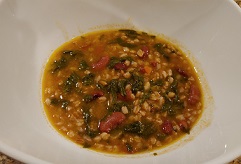
Farro and spinach soup

Reduce meat consumption by switching to a diverse, plant-based diet. This delicious recipe is based on farro, one ancient grain that, after being forgotten for sometime, is making a comeback. Farro was extremely popular in ancient Rome, and a staple food for the Roman legions. I use pearled farro that cooks faster, especially after soaking.

Farro can be used as a side dish, in salads, and I am discovering that it can be used as an alternative to rice.

Sustainability tips:

Organic farro is a sustainable crop that can be part of a diverse diet. Spinach can be loaded with pesticide therefore organic better. Remember that supporting organic and sustainable produce goes a long way to reduce harmful pesticide use. I also suggest to avoid produce in plastic bags and to bring your own reusable bags to help reduce the amount of plastic dispersed in the environment. I can send you free cotton grocery and produce bags entirely upcycled from old fabric. Just contact me if you need any.

Useful things to have ready

Rinse and soak the farro and kidney beans together for about 7 hours. Notice that it is not necessary to soak the pearled farro for so long, but soaking will reduce the cooking time and give a creamy consistency to the final dish. A great thing about this recipe is that it can be made as a soup or as a risotto-style dish.

Soak farro and beans overnight or for ~ 7 hours

Preparation time: about 30 minutes

Ingredients (3-4 people)

  • 2 fistful of soaked farro per person
  • 1 bunch of spinach (frozen spinach also works)
  • 2-3 fistful of red kidney beans (soaked with farro for about 7 hours)
  • 1 chopped tomato (I peel it but is not necessary)
  • half onion (if small) or 1/4 (if large) chopped in small pieces
  • 1 garlic clove-mashed
  • Crushed red chili
  • 1 carrot
  • 2-3 spoons of olive oil
  • 1 tablespoons of tomato paste (or tomato sauce)
  • Salt

Procedure

  • Wash the spinach carefully and chop them.
  • Wash and peel the carrot and tomato
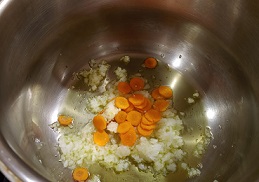
  • In a pressure cooker heat the oil, add chopped onion, mashed garlic, carrots, crushed chili, and cook for a few minutes on medium heat.
Add onion, garlic, and carrot to the hot oil
  • Add tomatoes, tomato paste, and spinach and let cook for 5 minutes
  • Add drained and rinsed farro and kidney beans
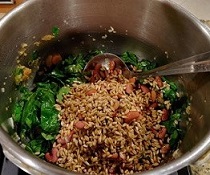
Add spinach, farro, and beans
  • For a soup add enough water to exceed the level of farro, for a risotto-like consistency add enough water to just cover the farro.
  • Close the lid and pressure cook for about 15 minutes from when it starts whistling.
  • Let the steam out and check consistency. You may need more time depending on the type of cooker and desired consistency.

Enjoy!

Help reduce meat consumption! If you have a vegetarian recipe you would like to share please email me at info@choosesustainable.org and I’ll post it on this blog.

Still undecided? Read here about the destructive impact of the meat industry on forests.

The YouChoose App contains links and information about sustainable food choices with a searchable database of common food items.

Actions and News: Tell the Biden administration to stop deep sea mining

Welcome to YouChoose, a blog about individual climate action.

The 28th Session of the International Seabed Authority started on March 7th in Jamaica. If you don’t know what this is you are probably not alone. Unfortunately these are the entities that regulate the future of our oceans based on commercial interests. We need to show that we are aware of what is happening and we have an opinion.

Keep the pressure on!

Click HERE to sign the Greenpeace petition and tell the Biden administration to ban deep sea mining.

If you liked this post please share it!
Actions and News: Please urge Congress to reintroduce the Recovering America’s Wildlife Act (RAWA)

Welcome to YouChoose, a blog about individual climate action.

Do you know that the great American prairies are among the most endangered ecosystem on Earth? Less than 1% of them are left!

Last year there was great hope that Congress would pass legislation to help the recovery of America’s wildlife and biodiversity. Unfortunately that didn’t happen. There is a chance to urge lawmakers to reintroduce the bill and people’s support is the biggest voice we have to make ourselves heard.

Please add your name to the Nature Conservancy petition and urge Congress to reintroduce the Recovering America’s wildlife Act.

https://preserve.nature.org/page/86239/action/1

Please share this post and keep the pressure on!

Actions and News: Agreement reached at the UN conference on marine biodiversity

Welcome to YouChoose, a blog about individual climate action.

An agreement was reached at the UN Fifth Intergovernmental Conference, or IGC5, to protect Oceans’ biodiversity.

Thank you to all who signed the petition. Below is the link to Greenpeace press release.

Historic UN Ocean Treaty agreed

Keep the pressure on!

Stop buying fish from grocery stores that disregard basic environmental and human right protections. Click HERE to sign the Greenpeace petition to US giant grocery store chains to stop selling tuna linked to environmental destruction.

Do you want to know where your grocery store stands in the tuna scorecard? Check out here the Greenpeace report to find out. You need to place your cursor on the image and advance the pages at the bottom of the image. The report scorecard is on page 4. Think of this report next time you want to buy tuna!

If you liked this post please share it!

Is this a key to sustainable EVs?

Welcome to YouChoose, a blog about sustainable living. In this post I wanted to share some information about batteries and electric vehicles.

If you have a lot of old cell phones in your home you may be interested in this Argonne National Laboratory OutLoud lecture on battery recycling. It contains very useful information on how batteries from cell phones can provide useful material to make new batteries. It takes less than 200 old phones to make a new EV battery! It is a good incentive for all of us to find out where the nearest battery recycling facility is located and drop off the old batteries cluttering our drawers.

Below is the link:

If you liked this post please share it!
Actions and News: UN conference on marine biodiversity resumes in NY

Welcome to YouChoose, a blog about individual climate action.

The UN Fifth Intergovernmental Conference, or IGC5, to protect Oceans’ biodiversity is underway in New York.

https://www.un.org/bbnj/

Here is a WWF article that explains why it is important that we protect oceans from destruction. Click on the link below to go the WWF article:

https://wwf.panda.org/wwf_news/?7704966/high-seas-treaty-2023

Grocery stores are largely responsible for relying on supply chains that disregard the environment as well as human rights.

What can we do?

We can stop buying fish from grocery stores that disregard basic environmental and human right protections. Click HERE to sign the Greenpeace petition to US giant grocery store chains to stop selling tuna linked to environmental destruction.

Do you want to know where your grocery store stands in the tuna scorecard? Check out here the Greenpeace report to find out. You need to place your cursor on the image and advance the pages at the bottom of the image. The report scorecard is on page 4. Think of this report next time you want to buy tuna!

If you liked this post please share it!
Meet my groundhog neighbor

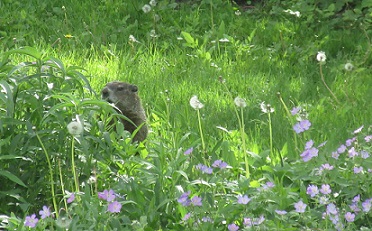
Welcome to ChooseSustainable.org a blog about individual climate action and sustainable choices. This week I wanted to seize on this groundhog day celebration to introduce you to my gentle, albeit hungry, resident groundhog.

A nice article on these extremely shy animals can be found at this Lake County forest preserve page: https://lakecountynature.com/2020/02/01/get-to-know-groundhogs/

Plan to start a native garden to support local wildlife and get a thank you hand-painted bookmark! See what’s available here.

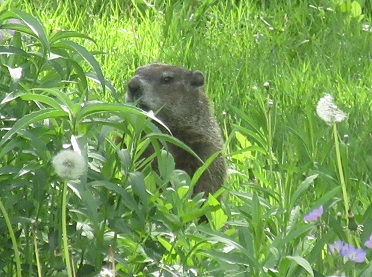
Every spring I hope to catch a sight of my resident groundhog and in a few months you may see one too, a large beaver-like guest feeding in your yard. They come out at the end of April to feast on dandelions and emerging plants. Some years I don’t see them, some years I have had two at the same time.

Groundhog feeding on dandelions

Groundhogs are among the many inhabitants of our land who are thankful for the small twigs and dry leaves left on the ground from the previous winter, one more reason not to obsess with fall cleaning.

A groundhog collects twigs and dry leaves in early spring

As many of you probably know, groundhogs are large rodents, true hibernators that emerge in spring and again hibernate in fall. They dig large underground chambers that can be also used by other animals once abandoned. To my amazement, for all their weight, they are extremely fast and skilled tree climbers.

This is the entrance of the groundhog’s burrow in my yard. It is located in a quiet wooded area

When they emerge from hibernation they are very hungry and will eat whatever green they find around. My resident groundhog is very fond of golden alexander and other native plants, but it also happily eats dandelions.

Golden alexander is very much appreciated

Groundhogs are often regarded as ‘pests’ because they might eat our precious garden plants and occasionally we hear of disturbing events regarding homeowners poisoning groundhogs, chipmunks, and beavers in their backyards. I can understand that voracious eaters can create problems for farmers, however for us suburban dwellers the ‘damage’ they may cause is minimal. ‘Our‘ property was theirs before we arrived and they only eat to survive, not to cause damage on purpose. The groundhog in my yard eats voraciously in early spring, but already in summer its activity subsides to nothing. When we say ‘I love wildlife but just not in my yard‘, we need to remember that as we expand the suburban landscape, we chip away more and more land. What is not our yard becomes somebody else’s yard. We need to abandon the absurd aesthetic impositions of traditional suburban landscape and make our backyard friendly to wildlife so that our arrival doesn’t dislodge other inhabitants.

This blog is about reminding us that we are all guests on this Earth and our lives are better when guided by kindness and compassion towards all life. I encourage you to welcome groundhogs to your backyard, they have their place in the ecosystem. Plant in abundance so that plants can serve their true purpose which is to feed and shelter the local wildlife. If really you can’t tolerate having a groundhog in your backyard, please try to humanely encourage it to move. Here is a link to the Humane Society website with some tips on how to humanely dislodge a groundhog.

https://www.humanesociety.org/resources/what-do-about-woodchucks

Thank you for letting me live in your backyard. I always bring the good news that spring has arrived at last!!

Happy groundhog day!

Would you like to talk about wildlife in your backyard? Please send me your post at info@choosesustainable.org

If you liked this post please share it!

Penstemon digitalis (Foxglove penstemon)

Welcome to ChooseSustainable.org a blog about sustainable choices. In this series of short posts I present a native plant to encourage everybody to abandon our traditional way of gardening (basically a continuous fight against nature) and engage in sustainable gardening practices that nurture the ecosystem, sustain wildlife and foster biodiversity. I hear sometime people worrying that native plants may look weedy in a backyard. This notion is mostly misguided, that’s why here I show native plants in a garden setting.

Make a New Year resolution to start a native garden and get a thank you hand-painted bookmark! See what’s available here.

I know it’s January, but one nice thing about native gardening is that there is never a dead time. As a matter of fact, this is the time to think of spring and of the plants to add to our backyard in a few months. This spring-blooming, perennial plant provides early nectar to several species of bees and food for the caterpillars of a few moths. If you are planning a pollinator garden, this plant is an excellent starter, it is easy to grow and self pollinates extensively providing quick results while slower plants develop: Penstemon digitalis (foxglove penstemon).

Foxglove penstemon is a great garden choice.

Quick facts:

  • Zones:4-8
  • Bloom time: Early Summer (May-June)
  • Sun: Full, partial
  • Soil Moisture: Medium, Medium dry
  • Aggressive: MODERATE
  • Front yard: YES
  • Height: about 4 feet
  • Status: OK
  • Maintenance: LOW
  • Wildlife value: Medium

Wildlife connection: This perennial spring bloomer attracts wasps, bees, bumblebees, and some variety of moths. Some small butterflies may visit it and it also attracts hummingbirds, although I have never observed that.

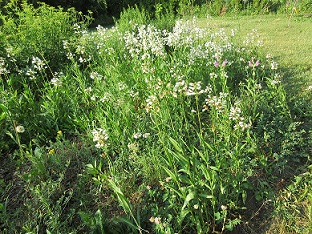
I planted about 6 or 7 small plants several years ago in a dry area of my yard. The plant is quick and easy to grow and it spreads abundantly in the assigned area. Occasionally, I also find new plants in other areas of the garden but overall it is not a very aggressive spreader. I planted this in the same area as the Golden Alexander, another aggressive self pollinating perennial. They bloom approximately at the same time and together they attract a large number of pollinators.

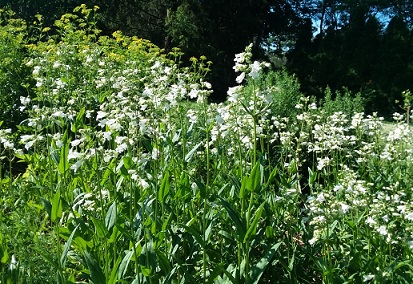
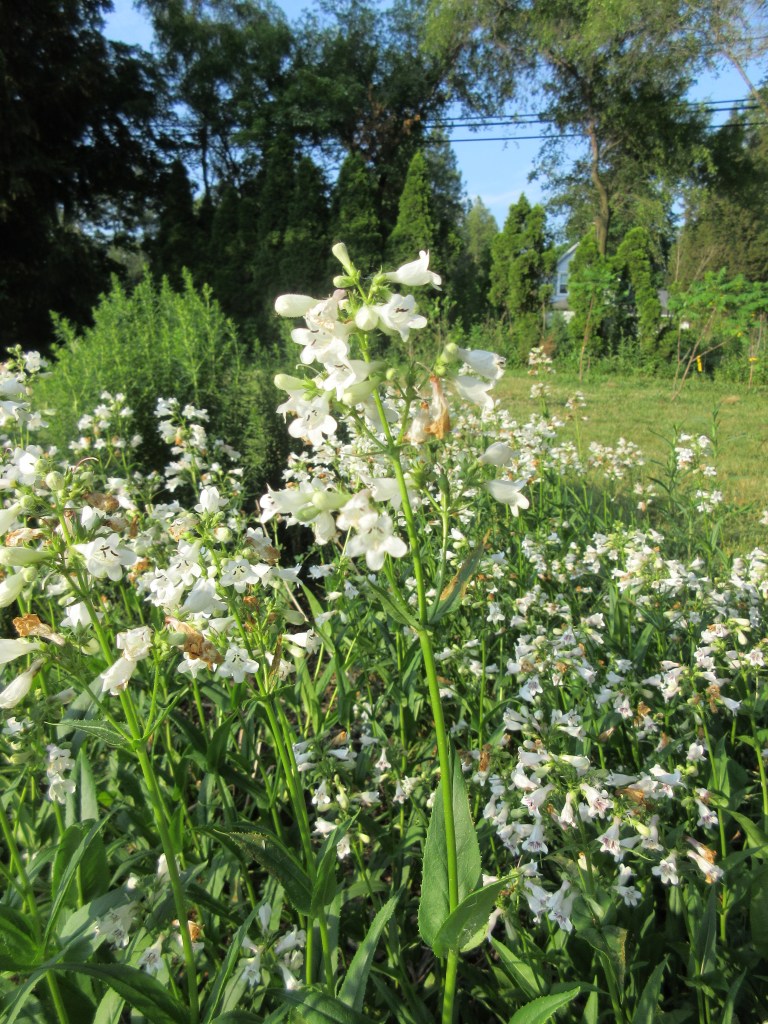
Foxglove penstemon shows off its bloom in spring, May-June

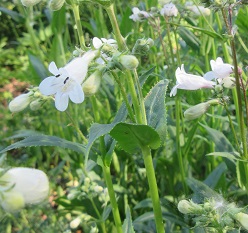
The single flowers are white and small but, as the plants expand, they provide a very attractive ensemble view that last about one month. The leaves are elongated and shiny in spring and summer and change color to red-brown in fall. I used to cut them back in the fall, but now I let them stay untouched until the next spring.

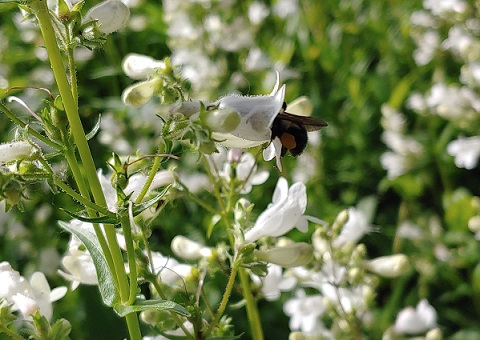
Foxglove penstemon attracts a lot of bumblebees that make their way in the tubular flowers helping with pollination as well.

Penstemon digitalis is valuable to bumblebees
Several types of bees and wasps visit the flowers regularly in spring

Overall the plant is really low maintenance, it is very resistant to drought and hardly needs and care besides some occasional pulling if it expands where is not wanted.

As a note I want to add here that, despite the vague resemblance in name and shape to the European Digitalis Purpurea (common foxglove), penstemon digitalis is not listed as toxic, although of course please don’t eat any part of it.

I hope you will consider this great, easy native plant for your garden this spring. Every native plant you add brings back a piece of ecosystem that is vital to biodiversity.

Would you like to talk about a native plant in your backyard? Please send me your post at info@choosesustainable.org

If you liked this post please share it!

Zucchini stuffed with millet

This recipe seems complicated, but in reality is quite simple once you have familiarized yourself with millet. It took me a few tries to get the right way to cook millet. I’ll share here the basic cooking, you can try and see if it works for you.

Millet is a variety of whole grain that can be used in several dishes. It is a nice alternative to rice or couscous. If you have never tried it I suggest you give it a try. It doesn’t require soaking and cooks very quickly.

Sustainability tips:

Millet is a sustainable crop that requires less resources compared to other cereals. Diversifying our diet is also a great way to increase crop biodiversity. Please check out this link on millet crops.

https://news.un.org/en/story/2021/05/1092492

The remaining ingredients for this recipe are quite basic and generally sustainable. Remember that supporting organic and sustainable produce goes a long way to reduce harmful pesticide use. I also suggest to avoid produce in plastic bags and to bring your own reusable bags to help reduce the amount of plastic dispersed in the environment.

Useful things to have ready

Cooked millet: I used to follow directions and cook the millet in little water letting the grain absorb the water slowly. However this preparation method resulted in a sticky blob of millet that was difficult to utilize. I therefore suggest the following method for the basic preparation:

  • Place millet in a bowl and rinse it several times draining the water with a fine mesh strainer (the grains are quite small).
  • Fill up a pot with water and add salt, water should be abundant compared to the amount of millet.
  • Add 1 fistful of millet per person (it grows a lot).
  • Bring the water and millet to a boil on a medium flame and let it boil until the millet is soft (about 10 minutes). The millet should be circulating in the pot.
  • As soon as the millet is soft drain the water with a strainer and rinse the millet under cold running water, this will stop the cooking and leave the millet intact.
  • At this point you can store the millet in the refrigerator and use it later or proceed to this recipe or any other recipe.

Preparation time: about 30 minutes

Ingredients (3-4 people)

  • 1 large chopped tomato (I peel it but is not necessary)
  • half onion (if small) or 1/4 (if large) chopped in small pieces
  • 4 zucchini (courgette)
  • 2 scallions
  • 1 garlic clove-mashed
  • 2-3 spoons of olive oil
  • 2 tablespoons of tomato paste (or sauce)
  • 1 handful of capers and olives (optional)
  • Salt

Procedure

  • Cut zucchini in cylinders about 1 inch high and place them into a pot of water. Bring to a boil until the zucchini are softer, but not fully cooked (about 5-10 minutes).
Soft zucchini ready to be carved
  • Carve the zucchini removing the soft center and leaving the outer skin
  • In a pot heat the oil, add chopped onions, mashed garlic and cook for a few minutes
  • Add scallions

  • Add the zucchini pulp, chopped tomatoes, tomato paste, salt, olives and capers.

Cook 6-7 minutes until the tomatoes are well cooked, add the cooked millet and check the salt. The millet will quickly absorb any excess liquid.

Add millet to the mix
  • Place the empty shells on an oven pan and fill up with the millet.
  • Place in the oven for about 20 minutes
Bake at 400 F for about 20 minutes

Enjoy as a side dish or a nice appetizer!

Help reduce meat consumption! If you have a vegetarian recipe you would like to share please email me at info@choosesustainable.org and I’ll post it on this blog.

The YouChoose App contains links and information about sustainable food choices with a searchable database of common food items.

Don’t wait to be saved

Welcome to YouChoose, a blog about sustainable living. In this post I wanted to share some great information provided by Ashok Nagella, MD, on the impact of a plant-based diet on our health and our planet. The intention is not to scare people off into a vegan diet, but rather to share a few good reasons to reduce our consumption of meat and animal ingredients to a minimum and make more room for a variety of plant-based food. The full set of slides can be found here.

https://docs.google.com/presentation/d/1BYlGiR6qPDcjtZatSCsziKoPtV_qwxSebRY39VKoHTc/edit?usp=sharing

Why is it important for our Earth that we reduce meat consumption?

If it is true that a picture is worth a thousand words, then the following two images should speak for themselves.

Agriculture emissions (in green) constitute about one fourth of global emissions. A large portion of these are due to cattle and animal farming (website: drawdown.org)

The animal industry alone is responsible for the same percentage of emissions as the entire transportation industry but with the additional damages of deforestation, loss of biodiversity, and enormous water consumption.

Electricity, agriculture, and industry are the largest sources of greenhouse gases. We, as individuals, can directly influence a few sectors, for example switching to electric vehicles, low consumption bulbs, and reducing the use of high consumption devices. The sector over which we can have the most effective impact is agriculture. In fact, emissions due to the cattle industry are higher than those due to the entire transportation sector. And it is not just greenhouse gases emissions, but also water consumption, because a great amount of water is necessary to raise, kill, and process animals.

Why is it important for Us to reduce meat consumption?

Check out these health benefits of a plant-based diet.

  • Significant increase in Fiber, Antioxidants, Omega 3 Fatty Acids, and Neurotransmitter Production
  • Significant reduction of Inflammation, saturated fat, and cholesterol
  • Increase in longevity while preventing cancer, heart disease, strokes, and dementia
  • Improvement in mood while reducing anxiety
  • Improvement in focus, attention, and memory

Often, we get frustrated about politicians not doing enough for the planet and the climate, at the same time feeling powerless and depressed. However, let’s think about this: We, as individuals, have complete control of what we eat. The greatest change we can make for our planet is also the one that requires the least effort and is good for us. We don’t have to wait for governments to take action on our behalf, we can take our own actions!

Send me your experience at info@choosesustainable.org and I’ll add it to this blog.

If you liked this post please share it!