Welcome to YouChoose, a blog where we explore ways of living sustainably. This week I wanted to share a few thoughts about the past year.
I have never been one for new year celebrations and even less for new year resolutions. When I was younger perhaps, but lately new years always bring mixed feelings of time passing by and uncertain future.
A few years ago, as I started on a path to be more sustainable I focused on few goals easily achievable: Reducing dairy products and eliminating shopping plastic bags. One by one I introduced more and more goals such as eliminating palm oil, reducing waste, and consuming less. When trying to change lifelong habits it is easy to feel overwhelmed and frustrated. For this reason I share here a few achievements of the past year, focusing on the positive and knowing that there is much more that could be done, but we can’t do everything at once.
Palm oil elimination: Switched to sustainable laundry soap
This past year I have been able to keep up with the no-palm oil policy. Still occasionally I discover that I made a mistake and didn’t look carefully at the labels, however overall I have eliminated the noxious ingredient from more than 95% of my purchases. In the process I discovered wonderful alternatives to what I used to buy. The same holds for liquid soap, dish soap and shampoo which I have been making from palm oil-free soap bars. In 2021 I went one step further and switched to palm oil free conditioner and laundry soap. I think there are still a few more items on the list and hopefully I’ll work on those this year.
CO2 reduction: Switched to hybrid car
In 2021 I had to replace my car of 15 years and for the first time we purchased a hybrid model. We also downsized and got a smaller car that uses less gasoline. This choice was somewhat controversial as I wasn’t entirely sure of the environmental benefits of hybrid cars when we consider the entire lifecycle of the product. I’ll try to discuss this more in a future post.
Waste reduction: Started a compost pile
This is an area were I still have much improvement to achieve. Last fall when I collected the fall leaves I started a leaf compost pile and have been adding food waste there: Fruit and vegetable peels, green leaves, stems, and also coffee ground. Since starting, I noticed that my kitchen waste decreased almost 50%. I had never realized how much organic waste we were generating. Composting will be the topic of a future post once I see how the compost experiment turns out.
Outreach: Started to share what I am learning
One big achievement in 2021 was starting this blog (I think it has been one year this month!) and publishing the app. Hopefully I’ll be able to keep up with both this coming year. I also picked up two meetup groups that everybody is welcome to join (they are listed on the right). We meet virtually and in person to discuss sustainability and climate topics.
Now a quick look at some ideas for this year 2022. I am looking forward to expand my native garden to the front yard, grow indoor herbs, and venture in the realm of up-cycling. We’ll see what comes out of it!
If you want to share your achievements or failures in becoming more sustainable send me a post. I am looking for collaborators for the blog and the meetups!
Welcome to ChooseSustainable.org where we discuss sustainable choices. In this post I would like to talk about the winter garden.
One of the wonderful rewards of switching to native and sustainable gardens is that there are no dead seasons. In the traditional suburban gardening the fall season is the time to tidy up the yard and leave everything cut and clean, waiting for spring. A lot of effort goes into vacuuming, blowing, cutting, and shredding. All this cleaning up however does nothing but deprive wildlife of the food and shelter needed to survive the winter.
A gold finch enjoys eating brown-eyed Susan’s seeds in winter
In a sustainable garden the fall season is the time when Nature provides everybody with the means to survive the winter. The fallen leaves are used by larvae and small insects to hibernate, the flowers produce abundant seeds that birds can use as winter food, dead trees and rotting wood provide shelter from the cold for insects and small mammals, dry twigs provide winter food for herbivores that don’t hibernate. Coneflowers, sunflowers, and goldenrods produce much appreciated seeds when left untouched until spring.
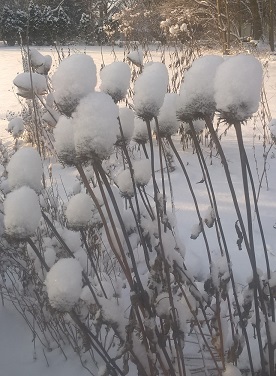
Besides providing for wildlife, untouched grasses and forbs add beauty and character to the winter garden.
Winter plants add beauty to the gardenPurple coneflowers in winter
Chickadees, dark eye juncos, gold finches, a pair of red cardinals that I think have been together for a few years, woodpeckers, and of course, owls inhabit my backyard in winter. Now that I am mostly working from home I love watching them come and go. Actually I have never seen the owl, but I hear it at night. They are so attractive that, in spite of the fact that I never held a brush in my hand until now, I couldn’t resist painting them in small pieces of scrap paper and make bookmarks from up-cycled pizza boxes to give to family as gifts. If you are thinking of starting a wildlife garden I’ll be happy to send you a hand-painted bookmark as a thank you gift. You can check them out here.
The adorable black-eyed juncoThe couple of Northern cardinals
Sometime I hear that we shouldn’t feed birds so they don’t become dependent on us. In my opinion this would be true if we had left their original habitat intact. Certainly the best thing is to leave native plants and grasses uncut until at least the end of February and also provide additional seeds during the harshest months from December to March. I do my part and place the seeds under a shrub or a tree with tall grasses around to provide shelter from predators.
Providing water during the winter months is challenging. Usually the bird bath can stay outside until the end of November, but it needs to come inside after that. From December to March a black plastic saucer can be used for water, however in the absence of a water heater the water freezes quickly. One of the benefits of working from home is that in the warmest hour I can remove the ice and replace it with slightly warm water. In typical Illinois winter temperatures of 15 to 25 F (-10 to -5 C) this provides birds with a few hours of fresh water every day.
If you are considering native and sustainable gardening I hope this post was useful to see how planting native grasses and trees, avoiding pesticides, leaving grasses, twigs and seed heads in the yard through the winter, helps wildlife survive the cold months. Who knows? It may even inspire you to start painting!
The YouChoose App provides several links to resources to get you started with sustainable gardening. It also provides links to native plants in specific regions. You can download it from Google Play or through the link on the right.
Welcome to YouChoose, a blog where we explore ways of living sustainably. This week I’ll talk about a few ideas to make our lunch box more sustainable.
If you go to work or have school age kids you probably choose between purchasing your lunch every day or bringing it from home. The first option is certainly more convenient, but it can be expensive in the long run. Long time ago, before the pandemic, I used to go to the office and took my lunch box with me. Because we are vegetarian, and sometime school cafeterias don’t offer great vegetarian choices, I also pack a school lunch box for my daughter.
As I was trying to minimize our environmental footprint I was concerned about the amount of trash produced by lunch packaging. If we think about it, a traditional school lunch box can leave a considerable trail of daily trash behind:
A zip lock bag for sandwich that is trashed every day.
A bag of chips.
A plastic bottle.
A single size milk or juice carton.
A paper napkin.
A plastic fork.
A second zip lock bag for fruit.
These are all items that on average are considered single use. Multiply all this by 180 days and you’ll see that just one kid can produce a large amount of plastic pollution in one school year. This is true for adults as well. I thought it was necessary to teach my daughter the importance of not producing trash, therefore I tried to train her to bring back everything that was in the lunch box so that it could be washed and re-used. It started when she was in elementary school and at the beginning it required some time to get used to it, but it has worked very well. I am proud of her because she has been now producing zero lunch waste for many years. Here are some ideas on how to pack a zero-waste lunch box.
Sandwiches can be packed in zip lock bags or in sandwich wraps. They both are washable and reusable. I wash both by hand with dish soap. The wraps last for years and the zip lock bags can be washed and used until they last, certainly more than once.
Reusable food wraps can be used for sandwiches, cookies and other items. They can be rinsed and reused
Provide one reusable water bottle to fill up at school. The bottle can be brought back home where is rinsed every day. For water there are also water fountains. Juices or milk can be carried in small reusable bottles that are washed at home.
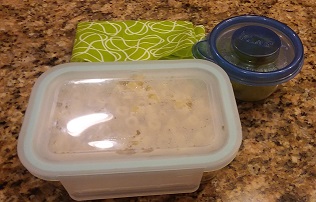
Now that my daughter is in high school I often pack dinner leftovers for lunch. A reusable, microwave safe food container and a metal fork or spoon can be brought back and placed in the dishwasher. Even plastic forks can be washed and reused multiple times.
Reusable glass boxes can be used to pack food that needs to be warmed up in the microwave
Chips, fruit and vegetables can be packed in zip lock bags or other reusable pouches. They can all be rinsed and reused multiple times.
Here is a zero waste soup and sandwich lunch with fruit
To reduce even more the use of plastic I lately have been thinking of making my own food pouches from fabric scraps that I have at home. I’ll post later about my progress (or lack of) on this topic.
Eliminating lunch trash is a great way to teach younger generations the importance of reducing pollution and our environmental footprint. This basic lesson will go a long way in guiding their future choices.
The YouChoose App provides several great links to resources on sustainable products. If you have an android phone you can download the app from Google Play using the link on the right.
Welcome to YouChoose, a blog where we explore ways of living sustainably. This is the time when we like to go out shopping for gifts for friends and family. Here are some ideas to make our Christmas more sustainable.
Take your own shopping bags
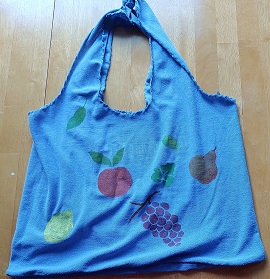
When we take our own bags for all Christmas shopping we save resources, pollution, and waste. It doesn’t matter whether we use cotton, plastic, or paper. The most important thing is to reuse as much as we can. Sometime we get bogged down in idle discussions about whether plastic, fabric, or paper take more resources to make, however the important point is to use what we already have to get away from waste and pollution. I have used my five reusable bags for years and they will probably last me for the rest of my life. They were collected at various conferences and I can’t think of a better use for them. This year I also made a new one from an old t-shirt that was too faded to donate. Old t-shirts or any old fabric you have at home can be repurposed to make nice produce bags, easily washable and light to carry.
I made this light produce bag from an old faded t-shirt
Buy second hand books
Second hand books make a great gift for readers. It is an excellent way to reuse resources and save trees and money. There are plenty of them all around and online and most of them are in excellent conditions. Used book shops have a variety of selection of different editions and unusual books. If you have books you are planning to dispose of you can also donate them to a library or resell them.
Second hand books save trees and resources
Make your own Christmas tree decorations from reused items or from the garden
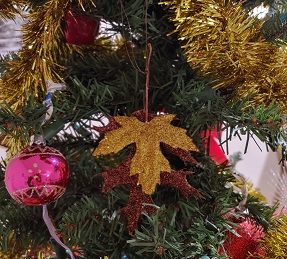
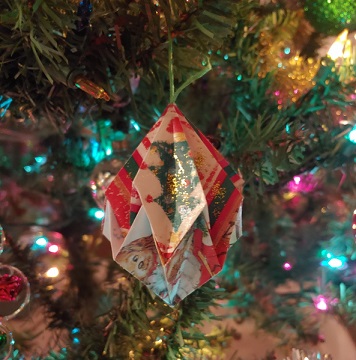
One nice thing about wildlife gardening is that it doesn’t end in September. I keep working in my yard all year round (snow permitting). In winter I bring the garden indoor to make Christmas decorations. I like to use garden items such as leaves and pine cones. Another thing I discovered is that you can reuse old pieces of wrapping paper from last year’s gifts or even cardboard to make decorations that last for a long time.
Pine cones make nice tree decorationsHere is another great use for fall leavesRecycle used wrapping paper
Cook a vegetarian menu for Christmas
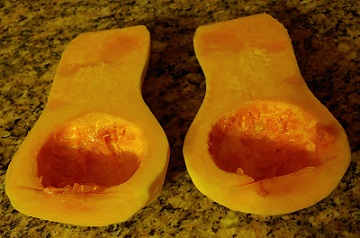
I know that holiday menus are supposed to include meat or fish, however a great dinner can be put together of vegetarian ingredients. Here is one idea for a holiday menu, I tried this for thanksgiving and it came out very good: Appetizer: Bruschetta with hummus, olives, and artichokes. Soup: Mushroom potage. Main entree: Lentil loaf with roasted butternut squash, sage, and chestnuts.
Roasted butternut squash with sage and chestnuts is an easy and flavorful side dishIngredients such mushrooms and lentils are perfect for a delicious Christmas dinner
Buy something for yourself and the Earth
If you feel like buying something to embellish your backyard, owl houses and bird baths enhance the look of the garden and also help wildlife. We can also give a gift to Earth this Christmas and donate to a reforestation or conservation effort, there is much to be done.
There is nothing like a cool bath on a dry fall day
No matter what we do these holidays let’s include sustainability in your consumer choice equation and reward companies that care about the Earth.
The YouChoose App provides several great links to resources on sustainable products. If you have an android phone you can download the app from Google Play using the link on the right.
Welcome to YouChoose, a blog where we explore ways of living sustainably. This week I wanted to share a few thoughts about the recent Glasgow climate conference that ended this past week.
After all the news and coverage the conference ended as expected with little agreement among the parties. It is hard to convert goodwill into action when countries economies are at stake.
For those of us who are convinced of the urgency of the matter it is easy to feel discouraged and come to the conclusion that we have no control over the decision making process. What is lost in the process is the notion that we are the buyers that are at the end of the supply chain. If we remove the buyer from the process the producers are forced to change. What can we do as single individuals to achieve what the world conferences constantly fail to achieve? In this post let’s go over one of the topics discussed, one that I consider perhaps the most important: Trees and forests.
Deforestation poses an existential threat to our Earth and to our very physical and spiritual being. It causes loss of biodiversity, extinction of species, soil erosion, air quality deterioration, and a change in the precipitation patterns that affects the entire hydrologic cycle. In addition, it causes the loss of life and spiritual heritage of communities whose livelihood depends on the forests. It is not an exaggeration to say that by erasing forests we are erasing our very soul. Many, but not all, of the countries participating in the meeting have agreed to stop deforestation by 2030. Whether we believe it or not is a different story.
Powerful economic interests are at the source of the problem. Let’s have a look at the economic drivers of deforestation and how we as consumers are part of it. Deforestation is mostly driven by these sectors: Agriculture (mostly palm oil, soy, cocoa and coffee), mining and logging (mostly industrial logging, mining, oil and gas), urbanization: (urban expansion with related consequences).
Although there are complex issues behind each sector the majority of the products causing deforestation are found in our homes and on our tables. In other words we are financing deforestation with our shopping. Here are some things we can do to avoid that our money is used to destroy the planet.
What finances agriculture driven deforestation?
Among companies responsible for deforestation we find the biggest retail chains. Their shelves are packed with meat and palm oil ingredients sourced with the destruction of forests. Amazon Watch (amazonwatch.org) keeps a record of the commodities companies that cause the largest deforestation, the banks that finance them, and the retail stores that buy from them. You can check it out to find out where your money is going. For those of us who don’t want to finance large scale environmental damages avoiding meat in general and specifically meat from fast foods goes a long way. Fast food companies are among the largest customers of meat suppliers known for their destructive practices.
Just as meat, leather products are linked to deforestation. The fashion industry, including luxury brands, has a very poor record of checking the provenance of their leather materials.
Another important step is to avoid all products with palm oil (Yes! you can survive without it). Many grocery stores use palm oil in their own baked good, in addition to purchase from companies known for their poor environmental records. Palm oil of untraceable origin is also widely used in big brand cosmetic industry.
Bananas (except perhaps organically grown), avocados, cocoa and coffee have a negative environmental impact, unless grown sustainably. Be careful when buying and only buy products with certified sustainable practices.
What finances logging and mining driven deforestation?
High demand for new furniture and wood products is a driver of deforestation.You may be surprised to find out that many popular furniture stores in the US are fueling deforestation. I myself was fooled long time ago when I bought a dining set in a major US furniture store because I trusted the word of the store employee who ensured me that their wood was sourced by traceable suppliers. I later found out that the store in question had a poor record of choosing their wood suppliers and acquired wood from unverified sources. I never forgave myself for not having researched better the store ahead of time.
For this reason it is important to research the store record on deforestation before purchasing furniture and to avoid furniture made from tropical woods. Unfortunately too many furniture stores still have no problems dealing with tropical woods from Asia and South America, wood from endangered Eastern European forests, African and North American old growth forests without controlling the entire supply chain.
Gold, lithium, and rare earths elements are used in the jewelry business and in the manufacturing of electronics and batteries. An average phone can easily last more than 5 years, yet on the average people replace their phones every 2.5 years. Our continuous demand for the latest smart phone model contributes to deforestation. Keeping our smart phones and tablets as long as we can is a good practice to reduce the demand for always new devices.
This week the EU, whose insatiable hunger for meat, soy, coffee, cocoa, and palm oil makes it one of the largest financier of deforestation announced that they are considering blocking the imports of such goods from high risk regions unless the products are certified deforestation free. I am sure the proposed legislation will find much opposition from big conglomerates. We consumers however can control where our money goes by researching companies and following the money trail. Although it is not possible to be 100% sure of what we buy we can certainly be better informed. So this Christmas instead of asking for a new smart phone, a new piece of jewelry, a new SUV, or thinking of replacing the entire living room because we are just tired of it let’s all reflect on what we can give back to our Earth and instead plant a tree or make a small donation towards a reforestation effort.
The YouChoose app provides several links and information on unsustainable wood and food, hopefully the information is useful.
If you found this post useful, please share it and spread the word and if you want to contribute to this blog send me a post!
Welcome to YouChoose, a blog where we explore ways of living sustainably. As Halloween is getting closer I wanted to share some information that can help us make this celebration Earth friendly.
As we all know the beloved Halloween trick or treating tradition has become big business. The stores are full of bags of candies of all sorts and because we are always pressed for time we purchase bags and bags of candies many of which stay in our pantry for a long time afterward. Many of the “big brand” candies unfortunately contain palm oil. As discussed in previous posts palm oil causes enormous environmental damage and it is one of the major drivers of deforestation.
If you want to celebrate an Earth-friendly Halloween please read the ingredients in the candies you purchase and make sure to buy only those that don’t list palm oil among them. This is hard, but you still have several good choices available in general stores or you can choose to bake your own cookies if you have the time.
If you do decide to buy palm oil free candies, I am providing here a link to the WWF rating of corporations based on their deforestation record. You can copy and paste the link provided below into your browser, find your preferred candy company and decide if you want to buy their product.
As you can see in the WWF analysis, no company produces 100% traceable and sustainable palm oil. Even purchasing from the high scoring companies means encouraging deforestation to some degree so it is better to keep that to a minimum.
In case you want to spend half hour baking I am posting here a nice recipe for pumpkin cookies. I tried it myself for the first time and it came out good.
The YouChoose app provides several links and information on food products that are unsustainable and bad for the environment.
Do you want to contribute to this blog? Send me your thoughts at info@choosesustainable.org and I’ll add them to this blog.
Welcome to YouChoose, a blog where we explore ways of living sustainably. I am sharing here a recent article that appeared in the IEEE Geoscience and Remote Sensing Society newsletter. You can view the the article by copying and pasting the link below in your browser.
The article shows a satellite view of deforestation in South America linked to clearing for cattle and soy plantations (for feeding cattle). From the satellites it is also possible to follow the evolution in time of the rate of deforestation.
In North America environmental destruction is also causing large scale decline in biodiversity and extinction of species due to pesticides used in large scale farming. Below here is an interesting article from the BBC about California’s endangered butterflies and what we can do.
The YouChoose app provides several links and information on global food issues and lists of sustainable and unsustainable foods including fish and vegetables, hopefully the information is useful to get started.
In this blog there is a recipe section where I share meat-free recipes to help out. If you want to share your sustainable recipes to help others, I’ll be glad to post them in this blog.
Do you want to share your progress on eliminating meat from your diet? Send me an email at info@choosesustainable.org and I’ll add it to this blog.
Welcome to YouChoose, a blog where we explore ways of living sustainably. This week I would like to talk about achieving a palm oil-free life.
Avoiding palm oil is imperative to stop deforestation. It is also one of the most difficult tasks when transitioning to a sustainable lifestyle. Palm oil was a relatively unknown ingredient until a few decades ago, but now it has become one of the most pervasive components in the mass-produced products we buy every day.
Palm oil is found in almost everything we eat: cookies, crackers, candies, spreads, jellies, cereals, and packaged products. It is also found in many house products such as laundry soaps, and in personal care products such as shampoos, soaps, conditioners, lotions, lipsticks, creams, cosmetics, and toothpaste.
Occasionally we hear halfhearted declarations from some world leader about reducing the import of products that are responsible for deforestation, however, after doing research for the YouChoose App, I learned one important thing: If I wanted to find out who was responsible for the extensive deforestation of the past few decades, the decline in biodiversity, and the extinction of primates I needed to look no farther than the mirror.
The high and growing demand for this cheap oil by multinational corporations has led to widespread destruction of rain forests in South East Asia and is bringing primates and other species to the verge of extinction. These rain forests are cleared usually by setting them on fire and are replaced with mono-culture plantations of palm trees (which are not a native species to that region) to produce palm oil.
I checked the products in my house, in the pantry, in the bathrooms and kitchen and found out that most of them indeed contained (explicitly listed or hidden behind other names) ingredients that are derived from palm oil.
Look at the ingredients of every packaged item you want to purchase
Cleaning and personal care products don’t list the ingredient as palm oil, but hide it behind the names of the chemical compound derived from it. The YouChoose App provides a list of chemical compound names that usually indicate the presence of palm oil.
A common skin-care product found in convenience stores. Can you spot the palm oil?
I really had to take a hard look at myself, which is never easy to do. I could no longer blame others for my doing. In that painful moment of awakening, I decided to embark on a journey to free myself of palm oil.
Here is a list of actions we can take to eliminate or substantially reduce our dependence on palm oil. Each action in itself is a journey and will be discussed in separate posts.
Be firm in our resolve, this is a very difficult path, but we shouldn’t doubt that it is worth pursuing.
Read ingredients of every food item at the grocery store. Palm oil is found in the most unexpected places.
Read ingredients of personal care products and avoid those that are derived from palm oil. A list is provided in the YouChoose App and it will also be provided in a following post.
Read ingredients of house cleaning products and avoid those that include palm oil.
Read ingredients of beauty and cosmetic products and avoid those with palm oil. A list of these is provided in the YouChoose App and it will be provided in a following post.
Don’t be fooled by “vegan”, “green”, and “eco” labels or by statements from corporations on how they plan to make their palm oil sustainable by 2025 or 2030. These are empty words that only betray the callousness of these enterprises.
After you go through this list you will discover that there aren’t many products you can buy in stores and, if you are brave enough, your journey will begin. It will involve giving up things you like, abandoning easy choices, and probably some discussions with your friends and family.
It is also important to remember that not all palm oil is destructive, there are many small companies that source their palm oil from places were the plant Elaeis Guineensis is native (mostly West Africa) and grown responsibly. These are not the major brands found in big store shelves. Before purchasing products with this ingredient it’s important to check with the company to see where and how they source their ingredients and purchase only if the answer is satisfactory.
To answer our initial question: Is a palm oil free life possible? The answer is Yes, but it’s not easy. Here is one topic where doing the right thing involves choosing the narrow path. I’ll share my progress in following posts. The YouChoose App provides links and resources with information on this topic.
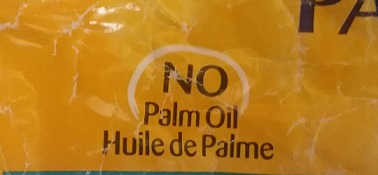
Labels like this are unfortunately rare
Do you want to share your progress on eliminating palm oil from you shopping list? Send me an email at info@choosesustainable.org
Remember that saving our Earth starts at home with our everyday actions. Please don’t doubt for a second that even small changes in our habits make a difference.
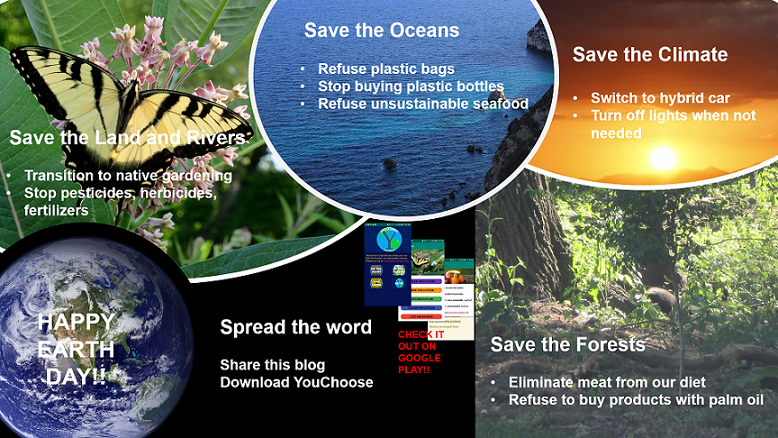
Here are 10 actions we can all take every day for our Earth:
Save the Forests:
Reduce meat consumption
Refuse to buy products responsible for deforestation
Save the Oceans:
Refuse unsustainable seafood
Stop using plastic bags
Stop plastic bottles and single-use plastic as much as you can
Save the Land:
Stop using pesticides, herbicides, and fertilizers in your yard
Reduce lawns and help restore native plants
Reduce waste
Save the climate
Reduce use of electricity
Buy local
Get informed
Want to know more? Download the YouChoose Android app from Google Play (free and no ads)
I am sure there are many more things we can do. Please send me your thoughts at info@choosesustainable.org
Welcome to YouChoose, a blog where we explore ways of living sustainably. This month I would like to share one step we can all take to reduce our environmental footprint: Reduce the use of plastic bags. This seems like a fairly straightforward step, however, as it always happens when trying to change long ingrained habits, it takes some discipline, planning, and a little time. There is more to plastic than just bags and some plastic is difficult to eliminate depending on where one lives because of the lack of alternatives. For this reason we’ll focus on different items in different posts.
If you look around you will see that there is still much to do in this area. In some places plastic bags are banned altogether, however, while we wait for businesses to help out, individual actions are fundamental in making a difference and this is really one area where they can. The fact is that no matter how large or small the item we purchase is, we seldom get out of a store without holding a plastic bag, big or small, plain or decorated, distinctive or unremarkable. Even if the purchased object is something that could easily fit in a pocket or a purse, it is invariably placed and handed to us in a plastic bag and we, like automata, extend our hand and grab the bag before heading out of the store.
Free produce bags and cotton bags upcycled from old fabric are available. Check them out here.
QUICK TIPS TO REDUCE PLASTIC BAGS
Recognize the importance of the problem and the need totake action
Be disciplined and train yourself to refuse plastic bags
Set realistic goals and achieve them one by one
Keep a set of reusable canvas bags in the car
Keep a set of reusable produce bags in the car
When checking out of any store ask yourself: “Do I really need a bag?”
Buy produce that is not packaged in plastic bags
Consider alternatives to plastic bags in the house
First of all, why is it important that we reduce plastic bags? Because they are contributors to a large percent of the plastic pollution of our planet on both sea and land and because they are for the most part unnecessary. That is also the reason why I find it really puzzling that we still rely so much on them. No day goes by without a news article or a talk about the scourge of plastic pollution in the oceans, and yet we fail to make a connection between that problem and our everyday habits. In fact I still see 99% of buyers coming out of stores carrying plastic bags. There is definitely room for improvement.
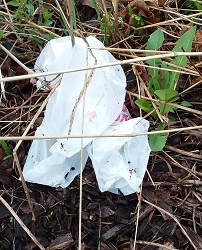
I routinely finds grocery store plastic bags in my backyard
I myself used to not worry so much about it, thinking that I recycled the bags after using them. However I realized later that recycling should be the last resort for the plastic we really can’t dispense with, not a feel-good excuse. In fact, recycling is not a sustainable option because it requires energy and because much of what we put in the recycle bin ends up somewhere in some other country still polluting land and rivers, just out of our sight.
WHERE TO START?
Step 1: Find the source
Action #1: Find out the provenance of the plastic bags in your home. At the beginning I tried to find the source of the plastic bags in my home. Certainly, the grocery storewas one major source of plastic bags. I used to be flooded with plastic, from packaged vegetables (for example a bag of potato, onions, and apples, etc.), frozen items, not to even mention plastic containers. Some high-end grocery stores have a paper bag only policy. Very few grocery stores in my area do offer a paper option, however it seems that most people opt for plastic. Additional, but less frequent, sources of plastic bags included other stores such as clothing, household, home improvement, or anything else. Therefore my first target was the trip to the grocery store.
Step 2: Eliminate grocery store bags
Action #2: Check if you have reusable bags in your home to put to a good use! If not available, you can purchase a set of washable canvas bags and train yourself to carry them with you in the store. After thinking about it I realized that several canvas bags collected throughout the years from meetings, conferences, and organizations I support were unused in the closet. I decided to take those with me every time I went shopping. The biggest challenge at the beginning was to remember to put the bags in the car and take them with me in the shop. It took me a while, but I can assure you that after a few months of persevering it becomes second nature to remember to carry the reusable bags with you. Now I keep the bags in the car (trunk or the back seat) and it has become a part of my habits so that I also carry them when shopping in other stores.
Step 3: Eliminate produce bags
Action #3: Get organized with reusable bags for fruits and vegetables. Once I settled with the reusable canvas bags I focused on the plastic produce bags. Reusing these didn’t work out very well because they tear easily and sometime become dirty so I ended up with shreds of dirty plastic bags that couldn’t even be recycled. I then decided to just place the vegetables directly in the shopping cart and then in the canvas bag with everything else at the checkout, this is an option, however it didn’t work out well for me.
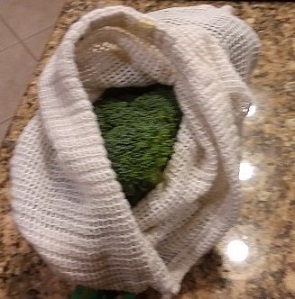
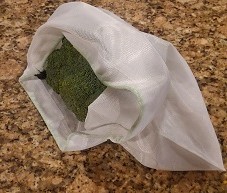
For this reason, I decided to invest a little amount of money (perhaps $30) to purchase reusable produce bags. I purchased two types: One is a natural fiber that has the consistency of a net, the second one is a synthetic pouch. They both come in a set of many sizes which are large enough to contain any amount of vegetables. Especially the canvas ones seem small, however they stretch and expand with the weight of the vegetables. I use the natural fiber bags at the grocery store and the other type to store the vegetables in the refrigerator, this way I never run out of them.
At the beginning I was a little bit worried about rotting, but I can definitely say that it is not the case and this system has worked very well for me for several years. Both models are washable in the washer so I just add them to the load and dry them quickly by hanging.
Step 4: Eliminate packaged fruit and vegetables
Action #4: Make a point to purchase plastic-free produce. The simple steps described above have definitely helped eliminate the vast majority of plastic bags entering the house. After settling in this routine (it took me several months) I focused my attention on selecting bag-free fruits and vegetables. Instead of purchasing potatoes and onions in five-pound bags, I now buy everything that is non packaged. It is true that sometimes it’s impossible to find what we like without plastic. For example we used to buy some small apples that were available only in plastic bags. I stopped buying them and now look for similar products without the plastic. Similarly, if organic vegetables come in plastic I opt for regular. Buying in bulk may be slightly cheaper, however if possible bag-free produce is a better choice.
Step 5: Reduce plastic bags in the house
Action #5: Think of ways to reduce plastic bags use in your home. Before I decided to reduce plastic bags, I used to keep one large trash bag in the bin and smaller bags around the house which were replaced weekly. In addition there were small bags to clean the cats’ litter box and Ziploc storage bags to pack my daughter’s lunch. We’ll talk about zero waste lunches and eliminating Ziploc storage in a different post. After thinking this through I realized that replacing all those plastic bags every week was really unnecessary. The kitchen bag was replaced with a compostable bag for all waste. There was an initial worry that a compostable bag in the kitchen will leak, however I found an excellent 13-gallon compostable bag that lasts the entire week without any leak. Similarly, all other bags in the house are not replaced weekly anymore but on a need basis. As for the waste from the cats’ litter box it now goes in small paper bags. In total we are down to one plastic bag per week.
In spite of all my efforts, I still produce enough plastic bags that occasionally a trip to the recycle collection is necessary, the amount of plastic that goes to recycle however is now considerably reduced. Where it used to be the equivalent of one grocery bag full of plastic every about 2 weeks it is now the same every 2-3 months. Additional sources that I am trying to reduce are bread and frozen vegetable bags.
To conclude this blog, I would like to extend two challenges here:
The first challenge is to ask ourselves whenever we are checking out of any store: Do I need a bag for this? Is this something that I can just carry to my car?
The second challenge is to take ownership of the plastic problem and make a conscious effort to take reusable bags with us every time we go in any store and tell the cashier: I brought my own bag, no need for plastic.
Do you want to share your experience about reducing plastic bags? Send me an email at info@choosesustainable.org











 You Choose