Welcome to YouChoose, a blog about individual climate action.
Do you know that the great American prairies are among the most endangered ecosystem on Earth? Less than 1% of them are left!
Last year there was great hope that Congress would pass legislation to help the recovery of America’s wildlife and biodiversity. Unfortunately that didn’t happen. There is a chance to urge lawmakers to reintroduce the bill and people’s support is the biggest voice we have to make ourselves heard.
Please add your name to the Nature Conservancy petition and urge Congress to reintroduce the Recovering America’s wildlife Act.
Stop buying fish from grocery stores that disregard basic environmental and human right protections. Click HERE to sign the Greenpeace petition to US giant grocery store chains to stop selling tuna linked to environmental destruction.
Do you want to know where your grocery store stands in the tuna scorecard? Check out here the Greenpeace report to find out. You need to place your cursor on the image and advance the pages at the bottom of the image. The report scorecard is on page 4. Think of this report next time you want to buy tuna!
Welcome to YouChoose, a blog about sustainable living. In this post I wanted to share some information about batteries and electric vehicles.
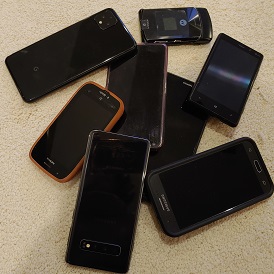
If you have a lot of old cell phones in your home you may be interested in this Argonne National Laboratory OutLoud lecture on battery recycling. It contains very useful information on how batteries from cell phones can provide useful material to make new batteries. It takes less than 200 old phones to make a new EV battery! It is a good incentive for all of us to find out where the nearest battery recycling facility is located and drop off the old batteries cluttering our drawers.
Grocery stores are largely responsible for relying on supply chains that disregard the environment as well as human rights.
What can we do?
We can stop buying fish from grocery stores that disregard basic environmental and human right protections. Click HERE to sign the Greenpeace petition to US giant grocery store chains to stop selling tuna linked to environmental destruction.
Do you want to know where your grocery store stands in the tuna scorecard? Check out here the Greenpeace report to find out. You need to place your cursor on the image and advance the pages at the bottom of the image. The report scorecard is on page 4. Think of this report next time you want to buy tuna!
Welcome to YouChoose, a blog about sustainable living. In this post I wanted to share some great information provided by Ashok Nagella, MD, on the impact of a plant-based diet on our health and our planet. The intention is not to scare people off into a vegan diet, but rather to share a few good reasons to reduce our consumption of meat and animal ingredients to a minimum and make more room for a variety of plant-based food. The full set of slides can be found here.
Why is it important for our Earth that we reduce meat consumption?
If it is true that a picture is worth a thousand words, then the following two images should speak for themselves.
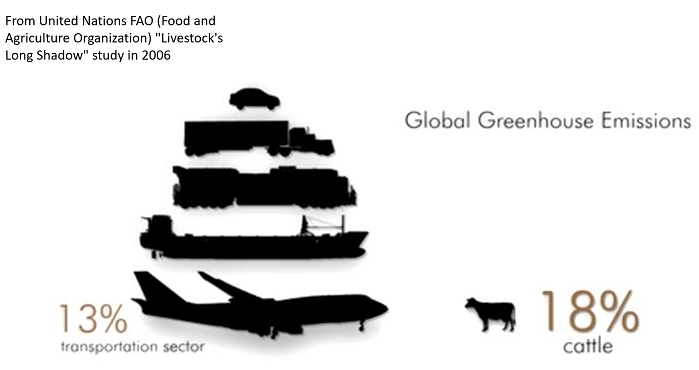
Agriculture emissions (in green) constitute about one fourth of global emissions. A large portion of these are due to cattle and animal farming (website: drawdown.org)The animal industry alone is responsible for the same percentage of emissions as the entire transportation industry but with the additional damages of deforestation, loss of biodiversity, and enormous water consumption.
Electricity, agriculture, and industry are the largest sources of greenhouse gases. We, as individuals, can directly influence a few sectors, for example switching to electric vehicles, low consumption bulbs, and reducing the use of high consumption devices. The sector over which we can have the most effective impact is agriculture. In fact, emissions due to the cattle industry are higher than those due to the entire transportation sector. And it is not just greenhouse gases emissions, but also water consumption, because a great amount of water is necessary to raise, kill, and process animals.
Why is it important for Us to reduce meat consumption?
Check out these health benefits of a plant-based diet.
Significant increase in Fiber, Antioxidants, Omega 3 Fatty Acids, and Neurotransmitter Production
Significant reduction of Inflammation, saturated fat, and cholesterol
Increase in longevity while preventing cancer, heart disease, strokes, and dementia
Improvement in mood while reducing anxiety
Improvement in focus, attention, and memory
Often, we get frustrated about politicians not doing enough for the planet and the climate, at the same time feeling powerless and depressed. However, let’s think about this: We, as individuals, have complete control of what we eat. The greatest change we can make for our planet is also the one that requires the least effort and is good for us. We don’t have to wait for governments to take action on our behalf, we can take our own actions!
Welcome to YouChoose, a blog about sustainable living. In this post I wanted to share a few reflections about recent heat waves.
This year, like every year, I was in Southern Europe for about 2 months and found myself in the middle of one of the hottest summers on record. This is the second year in a row that I find myself in such a situation over there. I grew up there and I am old enough to remember that summers used to be hot, especially in August, but generally pleasant in June and July. Lately the heat has become unsustainable from the beginning of June until September. The extreme heat was compounded by a drought and extended wildfires. The situation was such that, perhaps for the first time, climate change was perceived by everybody as a real and incumbent crisis. The reality of warming is becoming apparent to everybody.
Deforestation plays a major role in accelerating climate change. Globally, until now, tropical forests have acted as carbon sinks, sequestering large amounts of carbon dioxide. Today, emissions caused by the process of deforestation and land conversion to agriculture are starting to exceed the forest carbon sequestration. Forests are now becoming carbon sources instead of carbon sinks. . This in addition to land degradation, loss of biodiversity, and change in rainfall patterns.
Please read this very interesting article in NOAA’s research news:
The contribution of deforestation to climate change includes (1) emissions from deforestation, (2) emissions associated with land use (i.e. cattle farming, soy plantation) and (3) reduced amount of carbon sequestration due to the loss of canopy. Industrial agriculture is responsible for the largest part of deforestation with the products of deforestation coming to our grocery cart and our kitchen. It is imperative that we become conscious buyer and learn which products are driving deforestation.
What can we do as consumers:
Reducing (or eliminating) meat and dairy consumption is the single most important step we can take to stop deforestation
Eliminate palm oil from the shopping cart
Purchase certified sustainable coffee and chocolate
If choosing to consume meat, choose grass-fed, soy-free products.
Although soy for human consumption constitutes an infinitesimal part of the global soy production, it is important, when using soy-based products to make sure they are sourced from sustainable agriculture.
Be vocal and participate in campaigns. Demand that governments and companies act to stop deforestation.
What are you waiting then? Be part of the movement to stop deforestation. Can’t go wrong!
The YouChoose app provides several links and information on products and cosmetics ingredients that are unsustainable and bad for the environment.





 You Choose