Welcome to YouChoose, a blog where we explore ways of living sustainably. This week I would like to talk about living without dish soap.
You may think it is ridiculous to write post about such a trivial topic, however this is one small step that goes a long way in reducing plastic pollution and reducing deforestation due to palm oil demand. I have been living without a specialized dish soap for some time since I came to the realization that I didn’t need one. Here are a few reasons to give up dish soap:
Liquid soap comes in a plastic bottle that ends up in a landfill or in the ocean
Some dish soaps contain petroleum based ingredients
Almost all commonly available dish soaps contain products derived from palm oil
Fortunately there are alternatives to big brand dish soap and I invite everybody to take the time to explore palm oil free and plastic free products for the dishes suitable for our own specific needs. On my end I tried a few solutions and settled for a simple olive oil soap bar.
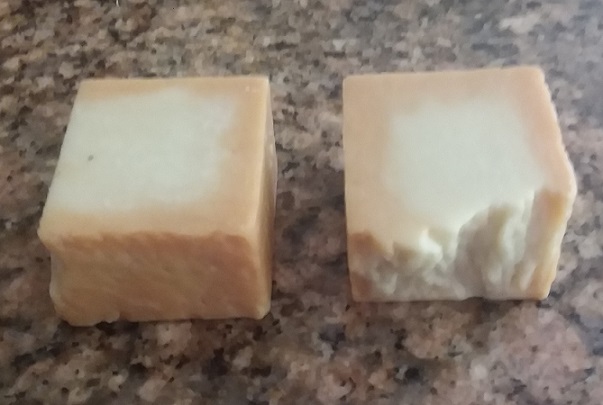
A basic 100% olive oil soap bar
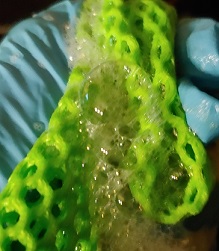
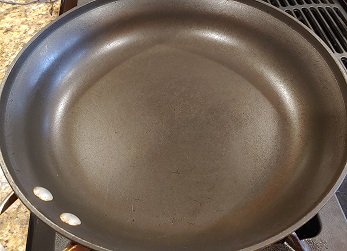
The bar comes in a paper box, just rub the bar on the dish cloth and you will get a nice foam that works really well even with oily pots and pans and doesn’t leave any residue on glass. Soap de Marseille is also effective, however most of it, these days, is unfortunately produced with palm oil instead of olive oil, so one needs to be careful to find the traditional one made with olive oil.
Still get a nice foam It is effective on oily pots
Another advantage of olive oil soap bars is that they are hard and last a long time without disintegrating under water.
You don’t have to give up clean dishes by giving up liquid dish soap
What are you waiting then? Eliminate something you don’t need, reduce plastic pollution, and reduce deforestation all in a small step. Can’t go wrong!
The YouChoose app provides several links and information on products and cosmetics ingredients that are unsustainable and bad for the environment.
Welcome to YouChoose, a blog where we explore ways of living sustainably. This week I wanted to bring to your attention the recent UN resolution on curbing plastic pollution.
This past month United Nations representatives from 175 countries signed a pledge to come up by 2024 with an agreement to end plastic pollution. Even if the plan doesn’t materialize by then this is still good news. It means that single use plastic is finally becoming a global issue to be dealt with.
We all know the devastating effects of plastic on land and marine wildlife. However, it is still nearly impossible for us to complete one trip to any store without coming out with plastic items in our cart. And I am not one that is oblivious to the problem. I have eliminated plastic shopping bags, produce bags, plastic water bottles, single use utensils, and glasses. And yet, every week I still manage to collect what I consider a large amount of plastic to recycle.
It does feel like an uphill battle and it can be frustrating, so we can be tempted to give up. Although it is true that we can’t eliminate all plastic from our lives, we may be surprised to know that there are just a few items that disproportionately constitute the vast majority of the pollution. And these few items we can really do without. Food wrappers, beverage bottles, bottle caps, grocery bags, straws, take out containers, cups, and plates make a substantial component of ocean pollution. Just eliminating bottles and plastic bags would go a long way.
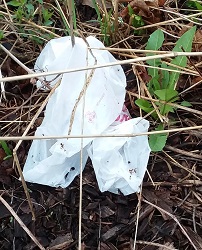
A discarded plastic bottle along the road lasts foreverPlastic bags easily escape the collection point
Recycling is not the solution because just as it takes energy to make things, it also takes energy to recycle them. Additionally, plastic bags can easily escape from the facilities where they are collected. I do see many plastic bags flying around where I live (I’m sure you do too) and we can easily multiply that by millions to imagine how many bags are dispersed in the environment every day. Even with our best intentions it is difficult to make sure that our bags end up where they are supposed to go.
If you want to add your voice there is a Greenpeace action to call on elected officials to take action on plastic pollution:
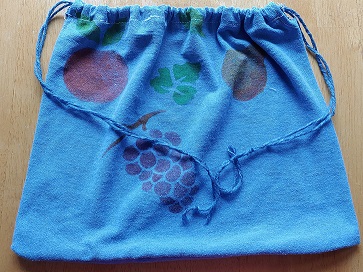
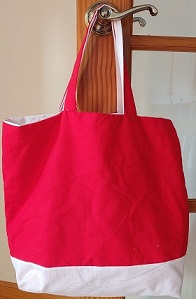
While we wait for actions at a government level we can also make plastic reduction a priority. You can start taking reusable bags with you, you don’t even have to buy them. They are easily made from old clothes and fabric. There are plenty of tutorial on the internet on how to make reusable bags. Do you have old shirts at home but don’t have a sewing machine? Don’t trash them, send them to me and I will send you back reusable shopping and produce bags.
Old T-shirts can be used to make reusable drawstring produce bags
With enough fabric from old tablecloths, curtains or sheets one can make reusable shopping bags
Here is some useful information on plastic pollution:
Welcome to YouChoose, a blog where we explore ways of living sustainably. This week I would like to share a small victory in my effort to free myself of palm oil (and plastic bottles).
It has been about two years since I bought my last bottle of liquid soap. The original intention was to reduce the use of plastic bottles, after all there are plenty of soap bars that can be used as alternatives. However, as I learned more about the ingredients in common soap bars and how they contribute to deforestation I decided to look for soap without palm oil.
That is where the real challenge began. I naively went around looking for palm oil free soap and realized that it is virtually impossible to find one. Now you may look at the ingredients in the soap (liquid or solid) in your home and be at peace because you won’t see a single mention of palm oil, still you’ll see seemingly innocuous ingredients such as: Sodium laureth (lauryl) sulfate, glyceryn, sodium kernelate, or additional names containing the palm suffix. These ingredients signal the presence of palm oil in the product. For example components such as laureth sulfate can be produced synthetically from petroleum oil or made using coconut or palm oil. Unfortunately, unless it is clearly stated that the product is palm oil free, you can be 99% sure that it is produced using palm oil. Note that many of these products are advertised as “natural”, “vegan”, “green”, which of course technically they are, except that their production brings devastation and deforestation.
Having failed hard on my attempt to purchase a palm oil free soap bar locally I turned my attention to the web. There are online several companies that produce really great palm oil free soap bars, the prices are also quite steep. It is understandable how these products may not be for every pocket, which brings us to the more general question of whether one has to be wealthy to be able to afford sustainable products. As it happens some of these products were too pricey for my pockets as well.
At the end of the day a compromise had to be made. I had to give up a luscious, foaming, creamy soap and fall back on a 100% olive oil soap bar. I resolved to use the scented ones for hands and shower, and the unscented ones for dishes. The price is very reasonable, they come in a paper box and wrapped in paper. They however don’t make a nice rich foam and come in limited scents. In the end for me this is a small price to pay to avoid palm oil and all the trail of destruction that comes with it.
A basic 100% olive oil soap bar
I make liquid soap from the olive oil soap bar this way:
Bring 6 cups (or about 1.5 liters) of water to a boil
Grate 1 bar (or 3.5 ounces) of soap. Cutting the soap in small pieces also works
3.5 ounces of olive oil soap cut in small pieces
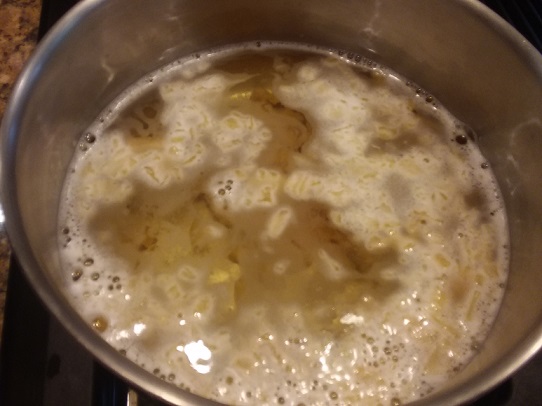
When the water is boiling lower the heat and place the soap in water
Turn off the heat and let the soap melt
Dissolve soap in water
Let it cool off
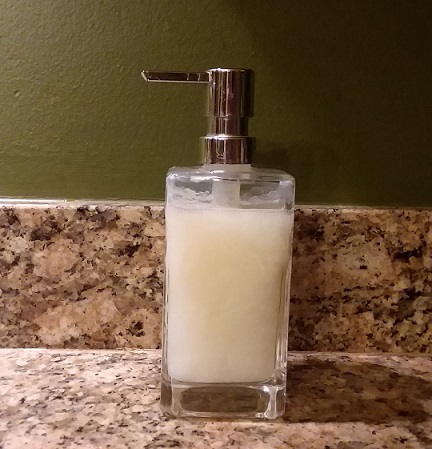
Transfer to a bottle, it is liquid at the beginning, but becomes dense later
A bottle of olive oil liquid soap
The amount of water may vary depending on the soap and on personal preferences so one may need to experiment a little. One can also add essential oils for specific fragrances. On my part I now use basic olive soap also for dishes and found it to be fairly good.
Olive oil soap works also for dishes
Perhaps in time I’ll find better alternatives, I recently found a possible substitute for the dishes, but haven’t tried it yet.
At the end of the day I have come to a conclusion that we can’t keep the same habits and hope that the outcome will change. We have to give up some things we like to switch to more sustainable products. We can argue that all these efforts are just a drop and don’t make a big difference, but if more people say no to products derived from palm oil the outcome may actually change.
The YouChoose app provides several links and information on beauty products and cosmetics ingredients that are unsustainable and bad for the environment.




 You Choose