Welcome to YouChoose, a blog about individual climate action. This week I would like to talk about invasive plants and how to remove them from our backyards.
In a previous post we reviewed the reasons why it is important to remove invasive plants from our backyard. Here we’ll review removal techniques. Again we’ll focus on buckthorn, honeysuckle, and garlic mustard.
These removal techniques worked for me, keeping in mind that I had a very bad infestation of a large area. Removing invasive plants is not an easy task, it is physically tiring, frustrating, and it requires patience. Additionally it is never finished, because, until the unwanted persist in the area, new ones will always appear. However with time the task becomes routine maintenance. Winter, early spring and late fall are the best times to do this job.
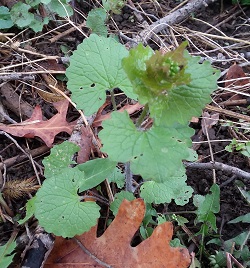
Garlic mustard (alliaria petiolata) removal techniques.
Garlic mustard is probably the easiest to remove. I went from having a large infestation to almost nothing very quickly. The fact that it has a two-year lifecycle works to our advantage because removing the plants before they bloom helps to reduce the population quickly. I was able to remove by pulling. For very large areas spraying with a herbicide may be necessary, however, for backyard-size areas, pulling should be a preferred technique. The population went down in about two seasons. Now I survey the area in spring and remove what I see coming up. Because garlic mustard self-seeds abundantly it is important to dispose of the pulled plants if they have flowers.
Buckthorn (Rhamnus cathartica) removal techniques.
Warning: As the name suggests buckthorn trees have very long and sharp spines. When working with developed plants it is important to use gloves and eye protection.
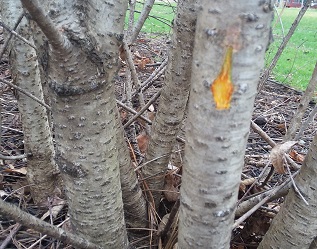
I had a large buckthorn infestation in one section of the yard. Working in winter or very early spring helps because leafless branches are easier to handle. Buckthorn can be recognized in winter by shaving off a small amount of the tree bark to expose what is immediately under. Buckthorn is of a very bright orange color.
Smaller plants (up to 1.5 inches in diameter) can be easily removed by eradicating them with a digging shovel. I was able to remove many younger plants this way. It is a very labor-intensive task so it can be done little by little.
Medium plants (2-3 inch in diameter) were removed with a small chainsaw that even I could handle. For the bigger plants I had to call the help of a professional tree service.
Whether you or a professional do the cutting part, after the tree is cut it is necessary to brush the stump with herbicide such as 19% Glyphosate. This will prevent regrowth. Warning: 19% Glyphosate is found in commonly used Roundup. Despite their extensive availability herbicides should be used with extreme care and should go only on the interested area. Do not spray it as it increases the probability of inhaling it. You can use a brush to cover the stump.
Cutting the adult buckthorn tree is only the beginning of the battle. Buckthorn trees produce thousands of seeds that will generate small new plants for a few seasons after. It is therefore important to monitor the area and continuously remove the young plants. This is an easier task, monitoring the site a few times in a year will be enough to keep up with the regrowth.
Honeysuckle (Lonicera family) removal techniques
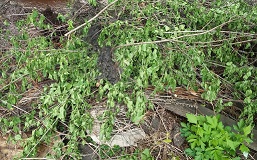
Once the buckthorn was gone the honeysuckle became more aggressive and was the second target of my battle against invasive plants. I was able to remove the younger plants with a digging shovel. However, the infestation was very bad, and it took two years of spring and summer working to achieve results. The few large plants were removed by a professional service, once the larger plants were cut it was necessary to brush the stump with 19% Glyphosate to prevent regrowth. New growths are now uprooted periodically as they emerge. Early spring and late fall are good months for honeysuckle removal as the plants are easily identifiable.
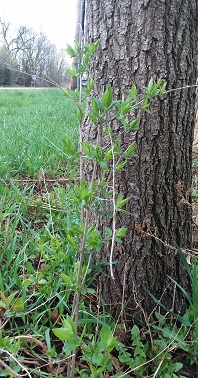
Once you have removed these invasive species from your yard, you can help our Earth by replacing them with native species that provide food and shelter to many creatures.
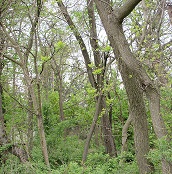
Here is a list of alternatives to buckthorn
- Dogwood (Cornus rugosa, Cornus alterifolia)
- Serviceberry (Amelancher arborea, Amelanchier laevis)
- Elderberry (Sambucus Canadensis)
- Nannyberry (Viburnum lentago)
- Chokeberry (Aronia melanocarpia)
- Spice Bush (Lindera Benzoin)
- Sumac (Rhus Glabra, Rhus Aromatica and similar)
The YouChoose App provides several great links to resources on native plants. If you have an android phone you can download the app from Google Play using the link on the right.
Do you want to share your experience? Send me an email at info@choosesustainable.org

 You Choose