
Welcome to ChooseSustainable.org where we explore ways of living sustainably. In this post I would like to talk about hummingbirds and how native and sustainable gardening is important to ensure their well being. This is true not only of hummingbirds, but of countless species that coexist (or try to) with us.
Sometime, when we take simple decisions such as getting rid of bugs, spiders, or dandelions in our yard we don’t consider the far reaching consequences of our actions. Most of the time things that we consider trash or nuisances are essential for the survival of other species. When we think of hummingbirds we think of feeders, but our yard can provide much more than that. The good news is that what they really need comes at no cost to us, it is already there, we just need to leave it where it is.
Every spring I look at the hummingbird migration map and around the beginning of April put out a feeder hoping that a few of them will take notice and stop in my backyard. The idea is to offer them plenty of reasons to stay through the summer and fall, so let’s see what hummingbirds need to be happy in our backyards.
Food and water
Contrary to common belief the main part of a hummingbird diet is not made of nectar, but of insects. Hummingbirds are voracious eaters of all kind of small insects, from spiders and small flies to aphids and 80% of their diet is made up of them. Nectar is important especially in early spring when the availability of insects is still limited. If we use pesticides to get rid of spiders, ants, or even mosquitoes in the yard we deprive hummingbirds of their main source of food and, even worse, we may poison them.
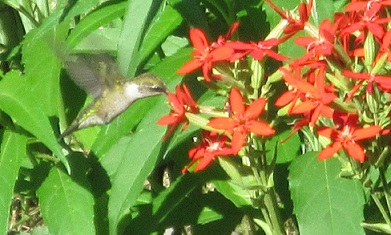
The best thing is to provide them with nectar-rich flowers and insect attracting plants from spring to fall. A shallow bird bath can provide water access. From what I see in my backyard, hummingbirds like to go to a variety of plants. Here are some plants that provide nectar and/or insects, these are mostly for the Midwest, please check native plants in your area:
Spring: Aquilegia Canadensis (columbine), Geranium Maculatum (wild geranium), Penstemon digitalis (foxglove penstemon), Diervilla Lonicera (dwarf honeysuckle)
Summer: Lobelia Cardinalis (cardinal flower), Silene Regia (royal catchfly), Monarda Fistulosa (wild bergamot or Monarda Didyma if you are on the East Coast), any native Liatris (for example Liatris Spicata), native Hibiscus if you are in the native range.
- Fall: Chelone Glabra (turtlehead), Lobelia Siphilitica (blue lobelia), any of the goldenrod (for example Solidago Speciosa).
Shelter
Hummingbirds are not exempt from predators. For this reason a habitat rich with tall grasses, tall prairie flowers, and shrubs near the feeder provides a better way for the hummingbird to avoid hunters.
Nesting
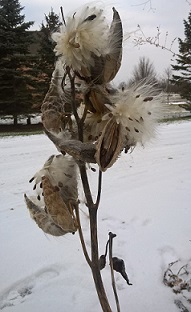
Hummingbirds use spiderwebs and possibly fluffy material to build their nest. The fluffy material is provided for example by dandelion and milkweed. If you eliminate spiders from the backyard you eliminate essential elements for the survival of hummingbirds. Similarly leaving an untidy backyard over the winter with grasses and twigs and possibly dandelions in spring will provide material for nest building. Additionally, tall trees provide a place where to position the nest.
Feeder
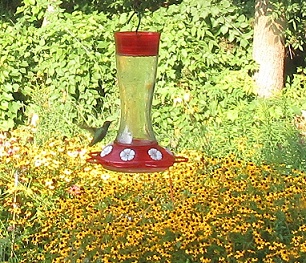
In addition to to a variety of native plants a feeder is a good way to provide easy access to nectar and to attract hummingbirds near your window where you can see them often. I love watching them come and go and I know that, as I observe them, they observe me. They observe me when I go to replenish the nectar and they come to look inside the window when I am in the kitchen.
Preparing nectar is quite simple: 1 part of sugar to 4 parts of water is enough. I warm up the water and dissolve the sugar until the solution is clear.
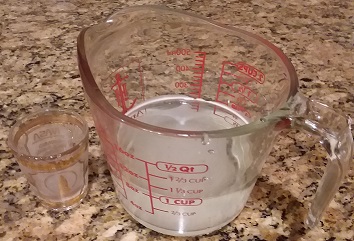
Because the sugary solution can be outside only for 2-3 days before it becomes old and dirty I put out only what is necessary for a few days in order to avoid wasting sugar. Every 2-3 days I rinse the feeder and replenish the nectar. Approximately once a week I empty the feeder entirely and wash it well to eliminate sugar residue. Keeping the feeder clean will also reduce ants that can sometime become a nuisance.
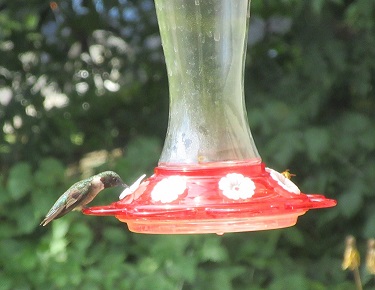
If you are considering native and sustainable gardening I hope this post was useful to see how planting native grasses and trees, avoiding pesticides, leaving grasses, twigs and seed heads in the yard through the winter, helps hummingbirds find a welcoming backyard in spring.
The YouChoose App provides several links to resources to get you started with sustainable gardening. It also provides links to native plants in specific regions. You can download it from Google Play or through the link on the right.
If you liked this post please share it!
 You Choose