
Welcome to YouChoose, a blog about individual climate action.
Have you ever thought about making laundry habits more sustainable? Laundry habits are very personal and intrinsically linked to our health and lifestyle, however even small changes to our routine can help reduce our environmental impact. In this post I talk about my personal experience in trying to do just that.
Just as many of us, every few months I used to go to a general store to purchase a jug of laundry detergent without worrying too much about ingredients or provenance. I generally looked for the cheapest option or whatever was on sale. As I became more conscious of the environmental destruction caused by palm oil-induced deforestation I decided to include laundry detergent in my list of products to review. My objectives were the following, ranked by increasing difficulty:
- Eliminate plastic
- Eliminate harmful chemicals
- Reduce waste in general
- Eliminate detergents that contain palm oil
- Do all of the above without increasing costs
I’ll review next to what extent I was able to achieve each goal.
Eliminate as much plastic as I can
Easy
Plastic jugs used in traditional laundry soaps end up in landfills. Even assuming a conservative estimate of about 4 jugs per year per household (I suspect it may be more) it results in about 400 million jugs of laundry detergent discarded each year. Read more about the problem here:
It is quite easy to find detergents that come without plastic. They are either powders or laundry sheets. I only found one brand that comes liquid in carton boxes. I must say that the idea of laundry sheets, although certainly appealing, seems like one of those “created needs” generated through marketing. Personally I don’t see any practical advantage in using a laundry sheet instead of measuring a tablespoon of powder. I understand however that others may have different needs and prefer laundry sheets. When selecting laundry sheets you may want to inform yourself about microplastics that could be released. The ingredient in question in Polyvinyl Alcohol (PVA) a synthetic water soluble compound. There is still some debate on whether the ingredient is completely biodegradable in all conditions. Below are some studies that assess how much these compounds biodegrade. More studies are probably needed to better understand the effect of PVA on aquatic organisms.
https://www.mdpi.com/1660-4601/18/11/6027
https://www.mdpi.com/2073-4360/13/21/3742
I opted for a powder that comes tightly packaged in a small paper box, entirely recyclable. I dissolve a tablespoon of the detergent in a small amount of water before using it (but it can also be used directly in the washer).
Eliminate chemicals dispersed in the environment
Moderate
Fortunately, this objective is also becoming easier to achieve. Traditional laundry detergents may contain sulfates, synthetic surfactants, and brighteners that are not biodegradable. Dryer sheets contain synthetic fragrances. Searching for products with biodegradable ingredients is one effective way to reduce our pollution footprint.
In the image below I have annotated some of the ingredients in a traditional laundry powder product.
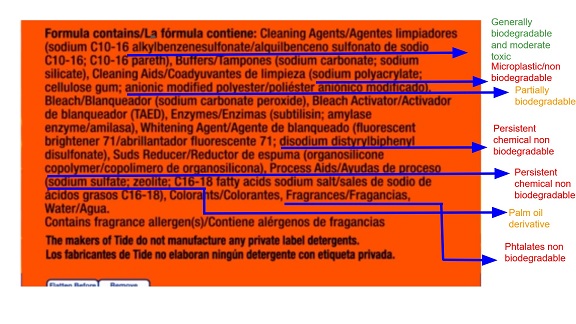
Ingredients obtained from petroleum that we can avoid:
- Ethoxylated ingredients, SLS, PEG/Polyethylene: 1,4-dioxane
- Fragrances: aldehydes, toluene, and phthalates
- Brighteners: Fluorescent Brightener 71, Disodium distyrylbiphenyl disulfonate
Below is a link with some additional information about products containing 1,4-dioxane.
What to look for
Entirely biodegradable formulas, non petroleum derivatives, plant based, fragrance free, essential oil fragrances. I opted for a powder that lists all ingredients and is made with only few biodegradable ingredients.
Reduce waste in general
Difficult
Waste when doing laundry can take many shapes. Reducing waste requires changing habits, which is a very difficult thing to do. I was only partially successful. One way to approach this is to ask ourselves: Do I need so many products? Can I wear something twice before washing? Below are some more examples.
| Wasteful habits | Suggestion | Impediments |
| Using too much water | Reduce number of loads. If possible, consider wearing clothes more than once before washing. | It strongly depends on individual lifestyle and needs. |
| Washing in hot water | Consider washing in cold water. | We may fear that clothes are not clean. There is an interesting reading here: https://www.worldwildlife.org/publications/encouraging-us-households-to-wash-laundry-in-cold-water/ |
| Doing laundry during peak electricity hours | Run washer and dryer during non-peak hours (10pm-6am and weekends) to maximize the use of renewable sources depending on where one lives. | Sometime we may be too tired or forget. |
| Old appliances. Energy and water inefficient machine | This is something to think about when it’s time to replace the machine. | It depends on cost and financial resources available at the moment. |
| Use too many products (dryer sheets, softener, stain remover) | Use one product for everything. Eliminate dryer sheets. Use minimum amount necessary. | Habits, fear of lack of alternative, takes time to find new ways. |
Eliminate detergents that contain palm oil
Extremely Difficult
The palm oil industry is a predatory industry that is built on the ashes (literally) of ancient rainforests. Palm oil plantations wipe out entire ecosystems. Below are some links that discuss the problems created by the replacement of biodiverse forests with monocultures of a foreign species.
https://palmoildetectives.com/the-problems-with-palm-oil/
https://globalwitness.org/en/campaigns/forests/the-true-price-of-palm-oil/
Unfortunately the vast majority of laundry detergents (even those marketed as green and sustainable) contain palm oil in spite of the fact that it is well established that sustainable palm oil doesn’t exist. In the majority of cases the ingredient is not clearly indicated in the label. Below are words to watch for. When in doubt contact the company directly:
- “Palm” or “kernel”: palm kernel or palm stearine or palm fruit oil, palmitate, palmate, and palmitoyl, Sodium Kernalate.
- “Sodium” or “Sulfate”: Sodium Laureth Sulfate, Sodium Lauryl Sulfate, Sodium Lauryl Sulfoacetate or SLS, Sodium Dodecyl Sulphate (also known as SDS or NADS), Sodium Isostearoyl Lactylaye and Fatty alcohol sulphate.
- “Cetyl”, “isopropyl”, “steareth”, “stearate”, “glycerol”, “glyceryl” or “lactylate”
So far, I only found a handful of companies that openly don’t use palm oil in their detergents. At the end of this blog there is link to information I have found on common brands and their palm oil policy.
Do all of the above without increasing costs
Are sustainable detergents more expensive than traditional detergents? It seems that they are slightly more expensive than the cheap detergents one can find in stores but they are comparable to high end regular detergents. There are however ways to reduce the costs even using the sustainable detergents. For example I add washing powder to reduce the cost per load. Using fewer products, fewer loads, and smaller doses has actually decreased my overall costs. Another saving comes from the fact that the laundry powder, with a small addition of borax, can also be used to clean carpet stains eliminating the need to purchase additional carpet cleaning products (in plastic bottles).
To conclude, I have put together a few slides that can be viewed at the following link. The last two slides contain a comparison of popular detergents, their price, and how they satisfy the criteria discussed in this post.
I hope this information can help you to make informed decisions on laundry detergents and to minimize our impact on the environment. Every change counts!
 You Choose