Welcome to YouChoose, a blog about individual climate action.
Forests are the soul of the Earth and deforestation is an existential threat to all life on our planet. Old growth forests in particular are home to countless species of plants and animals. If you have ever been in a forest you may have felt the connection to your very own spiritual essence.
The US Forest service is seeking out public comments on its forest management plans. If you care about forests and biodiversity this is a time to make your voice heard and let the government know that you care about protecting our forests.
This is the link to the US Forest Service page where information on the proposal is given.
Please tell our government to conserve and restore old growth forests and protect them from logging and exploitation.
Here is the link to the Defenders of Wildlife petition page where you can add your name to urge the US Forest Service to stop logging and conserve US forests.
Please share the link.
Do you want to do more? Palm oil, meat, and livestock industry are the #1 cause of deforestation worldwide. Don’t finance deforestation with your own money, boycott the products of deforestation.
Welcome to YouChoose, a blog about sustainable living. In this post I wanted to share some great information provided by Ashok Nagella, MD, on the impact of a plant-based diet on our health and our planet. The intention is not to scare people off into a vegan diet, but rather to share a few good reasons to reduce our consumption of meat and animal ingredients to a minimum and make more room for a variety of plant-based food. The full set of slides can be found here.
Why is it important for our Earth that we reduce meat consumption?
If it is true that a picture is worth a thousand words, then the following two images should speak for themselves.
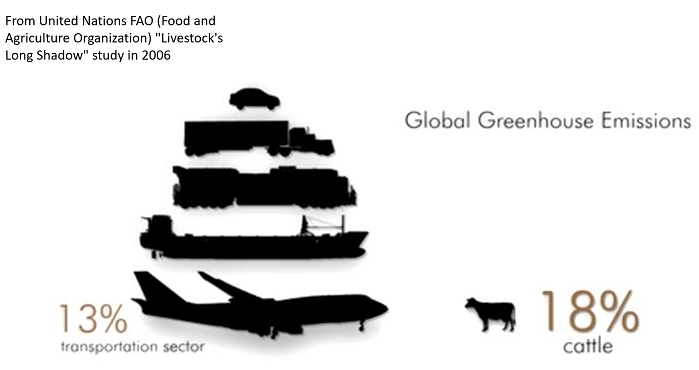
Agriculture emissions (in green) constitute about one fourth of global emissions. A large portion of these are due to cattle and animal farming (website: drawdown.org)The animal industry alone is responsible for the same percentage of emissions as the entire transportation industry but with the additional damages of deforestation, loss of biodiversity, and enormous water consumption.
Electricity, agriculture, and industry are the largest sources of greenhouse gases. We, as individuals, can directly influence a few sectors, for example switching to electric vehicles, low consumption bulbs, and reducing the use of high consumption devices. The sector over which we can have the most effective impact is agriculture. In fact, emissions due to the cattle industry are higher than those due to the entire transportation sector. And it is not just greenhouse gases emissions, but also water consumption, because a great amount of water is necessary to raise, kill, and process animals.
Why is it important for Us to reduce meat consumption?
Check out these health benefits of a plant-based diet.
Significant increase in Fiber, Antioxidants, Omega 3 Fatty Acids, and Neurotransmitter Production
Significant reduction of Inflammation, saturated fat, and cholesterol
Increase in longevity while preventing cancer, heart disease, strokes, and dementia
Improvement in mood while reducing anxiety
Improvement in focus, attention, and memory
Often, we get frustrated about politicians not doing enough for the planet and the climate, at the same time feeling powerless and depressed. However, let’s think about this: We, as individuals, have complete control of what we eat. The greatest change we can make for our planet is also the one that requires the least effort and is good for us. We don’t have to wait for governments to take action on our behalf, we can take our own actions!
Welcome to YouChoose, a blog about sustainable living. In this post I wanted to share a few reflections about recent heat waves.
This year, like every year, I was in Southern Europe for about 2 months and found myself in the middle of one of the hottest summers on record. This is the second year in a row that I find myself in such a situation over there. I grew up there and I am old enough to remember that summers used to be hot, especially in August, but generally pleasant in June and July. Lately the heat has become unsustainable from the beginning of June until September. The extreme heat was compounded by a drought and extended wildfires. The situation was such that, perhaps for the first time, climate change was perceived by everybody as a real and incumbent crisis. The reality of warming is becoming apparent to everybody.
Deforestation plays a major role in accelerating climate change. Globally, until now, tropical forests have acted as carbon sinks, sequestering large amounts of carbon dioxide. Today, emissions caused by the process of deforestation and land conversion to agriculture are starting to exceed the forest carbon sequestration. Forests are now becoming carbon sources instead of carbon sinks. . This in addition to land degradation, loss of biodiversity, and change in rainfall patterns.
Please read this very interesting article in NOAA’s research news:
The contribution of deforestation to climate change includes (1) emissions from deforestation, (2) emissions associated with land use (i.e. cattle farming, soy plantation) and (3) reduced amount of carbon sequestration due to the loss of canopy. Industrial agriculture is responsible for the largest part of deforestation with the products of deforestation coming to our grocery cart and our kitchen. It is imperative that we become conscious buyer and learn which products are driving deforestation.
What can we do as consumers:
Reducing (or eliminating) meat and dairy consumption is the single most important step we can take to stop deforestation
Eliminate palm oil from the shopping cart
Purchase certified sustainable coffee and chocolate
If choosing to consume meat, choose grass-fed, soy-free products.
Although soy for human consumption constitutes an infinitesimal part of the global soy production, it is important, when using soy-based products to make sure they are sourced from sustainable agriculture.
Be vocal and participate in campaigns. Demand that governments and companies act to stop deforestation.
What are you waiting then? Be part of the movement to stop deforestation. Can’t go wrong!
The YouChoose app provides several links and information on products and cosmetics ingredients that are unsustainable and bad for the environment.
Welcome to YouChoose, a blog where we explore ways of living sustainably. I am sharing here a recent article that appeared in the IEEE Geoscience and Remote Sensing Society newsletter. You can view the the article by copying and pasting the link below in your browser.
The article shows a satellite view of deforestation in South America linked to clearing for cattle and soy plantations (for feeding cattle). From the satellites it is also possible to follow the evolution in time of the rate of deforestation.
In North America environmental destruction is also causing large scale decline in biodiversity and extinction of species due to pesticides used in large scale farming. Below here is an interesting article from the BBC about California’s endangered butterflies and what we can do.
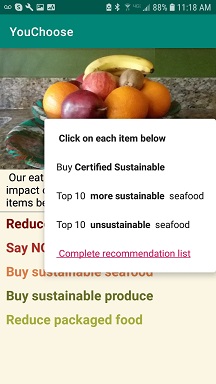
The YouChoose app provides several links and information on global food issues and lists of sustainable and unsustainable foods including fish and vegetables, hopefully the information is useful to get started.
In this blog there is a recipe section where I share meat-free recipes to help out. If you want to share your sustainable recipes to help others, I’ll be glad to post them in this blog.
Do you want to share your progress on eliminating meat from your diet? Send me an email at info@choosesustainable.org and I’ll add it to this blog.
Welcome to YouChoose, a blog where we explore ways of living sustainably. This week I would like to share some thoughts about reducing meat consumption.
Today, the link between meat consumption, deforestation, and emission of greenhouse gases is well established. Therefore one of the most important steps we can take for the benefit of our Earth is to eliminate meat from our diet. Legumes are among the most Eco friendly food we can consume and they are an important source of proteins. They are also beneficial for the soil and don’t require excessive water use.
Sometime when we think of legumes we get discouraged because we have to remember to soak them and need time to boil them. While this is true for some, not all legumes require long preparation time. Additionally it is possible to soak the desired amount in advance and keep it for one day or two. Soaking is an important step necessary to make legumes more digestible and eliminate anti nutrients. If we are pressed for time some limited variety of legumes are ready available in cans. This is very helpful, however there is a much greater variety of dry legumes so I suggest to explore ethnic grocery stores and see what is available.
Another frequent complaint is that legumes are hard to digest and make us uncomfortable. Again, this may be true of some types such as red or garbanzo beans, and it is especially true if we are not used to them. Here are some steps that can help us to to become more accustomed to the regular use of legumes.
Start with the varieties that are easier to digest: Green and yellow lentils, split peas, mung beans.
Introduce harder legumes (beans, garbanzo) in small amount at the beginning.
Soak the harder beans for 8-12 hours. Lentils don’t need to be soaked, however soaking them even for 2-3 hours makes them more digestible.
Cook the legumes thoroughly. They should be soft but not mushy.
Soak them when you remember, you can use them later.
In this post I’ll talk about a variety of easily available legumes we can quickly incorporate in our daily meals and will provide approximate preparation time. The following is the basic procedure, once cooked legumes can be used in recipes to make delicious snacks, soups, and side dishes.
Lentils
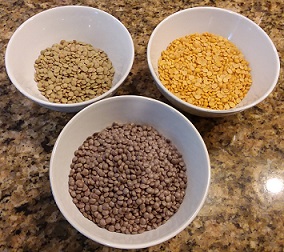
Lentils are probably the easiest to start with. They come in many types, green, yellow, brown. They make a great side dish, soup or can also be used to make fritters. They are fairly easy and quick to prepare and they don’t need soaking if there is no time. Lentils, like all legumes, should be rinsed and checked before use. Green and yellow lentils can be soaked for 3-4 hours or boiled directly in a regular pot with water. They are ready in 15-20 minutes. Brown lentils can be soaked overnight (but it is not necessary) and pressure cooked for about 8 minutes. Brown lentils can be cooked in the pressure cooker directly with other vegetables so they make a very quick meal. I plan to post some delicious and quick lentil recipes in the recipe section of this blog.
Green, yellow, and brown lentils are great starters to get yourself used to legumes. They are easy to prepare and can be used in a variety of dishes.
Garbanzo beans
I mostly use two types of chick peas: white and black. Garbanzo beans should be washed and soaked for at least 8 hours as they are generally harder than lentils. The black variety requires at least 12 hours. They can be cooked in the pressure cooker for about 15 minutes and kept in the refrigerator for 1 or 2 days ready to use. Garbanzo beans make an excellent salad addition for lunch, but are also very good in soups and can be used as a side dish, cooked with spices and tomatoes. Garbanzo beans can also be used to make hummus to use as snack or in appetizers.
Garbanzo beans are excellent cooked with a variety of spices or in salads
Mung beans
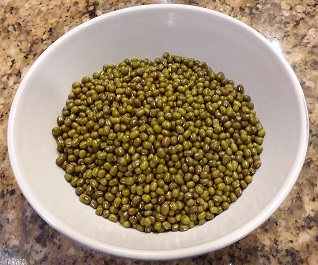
There are several types of mung beans (red, green,black). They make an excellent lunch, snack, or side dish. The best way is to soak them overnight before sprouting or cooking. Check out the easy sprouting procedure in the recipe section. Once soaked, cover the beans with water and bring to a gentle boil for about 15 minutes, make sure not to overcook them. They need to be just soft, but not mushy. Once boiled they can be cooked with spices and peanuts to make a great lunch or snack.
Mung beans cook very quickly after they have been soaked for 8 hours and don’t require a pressure cooker.
Beans including dried Lima beans
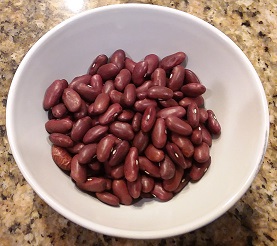
There is a great variety of beans, large, small, red, white, and more. Usually beans need to be soaked overnight and cooked for about 15 minutes in the pressure cooker depending on the beans and the cooker. Some can be quite hard, therefore the soaking and cooking part is important and should not be skipped. Beans can be added to salads, used in soups, or cooked in spices. One can get used to them starting with small portions.
Beans require soaking at least 8-12 hours and proper cooking to be more digestible
Peanuts
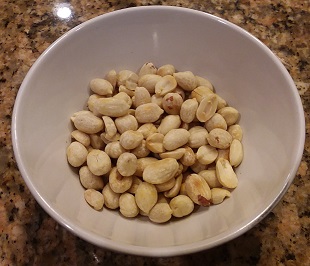
At last I’ll mention here peanuts. Although they are legumes, they are more similar to nuts. When lightly roasted they make a nice snack or can be used in small amount in a variety or recipes.
Peanuts are a sustainable food that can be added in small amount to dishes or used as snack
I hope this brief overview of some common legumes inspired you to include more of them in your daily diet. Including more legumes and less meat is one of the most important steps we can take to reduce greenhouse gases, reduce deforestation, and help our Earth.
The YouChoose app provides several links and information on global food issues and lists of sustainable and unsustainable foods including fish and vegetables, hopefully the information is useful.
In this blog there is a recipe section where I share meat-free recipes to help out. If you want to share your sustainable recipes to help others, I’ll be glad to post them in this blog.
Do you want to share your progress on eliminating meat from your diet? Send me an email at info@choosesustainable.org and I’ll add it to this blog.
Welcome to YouChoose, a blog where we explore ways of living sustainably. This week I would like to share some thoughts about food and meat consumption.
Meat consumption drives deforestation in two ways: 1. The forest is cleared to make room for cattle pastures and 2. The forest is replaced by large-scale soy plantations to be sold as food for cattle. Even in the USA almost half of the agricultural land is used to grow crop for cattle feeding. This has led to the destruction and near extinction of the great American Prairies and the entire ecosystem that depended on them, of which we’ll talk in another post.
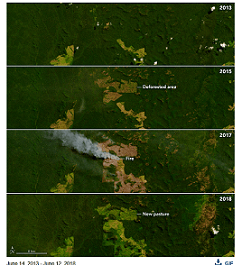
In the above image (https://earthobservatory.nasa.gov) the progressive deforestation of a large area for cattle pasture between 2013 and 2018 is captured in satellite images.
I think the German philosopher Ludwig Feuerbach (1804-1872) was right when he declared that “Man is what he eats.” Turning upside down Feuerbach’s Marxist materialism it seems that what we eat is at the core of our identity and it is a very difficult part of us to change. Perhaps for this reason advocating the reduction in consumption of meat and animal products to save the Earth is not a popular topic. What we eat is an essential element of our culture and of the way we perceive ourselves as a species and as part of social groups.
A long time ago I decided to stop eating meat. This decision was very personal, it had nothing to do with the environment or sustainability, it was more part of a spiritual path that helped me find my own place in the world. As a result I had to face an unexpected wave of hostility from my family. There was no family meeting in which I didn’t have to explain, defend, and justify myself. I noticed that people took this choice almost as a personal offense, an act of defiance, a refusal of cultural and social norms. However, even in my own culture, in the past, meat consumption was limited to special occasions. It has been only in recent years that meat has become part of the daily diet with bad consequences for animal welfare and for the environment.
For the last 23 years I have worked on eliminating meat entirely from my diet and on cutting back on animal products in general, including fish, eggs, milk, and cheese. Cumulatively animal products constitute now less than 3% of my diet and meat has been entirely absent for about 20 years. I am far from perfect, but it has been a continuous improvement. By substantially reducing the amount of animal products, I am also in the position to purchase products that are more sustainable, which sometime means more expensive.
Recently there has been more awareness of the environmental impact of meat consumption and a plant-based diet is becoming more acceptable, still meat consumption is on the rise. Today we know that reducing meat and animal products is one of the most important actions we can take to reduce and stop deforestation, pollution, and degradation of the environment.
I would like to invite everybody to gradually reduce meat and animal product consumption to a minimum. It is important not to set expectations too high, it is easy to quickly run out of food choices and give up. Gradually one can try new grains, legumes, roots, and vegetables. The possibilities are endless. One doesn’t have to become a perfect vegan overnight. It is more important to become conscious consumers and develop our own path to sustainability, even veganism doesn’t necessarily mean 100% sustainable.
The YouChoose app provides several links and information on global food issues and lists of sustainable and unsustainable foods including fish and vegetables, hopefully the information is useful to get started.
Here are a few more suggestions to help getting started:
Be firm in the resolve, changing food habits is not easy. Please don’t give up
Set one reachable goal at a time. For example one meat-free day a week to start and progress from there
Buy unknown vegetables, grains, legumes and look them up at home. You will be surprised of how many pleasant discoveries you will make
Make a point to try one new grain/cereal (millet, barley, black rice, farro)
Make a point to try one new legume (yellow peas, chick peas, green lentils, mung beans, kidney beans, brown lentils)
Try different recipes for the same vegetable
Cook ahead, sometime you can boil the legumes ahead and keep them ready in the refrigerator
In this blog there is a recipe section where I share meat-free recipes to help out. If you want to share your sustainable recipes to help others, I’ll be glad to post them in this blog.
Do you want to share your progress on eliminating meat from your diet? Send me an email at info@choosesustainable.org and I’ll add it to this blog.




 You Choose