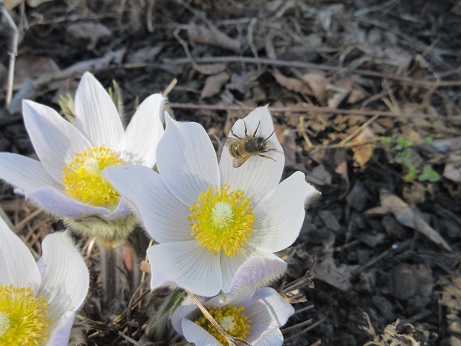
Prunus serotina (Black cherry)

Welcome to ChooseSustainable.org where we explore ways of living sustainably. In this series of short posts I present a native plant to encourage everybody to abandon our traditional way of gardening (basically a continuous fight against nature) and engage in sustainable gardening practices that nurture the ecosystem, sustain wildlife, and foster biodiversity.

In this post I’ll talk about a large cherry tree: Prunus Serotina (Black Cherry).
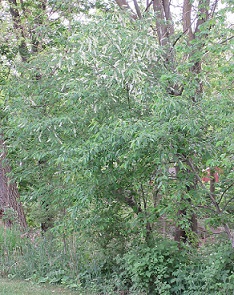
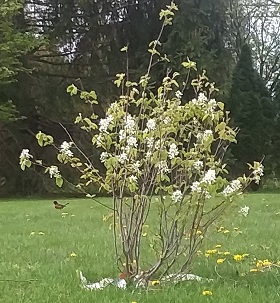
A young black cherry in my backyard. Mature trees grow up to 60′-80′ (18-25 m).

Quick facts:

  • Zones:3-7
  • Bloom time: Early spring (Apr-May)
  • Sun: Sunny area to shade
  • Soil Moisture: Wet-dry
  • Aggressive: NO
  • Front yard: YES
  • Height: (60-80’)
  • Status: OK
  • Maintenance: NONE
  • Wildlife value: Very High

Wildlife connection: A host of insects, birds and mammals depend on this tree for survival. The early flowers provide food for many species of bees and bumblebees, along with smaller insects. The leaves provide food for the caterpillars of several butterflies and moths and for a large variety of beetles. The fruits are extremely important for birds and mammals such as foxes, raccoons, opossums, chipmunks and squirrels.

I consider myself very lucky because I had a large black cherry in my yard. The tree was able to survive the invasive buckthorn and, after the buckthorn was cleared, two new small trees emerged. The large tree died last year, but the young trees are growing fast.

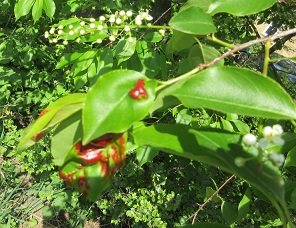
The leaves of this tree are bright green and shiny. If you look at them up close you will notice that many leaves have bumps and holes. There is no need to worry, it just means that the tree is serving its purpose and it is being used by insects, as it should be.
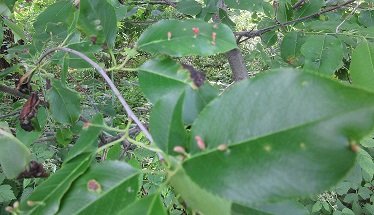
In mid spring (mid to late May in my yard) the tree blossoms with nice white flowers that unfortunately don’t last very long, perhaps 2-3 weeks. In summer the flowers are replaced by small black cherries that look more like berries. It is hard to catch a glimpse of them as they quickly disappear, eaten by birds.
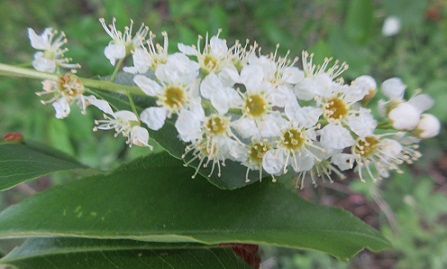
The flowers of black cherry in mid-late May

The importance of this tree to the ecosystem is hard to overstate and it is on the same level as the oak’s. Both trees provide to the essential needs of a large number of species. If you do have some room in your yard and are thinking of planting a tree, Prunus serotina is an excellent choice for conservation.

The tiger swallowtail is just one of the many creatures that rely on black cherry for survival. I wonder if this one was born on my tree

Please make sure to purchase native flowers from nurseries that don’t use neonicotinoids and look out for the full botanical name to avoid cultivars. The YouChoose App provides resources and several links to useful sites for sustainable gardening.

Would you like to talk about a native plant in your backyard? Please send me your post at info@choosesustainable.org and if you liked this post please share it with others.
Start a native garden: Motivation

Welcome to YouChoose, a blog where we explore ways of living sustainably. This week I would like to share the first steps we can take towards sustainable gardening. There are many topics to be discussed on this subject and I plan to share several postings about my journey to achieve a 100% sustainable backyard.

The focus of this post is motivation. It is important to be confident that our efforts make a difference. My experience bears witness to this fact: I have seen my backyard quickly transform from a lawn wasteland to an ecosystem full of life.

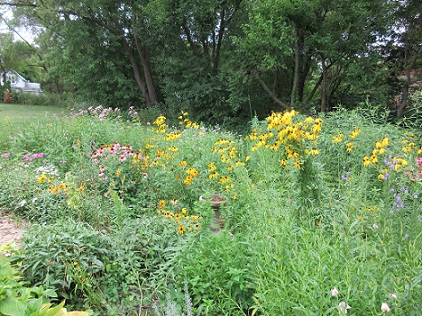
After-A part of the tall prairie section in my backyard
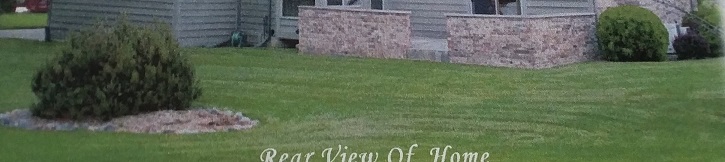
Before-My backyard as it was with the traditional suburban landscape

Here is just a quick overview, we’ll go into the details in future posts.

QUICK TIPS TO START – STEPS to DO

  • Be motivated and be sure that your efforts make a difference
  • Don’t be overwhelmed; small steps go a long way
  • Remove invasive plants (if any)
  • Reduce the amount of lawn in the yard
  • Plant native forbs and shrubs
  • Provide wildlife with places to live and shelter
  • Plant native trees
  • Provide water

QUICK TIPS TO START – things to AVOID

  • Being obsessed with lawn appearance
  • Being afraid of making mistakes
  • Using herbicides or pre-emergent chemicals
  • Using pesticides
  • Collecting and disposing of leaves

My neighborhood is a typical Midwest suburban neighborhood with single family homes surrounded by yards landscaped with lawn (a lot of it) and mulched areas planted with evergreens, roses, and plants readily available at general home improvement stores or nurseries. As a foreigner in a foreign land my initial efforts were devolved to maintaining what was found. Therefore, I joined the chorus, hired a lawn maintenance company to take care of the lawn and visited local nurseries or whatever was nearby to purchase familiar plants: roses, azaleas, peony, etc. Plant diseases or parasites were treated with chemicals recommended by the nurseries and, occasionally, a mosquito treatment kept the yard free of bugs.

It is likely that my experience mirrors the one of many homeowners. It was only later that I realized that the weed-free, picture-perfect look of the suburban homes is achieved at a very high environmental cost. The perfect lawn is maintained by pouring herbicides and fertilizers, in addition to constant mowing. The weed-free mulched areas are loaded with pre-emergent chemicals, and the bug-free backyard requires the use of non-selective pesticides that have repercussions on the entire food chain of the creatures living (or better trying to survive) in our backyards.

The eye opener for me came one day when I was going for a walk in the neighborhood and came across a road that was developed on one side and undeveloped on the other. The developed side had new homes surrounded by a luscious lawn of an intense green. The mulched areas were planted with flowers of almost a neon color that matched some of the house details, nothing was out of place, the whole view was studied to the detail. The undeveloped side in the front was filled with milkweed and other tall grasses and had the messy look of the summer prairie. When I stopped and listened, the developed part was dead silent, not a buzz to be heard, not a bug to be seen; the undeveloped side was a concert of sounds and voices of creatures living there.  This was when the realization came to me, that my move into a suburban acre was forcing all the other creatures living there to move out or die. I was depriving many species of food and shelter and was poisoning the soil and water.

Since that day my yard has changed very much and it is still an ongoing effort. I have also become addicted to bugs and can’t stop taking pictures of them and being amazed at their shapes and colors.

Are you ready to start the transition? Don’t wait and don’t be afraid of the messy look, there are wonderful native plants that are perfect for the front yard. My only regret is that I didn’t start earlier. It takes about 3 growing seasons to go from nothing to an initial blooming backyard.

In a next post we’ll discuss the first step: How to identify and remove invasive plants.

Do you want to share your motivation for starting a native gardening? Send me an email at info@choosesustainable.org

Amelanchier Arborea (Downy Serviceberry)

Welcome to ChooseSustainable.org where we explore ways of living sustainably. In this series of short posts I present a native plant to encourage everybody to abandon our traditional way of gardening (basically a continuous fight against nature) and engage in sustainable gardening practices that nurture the ecosystem, sustain wildlife and foster biodiversity.

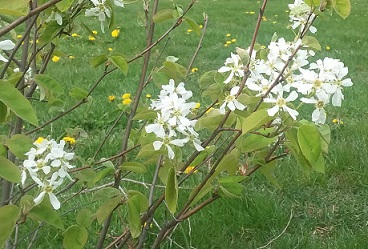
In this post I’ll talk about a small tree I planted in my yard a few years ago: Amelanchier Arborea (Downy Serviceberry).

Quick facts:

  • Zones:4-9
  • Bloom time: Early spring (March-May)
  • Sun: Sunny area to shade
  • Soil Moisture: Medium, Wet
  • Aggressive: NO
  • Front yard: YES
  • Height: (15-25’) But it can vary
  • Status: OK
  • Maintenance: NONE
  • Wildlife value: High

Wildlife connection: The trunk, flowers, leaves, and fruits of this plant are very important for wildlife. Serviceberry is the host plant to caterpillars of several butterflies and moths. Several other insects use this plant for their larvae. The flowers attract bees, honeybees, and other early insects and the berries are food to birds and small mammals.

I planted a very small serviceberry tree in my backyard several years ago. Not being very familiar with the plant I placed it in a location where it was unhappy. Thinking in retrospect, the soil was probably too dry. Although the plant is tolerant of a wide range of soil moisture it prefers moist and well drained soil.

After waiting for a few seasons I decided to transplant it to a different location. Since then the tree has been growing better and this year it bloomed for the first time.

If you are looking for a small tree, Serviceberry is a very good choice. Its size makes it suitable for small yards but it can be a nice decorative addition to a big yard as well. It provides early spring flowers, fruits, and foliage color in fall and it seems fairly low maintenance. The spring flowers are particularly important for early bees, when other flowers are still not available.

Please make sure to purchase native flowers from nurseries that don’t use neonicotinoids and look out for the full botanical name to avoid cultivars. Contact me for suggestions on where to buy.

Would you like to talk about a native plant in your backyard? Please send me your post at info@choosesustainable.org

Viola Sororia (Common Violet)

Welcome to ChooseSustainable.org where we explore ways of living sustainably. In this series of short posts I present a native plant to encourage everybody to abandon our traditional way of gardening (basically a continuous fight against nature) and engage in sustainable gardening practices that nurture the ecosystem, sustain wildlife and foster biodiversity.

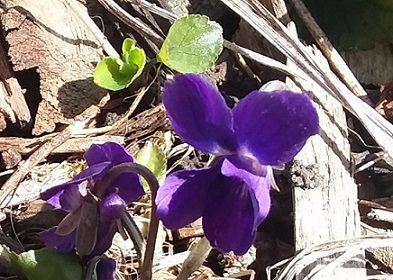
In this post I’ll talk about a spring flower that comes up in my backyard: Viola Sororia (Common violet).

Quick facts:

  • Zones:3-9
  • Bloom time: Early spring (March-May)
  • Sun: Sunny area to shade
  • Soil Moisture: Medium, Dry
  • Aggressive: YES (but keep in mind it is a 3 inch plant)
  • Front yard: YES
  • Height: (3-4’’)
  • Status: OK
  • Maintenance: NONE
  • Wildlife value: High

Wildlife connection: Viola sororia is the host plant of several marvelous butterflies whose populations have been declining. The caterpillars of at least five different  Fritillary butterflies feed on the foliage, the seeds are attractive to ants. Several birds and small mammals eat the seeds and occasionally the leaves of this plants. Read more at https://www.fs.fed.us/wildflowers/pollinators/pollinator-of-the-month/fritillary.shtml

I wasn’t really thinking of writing this post until last week when I was placing an order to purchase a few violets for the front yard and did a quick internet search on common violet. I was surprised and saddened to read the conversations about this little plant and felt that it deserves better than the constant disdain it gets. The discussions around this flower usually include terminology such as weed, extirpate, smother, eradicate and similar. One is even warned not be fooled by its innocent look! I quickly realized I was dealing with the public enemy #1 of the gardening world.

Apparently the unforgivable crime of this tiny warrior is that it refuses to die and go extinct like so many other less resilient native plants. In some posts the plant is tagged as an invasive! However if we look at the definition of invasive plants from the USDA we find that an “invasive species” is defined as a species that is:

  1. Non-native (or alien) to the ecosystem under consideration; and,
  2. Whose introduction causes or is likely to cause economic or environmental harm or harm to human health.

Our little viola sororia is a native plant, which means it was here before we Europeans even arrived, and it doesn’t cause any harm to anybody. It is actually an edible and medicinal plant. In addition, as the host plant of several butterflies, is beneficial to the environment. By this definition we humans are a more invasive species than the viola sororia!

In fact the gentle violet has been gracing our landscapes for thousand of years. Known in ancient Greece as ion, the violet was borne from an act of kindness of our Mother Earth (the goddess Gaia) to feed Io, a young girl turned into a cow by the always vengeful Greek gods. It speaks a lot of our gardening habits the fact that a gift from our Earth, a symbol of  love and gentleness has become the object of so much hatred.

I welcome violets in my yard wherever they come up, usually in patches here, there, and everywhere. Hopefully this short post will inspire others to see violets in a different light, to see that they have an important purpose and perhaps to stop and think before removing them. By letting this ancient flower thrive in your yard you will be feeding small herbivores and birds, and you will be sustaining a declining population of butterflies. If you think your efforts won’t make a difference think again. For the first time this past summer I was able to snap a picture of a Fritillary in my backyard.

Welcome back dear violets, resist, I am glad you haven’t become another casualty of our suburban gardening.

Please make sure to purchase native flowers from nurseries that don’t use neonicotinoids and look out for the full botanical name to avoid cultivars. Contact me for suggestions on where to buy.

Would you like to talk about a native plant in your backyard? Please send me your post at info@choosesustainable.org

Pulsatilla Patens (Eastern Pasqueflower)

Welcome to ChooseSustainable.org where we explore ways of living sustainably. Spring is here and I would like to share my first gardening post. This is the first short post in which I present a native plant to encourage everybody to abandon our traditional way of gardening (basically a continuous fight against nature) and engage in sustainable gardening practices that nurture the ecosystem, sustain wildlife and foster biodiversity.

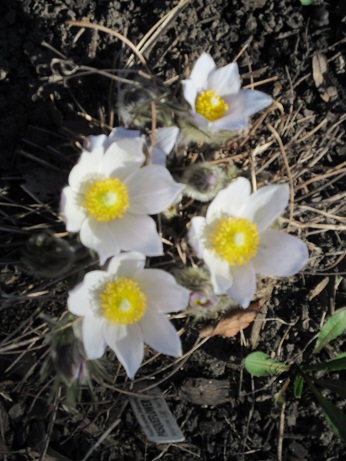
More on this later, now I want to talk about one of the first spring flower that come up in my backyard: Pulsatilla Patens (Eastern Pasqueflower).

Quick facts:

  • Zones:3-6
  • Bloom time: Early spring (April)
  • Sun: Sunny area or partial shade
  • Soil Moisture: Medium, Dry
  • Aggressive: NO
  • Front yard: YES
  • Height: (3-4’’)
  • Status: OK
  • Maintenance: NONE
  • Wildlife value: High

Every spring around March, after I do the spring cutting of the tall prairie plants, I anxiously await the first signs of spring in the garden. By the end of March as soon as the snow clears, I search for my beloved Pasqueflowers and feel very happy when I see them coming back, among the first to announce the arrival of spring. Pulsatilla Patens is one of the spring ephemerals. For many suburban inhabitants of the Midwest gardening season starts at the end of May, on Memorial Day, however for native gardeners the season starts much earlier, at the beginning of March. Spring ephemeral for all their understated and brief beauty play a very important role in sustaining the ecosystem and I encourage everybody to plant large amounts of these perennials. I have neglected spring ephemeral in my garden but am planning to substantially increase their number this year.

Of course, one may say we have plenty of early bloomers, daffodils, hyacinths and tulips, but none of them serves the important task that the native early spring flowers accomplish, which is to provide food to the first insects that come out of hibernation. Last year I planted a bunch more and I am hoping to see them come back this year.  This little flower makes a great addition to the front yard, it is very well behaved, doesn’t spread (I wish it did) and will also go very well in the mulched area under trees.

If you plant this little jewel in your yard, you’ll see early bees flocking to it when everything else is still dormant. Please make sure to purchase native flowers from nurseries that don’t use neonicotinoids and look out for the full botanical name to avoid cultivars. Contact me for suggestions on where to buy.