
Halloween without palm oil

Welcome to ChooseSustainable.org a blog about individual climate action. As usual, my October post is a reminder of the destructive properties of palm oil, a common ingredient in Halloween candies.

Palm oil is one of the most devastating commodities, driving deforestation, the extinction of countless species, and rampant human right abuses. Unfortunately it is found found in mass produced Halloween candies as well as other countless products. This Halloween take a few extra minutes and read the ingredients to avoid candies that contain palm oil.

Below is a link to a list of candies without palm oil. However it is always better to read the label to make sure ingredients haven’t changed.

The Orangutan alliance post linked below is a few year old, but it discusses the Roundtable of Sustainable Palm Oil (RSPO) certification.

Don’t be fooled by RSPO certifications. The only way to stop deforestation is the “Palm oil free” label.

Industrial deforestation, driven by palm oil demand, is one of the largest contributor to climate change and the largest driver of loss of biodiversity and mass extinction on the planet. Don’t finance the suffering of countless species with your money, this Halloween go palm oil free.

If you liked this post please share it!
Living without palm oil: You can do it!

Welcome to YouChoose, a blog about individual climate action. We talked in previous posts about the importance of reducing the demand for palm oil. This week I would like to talk about food products that are more likely to contain palm oil.

It is a fact that, unless we stop buying, companies will keep deforesting. Avoiding palm oil is one of the actions we can take to stop deforestation. You will hear all kind of reasons why palm oil is actually good for the planet and how avoiding palm oil will do more harm than good. Don’t fall for the greenwashing. The skyrocketing demand for the cheap oil is fueled not by any necessity, but by an increase in demand for junk and fast food. The big conglomerates responsible for deforestation are also the biggest producers of junk food. Their palm oil suppliers are linked to human right violations, intimidation, and destruction of indigenous community. For this reason reducing the amount of junk and packaged food that we purchase is a fundamental step to invert the trend. When we purchase food containing or prepared with palm oil we are contributing to deforestation. Unfortunately there is no nice way to put this. Read here from Palm Oil Detectives how “sustainable palm oil” doesn’t really exist. It is just something invented to make consumers feel good and enable the continuous destruction of the rain forest.

Here is a list of foods where you are likely to find palm oil. Keep this in mind next time you go to the grocery store. I assure you that, after eliminating palm oil, my life hasn’t changed much, but my health and wallet may have actually improved.

  • Doughnuts: Fast food chains use palm oil for frying. I used to like doughnuts, but stopped buying them entirely and never looked back.
  • Candies: Almost all chocolate candies and bars in grocery stores contain palm oil. I used to buy some for my daughter when she was a kid or for Halloween. After realizing what I was doing, I stopped entirely purchasing them and lived happily everafter. I also noticed that, when I explained to my daughter the reason for it, she agreed and never asked for them anymore.
  • PopCorn: Please read the ingredients in microwave-ready popcorn packages and you will discover that all of them are made with palm oil.
  • Chocolate spreads: Products such as hazelnut spreads and sometime peanut butter spreads list palm oil among their ingredients.
  • Fast food, fried items, and hamburgers: Major fast food chains use palm oil for frying, especially in Asia, but also in the US. I know this is a little bit hard but limiting fast food as much as possible is important and not that depriving. It may actually be good for us.
  • Crackers, cereals, cookies, pancake mixes, soups, bread products: I read ingredients carefully and find palm oil in all these items. I invite you to do the same and look for available alternatives. There are few brands that don’t use palm oil.
  • Bakery products in grocery stores: A large percent of baked good in US grocery stores contains palm oil. In the grocery store where I shop, palm oil is found in almost all baked goods. I encourage you to check it out next time you shop and look for alternatives.
  • Frozen meals, ice creams, frozen waffles, and pancakes: Palm oil in ice cream? There are things I wouldn’t buy even if they were good for the environment.

Please share this post and do your part advocating a stop to palm oil consumption.

Comments? Send me an email at info@choosesustainable.org

A palm oil free life: Is it possible?

Welcome to YouChoose, a blog where we explore ways of living sustainably. This week I would like to talk about achieving a palm oil-free life.

Avoiding palm oil is imperative to stop deforestation. It is also one of the most difficult tasks when transitioning to a sustainable lifestyle. Palm oil was a relatively unknown ingredient until a few decades ago, but now it has become one of the most pervasive components in the mass-produced products we buy every day.

Palm oil is found in almost everything we eat: cookies, crackers, candies, spreads, jellies, cereals, and packaged products. It is also found in many house products such as laundry soaps, and in personal care products such as shampoos, soaps, conditioners, lotions, lipsticks, creams, cosmetics, and toothpaste.

Occasionally we hear halfhearted declarations from some world leader about reducing the import of products that are responsible for deforestation, however, after doing research for the YouChoose App, I learned one important thing: If I wanted to find out who was responsible for the extensive deforestation of the past few decades, the decline in biodiversity, and the extinction of primates I needed to look no farther than the mirror.

The high and growing demand for this cheap oil by multinational corporations has led to widespread destruction of rain forests in South East Asia and is bringing primates and other species to the verge of extinction. These rain forests are cleared usually by setting them on fire and are replaced with mono-culture plantations of palm trees (which are not a native species to that region) to produce palm oil.

I checked the products in my house, in the pantry, in the bathrooms and kitchen and found out that most of them indeed contained (explicitly listed or hidden behind other names) ingredients that are derived from palm oil.

Look at the ingredients of every packaged item you want to purchase

Cleaning and personal care products don’t list the ingredient as palm oil, but hide it behind the names of the chemical compound derived from it. The YouChoose App provides a list of chemical compound names that usually indicate the presence of palm oil.

A common skin-care product found in convenience stores. Can you spot the palm oil?

I really had to take a hard look at myself, which is never easy to do. I could no longer blame others for my doing. In that painful moment of awakening, I decided to embark on a journey to free myself of palm oil.

Here is a list of actions we can take to eliminate or substantially reduce our dependence on palm oil. Each action in itself is a journey and will be discussed in separate posts.

  • Be firm in our resolve, this is a very difficult path, but we shouldn’t doubt that it is worth pursuing.
  • Read ingredients of every food item at the grocery store. Palm oil is found in the most unexpected places.
  • Read ingredients of personal care products and avoid those that are derived from palm oil. A list is provided in the YouChoose App and it will also be provided in a following post.
  • Read ingredients of house cleaning products and avoid those that include palm oil.
  • Read ingredients of beauty and cosmetic products and avoid those with palm oil. A list of these is provided in the YouChoose App and it will be provided in a following post.
  • Don’t be fooled by “vegan”, “green”, and “eco” labels or by statements from corporations on how they plan to make their palm oil sustainable by 2025 or 2030. These are empty words that only betray the callousness of these enterprises.

After you go through this list you will discover that there aren’t many products you can buy in stores and, if you are brave enough, your journey will begin. It will involve giving up things you like, abandoning easy choices, and probably some discussions with your friends and family.

It is also important to remember that not all palm oil is destructive, there are many small companies that source their palm oil from places were the plant Elaeis Guineensis is native (mostly West Africa) and grown responsibly. These are not the major brands found in big store shelves. Before purchasing products with this ingredient it’s important to check with the company to see where and how they source their ingredients and purchase only if the answer is satisfactory.

To answer our initial question: Is a palm oil free life possible? The answer is Yes, but it’s not easy. Here is one topic where doing the right thing involves choosing the narrow path. I’ll share my progress in following posts. The YouChoose App provides links and resources with information on this topic.

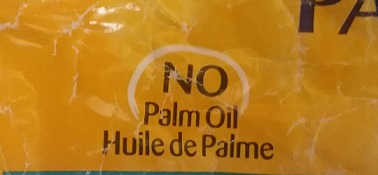
Labels like this are unfortunately rare

Do you want to share your progress on eliminating palm oil from you shopping list? Send me an email at info@choosesustainable.org