Welcome to ChooseSustainable.org where we explore ways of living sustainably.
To celebrate this year’s Earth Day I want to say a few words about a different approach to gardening, a gardening that is a way of healing ourselves and our Earth.
Our yard becomes a source of stress when we feel pressure to keep up with societal norms. In a stressful garden there is excessive mowing, there is a continuous rush to pick up every single straw, to remove every fallen leaves, to cut down immediately less than perfect plants. The garden is loaded with tons of chemicals to fertilize the lawn, remove weeds, kill grubs, kill weeds before they emerge, kill bugs, kill moles, kill opossums… see the long list of killing? In many cases these creatures get a death sentence for digging our perfect lawn, or for ruining our perfect roses. A stressful garden deprives countless living creatures of their lives, food and shelter, disrupts the food chain and contaminates the soil and the water with poison.
Gardening becomes healing when it is good for the Earth and therefore for us. I think it would be nice to make gardening not only about what we like, but about what is good for everybody, respecting the existence of other species even if their presence disrupts our idea of what should be a perfect landscape.
Here are some common yard “problems” and why they are really not problems at all.
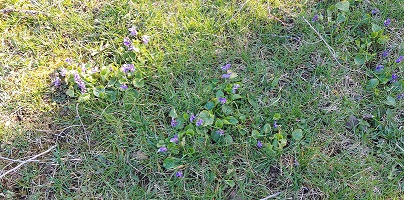
Violets on a lawn may appear unsightly but they are important host plants for the fritillary butterfly. Choose what is good for the Earth, choose not to kill them.
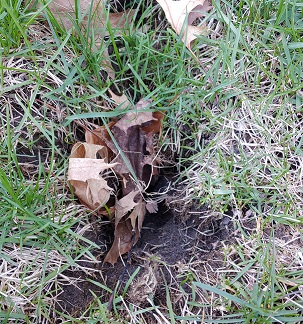
A small hole in the lawn may not be our ideal for a perfect landscape, but some creature with its meaning and role in the ecosystem is living there. Choose what is good for the Earth, choose not to kill it.
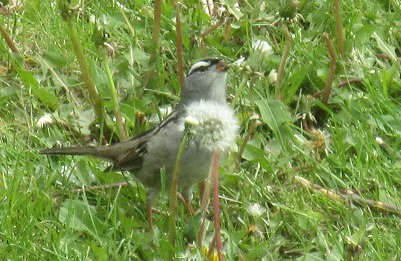
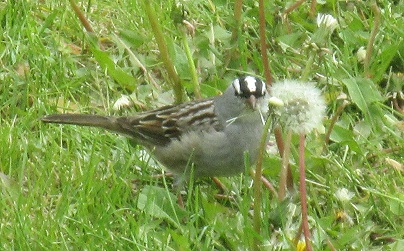
Dandelions and perfect lawns don’t go together, but bees and birds such as this white-crowned sparrow rely on them as early food source. Choose what is good for the Earth, choose not to kill them.
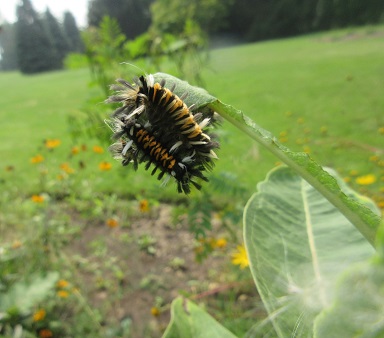
I know nobody likes to have their plants devoured by strange bugs, but several species may feed on the same plant. These moth caterpillars are also meant to feed on milkweed. Choose what is good for the Earth, choose not to kill them.
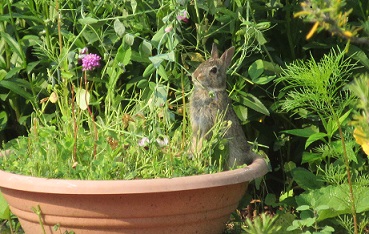
Some visitors may enjoy our attempt at planting annuals. They are hungry too!! Let them stay!
Next time we think of using herbicides or pesticides on our plants or lawn let’s ask ourselves: Is this really necessary? Am I just acquiescing to an unsustainable aesthetic canon? I hope we’ll think about this and place the spray bottle back on the shelf where it belongs.
The YouChoose App provides several links to resources to get you started with sustainable gardening. It also provides links to native plants in specific regions. You can download it from Google Play or through the link on the right. Please make sure to purchase native flowers from nurseries that don’t use neonicotinoids.
Would you like to talk about a native plant in your backyard? Please send me your post at info@choosesustainable.org
If you liked this post please share it!
 You Choose