Welcome to YouChoose, a blog where we explore ways of living sustainably. This week I would like to share some thoughts about food and meat consumption.
Meat consumption drives deforestation in two ways: 1. The forest is cleared to make room for cattle pastures and 2. The forest is replaced by large-scale soy plantations to be sold as food for cattle. Even in the USA almost half of the agricultural land is used to grow crop for cattle feeding. This has led to the destruction and near extinction of the great American Prairies and the entire ecosystem that depended on them, of which we’ll talk in another post.
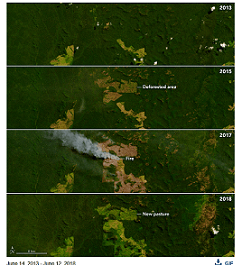
In the above image (https://earthobservatory.nasa.gov) the progressive deforestation of a large area for cattle pasture between 2013 and 2018 is captured in satellite images.
I think the German philosopher Ludwig Feuerbach (1804-1872) was right when he declared that “Man is what he eats.” Turning upside down Feuerbach’s Marxist materialism it seems that what we eat is at the core of our identity and it is a very difficult part of us to change. Perhaps for this reason advocating the reduction in consumption of meat and animal products to save the Earth is not a popular topic. What we eat is an essential element of our culture and of the way we perceive ourselves as a species and as part of social groups.
A long time ago I decided to stop eating meat. This decision was very personal, it had nothing to do with the environment or sustainability, it was more part of a spiritual path that helped me find my own place in the world. As a result I had to face an unexpected wave of hostility from my family. There was no family meeting in which I didn’t have to explain, defend, and justify myself. I noticed that people took this choice almost as a personal offense, an act of defiance, a refusal of cultural and social norms. However, even in my own culture, in the past, meat consumption was limited to special occasions. It has been only in recent years that meat has become part of the daily diet with bad consequences for animal welfare and for the environment.
For the last 23 years I have worked on eliminating meat entirely from my diet and on cutting back on animal products in general, including fish, eggs, milk, and cheese. Cumulatively animal products constitute now less than 3% of my diet and meat has been entirely absent for about 20 years. I am far from perfect, but it has been a continuous improvement. By substantially reducing the amount of animal products, I am also in the position to purchase products that are more sustainable, which sometime means more expensive.
Recently there has been more awareness of the environmental impact of meat consumption and a plant-based diet is becoming more acceptable, still meat consumption is on the rise. Today we know that reducing meat and animal products is one of the most important actions we can take to reduce and stop deforestation, pollution, and degradation of the environment.
I would like to invite everybody to gradually reduce meat and animal product consumption to a minimum. It is important not to set expectations too high, it is easy to quickly run out of food choices and give up. Gradually one can try new grains, legumes, roots, and vegetables. The possibilities are endless. One doesn’t have to become a perfect vegan overnight. It is more important to become conscious consumers and develop our own path to sustainability, even veganism doesn’t necessarily mean 100% sustainable.
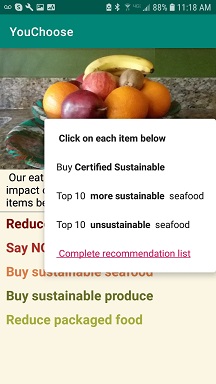
The YouChoose app provides several links and information on global food issues and lists of sustainable and unsustainable foods including fish and vegetables, hopefully the information is useful to get started.
Here are a few more suggestions to help getting started:
- Be firm in the resolve, changing food habits is not easy. Please don’t give up
- Set one reachable goal at a time. For example one meat-free day a week to start and progress from there
- Buy unknown vegetables, grains, legumes and look them up at home. You will be surprised of how many pleasant discoveries you will make
- Make a point to try one new grain/cereal (millet, barley, black rice, farro)
- Make a point to try one new legume (yellow peas, chick peas, green lentils, mung beans, kidney beans, brown lentils)
- Try different recipes for the same vegetable
- Cook ahead, sometime you can boil the legumes ahead and keep them ready in the refrigerator
In this blog there is a recipe section where I share meat-free recipes to help out. If you want to share your sustainable recipes to help others, I’ll be glad to post them in this blog.
Do you want to share your progress on eliminating meat from your diet? Send me an email at info@choosesustainable.org and I’ll add it to this blog.
 You Choose