Melanthium virginicum (Bunchflower)

Welcome to ChooseSustainable.org a blog about sustainable living. In this series of short posts I present a native plant to encourage everybody to abandon our traditional way of gardening (basically a continuous fight against nature) and engage in sustainable gardening practices that nurture the ecosystem, sustain wildlife and foster biodiversity.

In this post I present a rare flowering plant of ephemeral beauty, that will reward your patience with a few weeks of enchanting blooms: Melanthium virginicum (bunchflower).
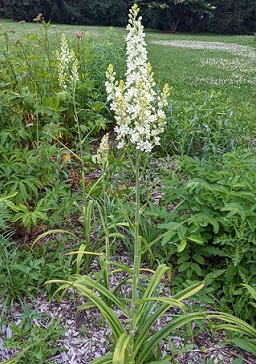
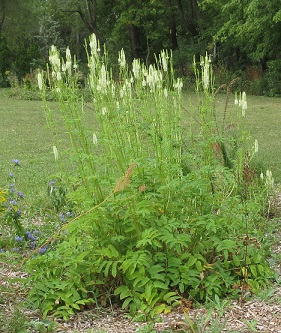
Bunchflower prefers rain gardens and moist conditions

Quick facts:

  • Zones:5-9
  • Bloom time: Summer (June-July)
  • Sun: Full, partial
  • Soil Moisture: Medium, Wet
  • Aggressive: No
  • Front yard: YES
  • Height: about 5 feet
  • Status: Endangered in Illinois and several other states
  • Maintenance: LOW
  • Wildlife value: Medium

Wildlife connection: This plant attracts many small insects, including small flies, and small beetles. The plant is toxic to mammals.

It is hard to imagine that something of such a beauty can be at risk of extinction, but in fact this plant went from being threatened to endangered in the past five years. Melanthium virginicum is a slow growing plant, it will require patience, and occasional discouragement but it will come through providing an exceptional addition to the garden.

I planted eight bare roots in early spring about seven years ago. I still remember watching the light green leaves sprout in spring to quickly wilt and disappear by end of summer. The next spring they came back, briefly and again became brown and disappeared. I thought the experiment had failed, but then I saw them coming back and becoming more visible and persistent year after year. It took about six years to get the first plant to bloom. This year almost all the plants bloomed in mid July!

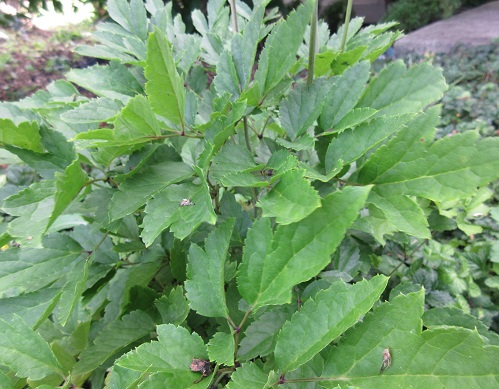
The plants develop with leaves at the base that look like those of lilies. Through the years the leaves become more abundant.
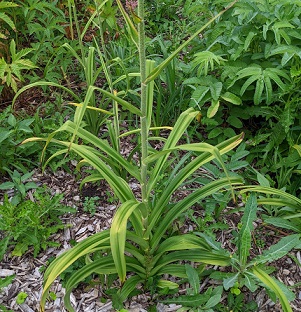
The leaves are at their best in early summer and become yellow in late summer

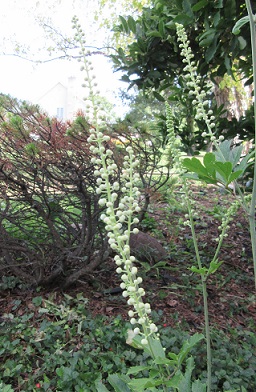
Flowers start out greenish early in the season and expand in summer with each plant developing one large bloom composed of small white flowers. Planting at least six or seven plants will provide a better effect than having just one.
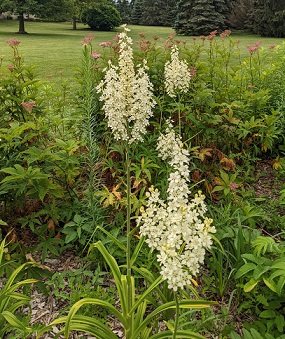
Planting six or seven plants provides a nice full bloom

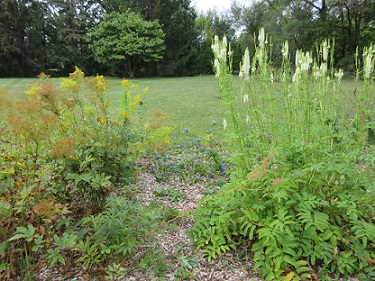
Melanthium virginicum loves to be in a rain garden or an area where water accumulates and quickly is absorbed in the ground. For this reason it goes very well with the Queen of the prairie (Filipendula rubra) another threatened wetland species that I’ll describe in a future post.
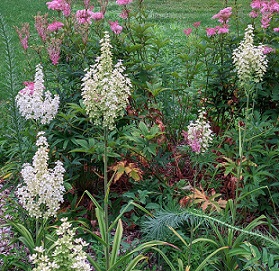
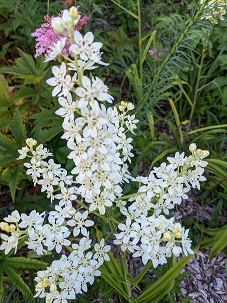
Bunchflower (in the foreground) and queen of the prairie (in the background) make a great white/pink mix of unusual blooms in early summer.

Although the bloom doesn’t last for too long, the plant still adds interest to the garden with its green seed pods that persist until early September.
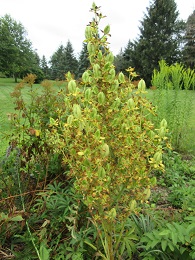
After bloom is over the plant still looks interesting.

If you are a patient gardener and have a section in your yard that you are considering for a rain garden Melanthium virginicum makes a fantastic addition together with the Queen of the prairie and, for example, some ornamental grasses that help water soak underground. You will also sustain biodiversity by planting a species that is on the brink of disappearing. You can’t go wrong!

Would you like to talk about a native plant in your backyard? Please send me your post at info@choosesustainable.org

If you liked this post please share it!
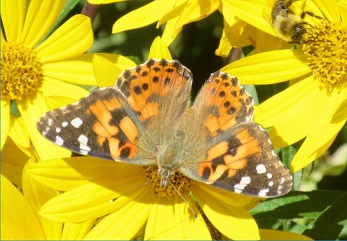
Top ten plants for pollinators

Welcome to ChooseSustainable.org a blog about sustainable living. Planting season is here! If you are thinking of starting a native garden you may be interested in 10 easy and guaranteed success blooming plants that have very high value for pollinators and birds. These plants do very well in the central and East US and they are all currently present in my backyard. Even if you have a small yard, or even a balcony, you can still do your part and recreate a small piece of prairie. I’ll feature them one by one in single posts, for now here is a quick reference sorted by bloom time.

Geranium maculatum (April-June)

Easy to grow from seeds, it forms a blooming ground cover from spring to early summer and maintains nice foliage until late fall. Important food source for early bees and pollinators. Common name: wild geranium.

Asclepias in many varieties (june-july)

I love this. It blooms around late June, flowers are extremely showy and fragrant. This is one of the most prized plants of my garden. Everything of this plant has value, from leaves to flowers to the pods that contain seeds. It is the host plant of the imperiled monarch butterfly and moths. Make sure to plant the varieties native to your region and to give it its own space, I noticed that it doesn’t like to be crowded. Common names of varieties include: Swamp milkweed, common milkweed, butterfly weed, showy milkweed, and more…

Echinaceas and Rudbeckia (july-October)

I include here many species of coneflowers including Ratibida pinnata and brown eyed susan. These are easy from seeds and have very high value for pollinators and birds that will feed on seeds through fall and winter. Different varieties bloom all the way to October. Host plant of several checkerspot butterflies and moths. Common names include: Purple coneflower, yellow coneflowers, black eyed susan, brown eyed susan.

Monarda fistulosa, didyma (july-august)

There is a reason why another name for this plant is “bee balm”. When it blooms in my yard it is surrounded by bumblebees and other pollinators from morning to evening. The leaves are very aromatic but be careful, it is quite exuberant, it may get out of hand! Host plant of several moths. Common names: bee balm, wild bergamot.

Eutrochium purpureum (july-august)

This plant is very attractive to bumblebees and butterflies. It takes a few years to establish and I noticed that it suffers in prolonged droughts. It is a host plant for several moths. Common name: Joe Pye Weed.

Silene regia (July-August)

Although this may not be the most common plant, I included it here because I noticed that it is one of the preferred foraging grounds for hummingbirds. Besides it is a red rarity among prairie flowers and it is listed as endangered in several states. It is very slow to establish and I have been trying to grow the population in my yard with mixed success, but it is definitely worth a try! Common name: Royal catchfly.

Liatris varieties (August – September)

With their purple spikes Liatris in many varieties attract a large variety of bees, butterflies and moths. The bloom lasts until early fall and it seems to me that the plant can be propagated through seeds quite easily. I have tried them this year for the first time, I’ll know more in a few months. The plant itself is very attractive, and is the host plant for several moths. I hope to post a better pick in a future post. Common names include: blazing stars, gay-feather.

Helianthus varieties (August-October)

There is no summer without sunflowers. Heliantus plants come in many varieties with beauty and boldness as their common factor. I have the variety Helianthus grosseserratus (sawtooth sunflower) that was chosen based on its high wildlife value and it was entirely grown from seeds. This native variety that I have requires some space, but there are better behaved native varieties. Common name: Sunflowers

asteraceae varieties (september-october)

The family includes many asters that in fall, when everything else is done blooming, keep bees and butterflies happy a little longer. Asters of the genus “symphotrichum” are used as host plants of 100 species of moths and butterflies. I grew my New England aster from seeds and small plants. They both did very well and they expanded considerably. In addition I have a few heath asters that came up on their own. Asters come in great varieties, some do well in sun, others in shade, the important thing is to let them thrive in your garden, birds will thank you too. Common names: New England aster, heath aster, Georgia aster, smooth aster and many many more. Just make sure that you plant the variety native to your area.

solidago varieties (september-october)

This is another extremely important fall plant for a large number of insects, including caterpillars. It provides food for migrating monarchs and winter seeds for birds. I planted the solidago speciosa, but I am planning to expand my population next year with more varieties. I do get a lot of Canadian goldenrod which I remove selectively, I leave some in specific location and remove what becomes overwhelming. Common name: Goldenrod in many varieties.

I hope this brief overview of top ten plants helped out. If you try any let me know how it goes.


The YouChoose App provides several links to resources to get you started with sustainable gardening. It also provides links to native plants in specific regions. You can download it from Google Play or through the link on the right. Please make sure to purchase native flowers from nurseries that don’t use neonicotinoids.

Would you like to talk about a native plant in your backyard? Please send me your post at info@choosesustainable.org

If you liked this post please share it!

A healing garden

Welcome to ChooseSustainable.org where we explore ways of living sustainably.

To celebrate this year’s Earth Day I want to say a few words about a different approach to gardening, a gardening that is a way of healing ourselves and our Earth.

Our yard becomes a source of stress when we feel pressure to keep up with societal norms. In a stressful garden there is excessive mowing, there is a continuous rush to pick up every single straw, to remove every fallen leaves, to cut down immediately less than perfect plants. The garden is loaded with tons of chemicals to fertilize the lawn, remove weeds, kill grubs, kill weeds before they emerge, kill bugs, kill moles, kill opossums… see the long list of killing? In many cases these creatures get a death sentence for digging our perfect lawn, or for ruining our perfect roses. A stressful garden deprives countless living creatures of their lives, food and shelter, disrupts the food chain and contaminates the soil and the water with poison.

Gardening becomes healing when it is good for the Earth and therefore for us. I think it would be nice to make gardening not only about what we like, but about what is good for everybody, respecting the existence of other species even if their presence disrupts our idea of what should be a perfect landscape.

Here are some common yard “problems” and why they are really not problems at all.

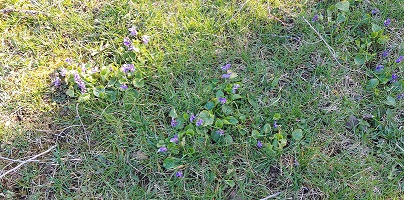
Violets on a lawn may appear unsightly but they are important host plants for the fritillary butterfly. Choose what is good for the Earth, choose not to kill them.

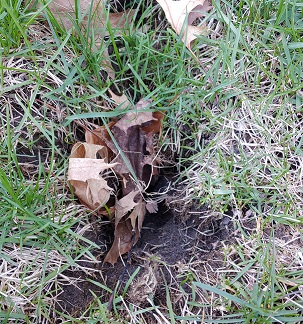
A small hole in the lawn may not be our ideal for a perfect landscape, but some creature with its meaning and role in the ecosystem is living there. Choose what is good for the Earth, choose not to kill it.

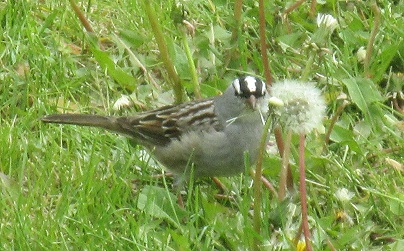
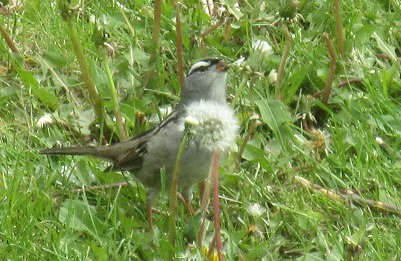
Dandelions and perfect lawns don’t go together, but bees and birds such as this white-crowned sparrow rely on them as early food source. Choose what is good for the Earth, choose not to kill them.

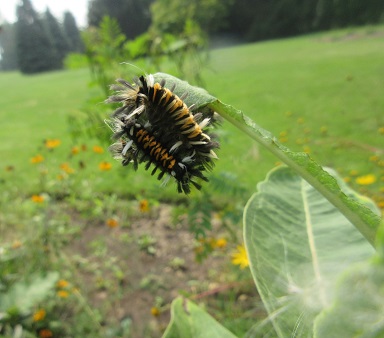
I know nobody likes to have their plants devoured by strange bugs, but several species may feed on the same plant. These moth caterpillars are also meant to feed on milkweed. Choose what is good for the Earth, choose not to kill them.

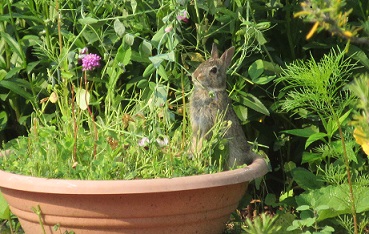
Some visitors may enjoy our attempt at planting annuals. They are hungry too!! Let them stay!

Next time we think of using herbicides or pesticides on our plants or lawn let’s ask ourselves: Is this really necessary? Am I just acquiescing to an unsustainable aesthetic canon? I hope we’ll think about this and place the spray bottle back on the shelf where it belongs.


The YouChoose App provides several links to resources to get you started with sustainable gardening. It also provides links to native plants in specific regions. You can download it from Google Play or through the link on the right. Please make sure to purchase native flowers from nurseries that don’t use neonicotinoids.

Would you like to talk about a native plant in your backyard? Please send me your post at info@choosesustainable.org

If you liked this post please share it!

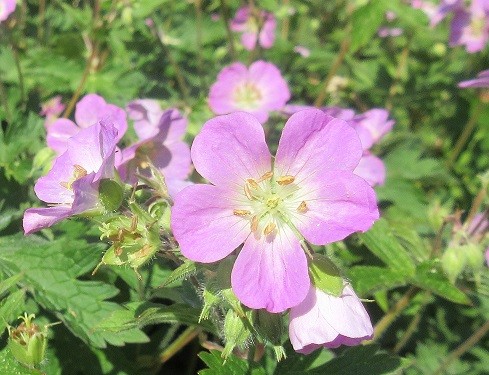
Geranium Maculatum (Wild geranium)

Welcome to ChooseSustainable.org a blog about individual climate action. In this series of short posts I present a native plant to encourage everybody to abandon our traditional way of gardening (basically a continuous fight against nature) and engage in sustainable gardening practices that nurture the ecosystem, sustain wildlife and foster biodiversity.

In this post I’ll talk about a spring perennial that is very easy to grow: Geranium Maculatum (Wild geranium).

Quick facts:

  • Zones:3-8
  • Bloom time: Spring (April-June)
  • Sun: Part shade to sun
  • Soil Moisture: Medium
  • Aggressive: Moderate
  • Front yard: YES
  • Height: 10”-12”
  • Status: OK
  • Maintenance: LOW
  • Wildlife value: High

Wildlife connection: The flowers attract many types of bees, bumblebees, flies, and butterflies. The leaves are also attractive to many insects that use them for their larvae. The caterpillars of several moths feed on the plant. The foliage and seeds provide food for small animals including chipmunks.

I just realized that is already time to start planning for spring planting. For this reason this week I’ll present this very easy plant that can be started from seeds. Don’t be fooled by the fact that the plant is adaptable and easy to grow. Like all early blooming flowers wild geranium is very important for bees and other insects during a time when there aren’t too many other flowers around.

Wild geranium forms a thick ground cover in early spring

You have probably seen this plant in wooded areas at some forest preserve, however it does quite well also in full sun. In the garden it spreads readily, forming a thick ground cover. The flowers last from May to June and the leaves persist through the summer and change color to a dark purple in fall. I let the plant spread freely because it is actually a great ground cover that doesn’t allow weeds to take over the mulched areas. It took me a while to realize this fact, but now I have decided to harness the power of fast spreading native ground covers into a weed control mechanism. I’ll talk more about this in a future post.

The nice thing about wild geranium is that after the bloom is over it tolerates the tall prairie plants around it and therefore can be planted in the same place as taller summer blooming plants.

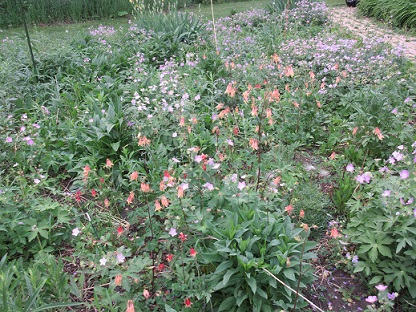
Wild geranium can be planted together with Columbine (Aquilegia Canadensis) that blooms at about the same time.

I started my geraniums from seeds but also planted a few small plants. Both methods were successful. Of course seeds allow to cover more but they take at least one extra season to fully develop. For this reason a mixed approach worked best for me. If you have the planting area ready, now is a good time to sow the seeds outside as soon as the snow has melted as they require about two months of cold to germinate.

The pink bloom of Geranium Maculatum lasts for more than a month

If you have an area in your yard where you have room for a ground cover, geranium maculatum is a great choice, especially if you are new to native gardening, I hope you will consider it, and please look for the full botanical name (geranium maculatum) before purchasing to avoid cultivars.


The YouChoose App provides several links to resources to get you started with sustainable gardening. It also provides links to native plants in specific regions. You can download it from Google Play or through the link on the right. Please make sure to purchase native flowers from nurseries that don’t use neonicotinoids.

Would you like to talk about a native plant in your backyard? Please send me your post at info@choosesustainable.org

If you liked this post please share it!
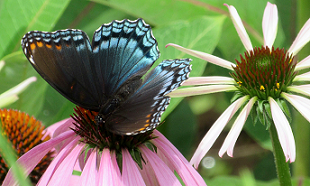
Birds of winter

Welcome to ChooseSustainable.org where we discuss sustainable choices. In this post I would like to talk about the winter garden.

One of the wonderful rewards of switching to native and sustainable gardens is that there are no dead seasons. In the traditional suburban gardening the fall season is the time to tidy up the yard and leave everything cut and clean, waiting for spring. A lot of effort goes into vacuuming, blowing, cutting, and shredding. All this cleaning up however does nothing but deprive wildlife of the food and shelter needed to survive the winter.

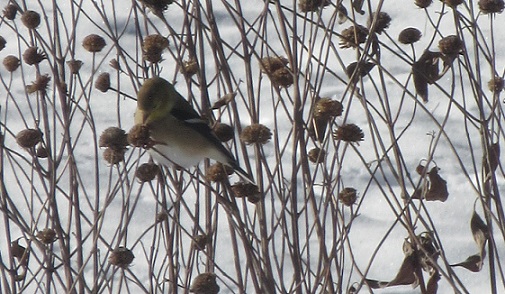
A gold finch enjoys eating brown-eyed Susan’s seeds in winter

In a sustainable garden the fall season is the time when Nature provides everybody with the means to survive the winter. The fallen leaves are used by larvae and small insects to hibernate, the flowers produce abundant seeds that birds can use as winter food, dead trees and rotting wood provide shelter from the cold for insects and small mammals, dry twigs provide winter food for herbivores that don’t hibernate. Coneflowers, sunflowers, and goldenrods produce much appreciated seeds when left untouched until spring.

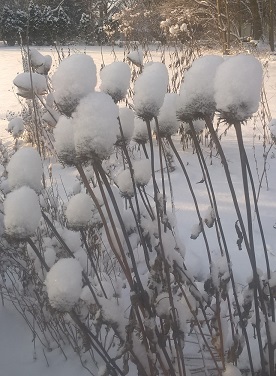
Besides providing for wildlife, untouched grasses and forbs add beauty and character to the winter garden.

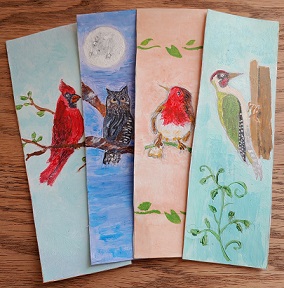
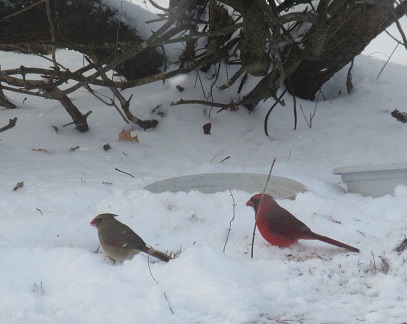
Chickadees, dark eye juncos, gold finches, a pair of red cardinals that I think have been together for a few years, woodpeckers, and of course, owls inhabit my backyard in winter. Now that I am mostly working from home I love watching them come and go. Actually I have never seen the owl, but I hear it at night. They are so attractive that, in spite of the fact that I never held a brush in my hand until now, I couldn’t resist painting them in small pieces of scrap paper and make bookmarks from up-cycled pizza boxes to give to family as gifts. If you are thinking of starting a wildlife garden I’ll be happy to send you a hand-painted bookmark as a thank you gift. You can check them out here.

Sometime I hear that we shouldn’t feed birds so they don’t become dependent on us. In my opinion this would be true if we had left their original habitat intact. Certainly the best thing is to leave native plants and grasses uncut until at least the end of February and also provide additional seeds during the harshest months from December to March. I do my part and place the seeds under a shrub or a tree with tall grasses around to provide shelter from predators.

Providing water during the winter months is challenging. Usually the bird bath can stay outside until the end of November, but it needs to come inside after that. From December to March a black plastic saucer can be used for water, however in the absence of a water heater the water freezes quickly. One of the benefits of working from home is that in the warmest hour I can remove the ice and replace it with slightly warm water. In typical Illinois winter temperatures of 15 to 25 F (-10 to -5 C) this provides birds with a few hours of fresh water every day.

If you are considering native and sustainable gardening I hope this post was useful to see how planting native grasses and trees, avoiding pesticides, leaving grasses, twigs and seed heads in the yard through the winter, helps wildlife survive the cold months. Who knows? It may even inspire you to start painting!

The YouChoose App provides several links to resources to get you started with sustainable gardening. It also provides links to native plants in specific regions. You can download it from Google Play or through the link on the right.

If you liked this post please share it!

Cimicifuga racemosa (Black Cohosh)

Welcome to ChooseSustainable.org where we explore ways of living sustainably. In this series of short posts I present a native plant to encourage everybody to abandon our traditional way of gardening (basically a continuous fight against nature) and engage in sustainable gardening practices that nurture the ecosystem, sustain wildlife and foster biodiversity.

In this post I’ll talk about a mystical flowering plant of striking beauty that I recently planted in my garden: Cimicifuga Racemosa (Black cohosh).

Black cohosh grows in rich soil possibly in shade or part shade

Quick facts:

  • Zones:4-8
  • Bloom time: Summer (June-September)
  • Sun: Shade to part shade
  • Soil Moisture: Medium, Wet
  • Aggressive: No
  • Front yard: YES
  • Height: 5-7 feet
  • Status: At risk in most native areas. Rare and endangered in Illinois and Massachusetts
  • Maintenance: LOW
  • Wildlife value: Medium-High

Wildlife connection: This plant attracts many small insects, including small flies, bees, and bumblebees. It is also the host plant for the Appalachian Azure butterfly caterpillars.

Sometime we feel it is hard to grow anything of value in the shaded areas of our yard. In the front of my house there is just such a space where sunshine is limited. The traditional suburban gardening solution for those “unwanted” areas is to plant hostas. I used to think along those lines and that is why it took me so long to come up with a planting strategy for the front. I now have learned that there are magnificent native plants for shade and regret not having more shaded areas. This past spring while looking for shade loving ideas I came across this marvelous perennial.

Although black cohosh is not common here and the region where I live is at the western far end of the native range, I couldn’t resist planting one next to the front door. In Illinois black cohosh is rare and listed as endangered. The plant is more common on the Appalachian Mountains where it is harvested for its medicinal properties and generally classified as at risk. Sometime I look at it and imagine how beautiful this plant must look in its native environment.

Because of its slow growth it is not recommended to start from seeds, therefore I planted a mid size plant (about 1 foot) in spring. Black cohosh loves a rich soil typical of the deciduous woodlands of which is native, it also needs space because, if everything goes well, should reach 6-7 feet in height. So far it seems happy where I planted it. The plant develops with a base of broad leaves of an intense green.

The leaves of black cohosh are large and of an intense green. They form a large base at the bottom of the plant.

The leaves cover the base of the plant giving it a nice full appearance. From the base spikes of white small flowers stand up. The small flowers open up to create a feather like appearance of the spikes. The plant bloomed in summer and it grew quickly about one foot. The full bloom started at the beginning of August and it lasted until September.

Early bloom of young black cohosh

If you have a shaded area in your yard that you wish to fill up with a spectacular and unusual plant black cohosh is an option. A few things to keep in mind are the following:

  • Make sure you have room. If everything goes well the plant should grow to a large size.
  • Please make sure you purchase from a reputable source. The population of this plant is in rapid decline everywhere and the species is generally considered at risk. Major threats come from excessive harvesting for its medicinal use and loss of habitat due to deforestation and development. I purchased mine from a conservation society which has the conservation of species at heart and doesn’t harvest plants from the wild.

Because this is one of the latest additions to my garden I’ll report more here once the plant grows to its final size, hopefully it’ll be good news.

The YouChoose App provides several links to resources to get you started with sustainable gardening. It also provides links to native plants in specific regions. You can download it from Google Play or through the link on the right. Please make sure to purchase native flowers from nurseries that don’t use neonicotinoids and look out for the full botanical name to avoid cultivars.

Would you like to talk about a native plant in your backyard? Please send me your post at info@choosesustainable.org

If you liked this post please share it!
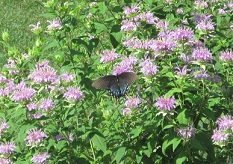
This gold is not for fools

Welcome to YouChoose, a blog where we explore ways of living sustainably. This week I would like to talk about one of my preferred times of the years: the time when leaves fall.

In winter a whole ecosystem lives beneath a carpet of leaves

There is something magic about standing under a shower of gold leaflets on a fall day. It always makes me think of enchanted forests where trees with precious glittering leaves grow. What? You may say, fallen leaves mean spending my afternoon collecting them, bagging them and trashing them, or spending money for a service.

If that is how you feel about leaves, I hope you will change your mind after reading this post. Leaves are a precious gift that our Earth gives us in fall and takes back in spring. I used to do exactly that, collect them and dispose them at the curb side as unwanted “garden waste”. No more. Here is what I learned about leaves and why it is so important to keep and reuse them.

Leaves are an essential component of the ecosystem. They improve the soil, keep the moisture, and provide essential living quarters for insects, amphibians, turtles and others to survive the harsh winter. Have you ever wondered where the fireflies go during the cold months? Their larvae overwinter in the fallen leaves and rotting wood. Keeping the leaves in your yard will ensure a wonderful display of fireflies in summer. I have seen that in my own backyard. Other species that rely on fallen leaves are several butterflies and almost all moths. Many non-migratory birds search for food in the fallen leaves during winter and rely on the emerging insects in spring. Removing and trashing leaves is an unsustainable practice that does great harm to biodiversity. Do you need more reasons to keep the leaves in your yard? Here are a few more.

It will save you money

This is a lose-lose situation. We pay somebody to come and pick up our leaves in fall and then in spring we pay somebody to bring them back into our yard in the shape of mulch. All we have to do is to utilize our leaves to achieve the same results for free. I started using my backyard leaves 2 years ago and I will discuss in future posts what worked and what didn’t work.

If you are really worried about your lawn suffering under the leaves you can select an area of your yard where you can collect all your leaves and let them stay there until spring. By then they will be ready to be distributed around trees or on planted areas.

You can keep a small portion of the yard to collect leaves
It will save you work

If you have a wooded area in your yard you can leave the fallen leaves where they are. No need to do any work. They will provide beautiful colors and habitat under the snow cover. On the lawn I like to spend one hour on a beautiful fall afternoon raking leaves, however a blower will also do if you can stand the noise. I usually collect a many as I can and move them, but also leave some where they are. Some suggest to shred the leaves to make them break down faster, however in my opinion this should really be the last option. Shredding the leaves will likely destroy the caterpillars and other bugs sheltering in them.

I hope this fall you will decide to stop mowing, blowing, shredding, bagging, hauling, and just enjoy all the treasures that our Earth provides for us.

The YouChoose App provides several great links to resources on native plants and sustainable gardening. If you have an android phone you can download the app from Google Play or using the link on the right.

Do you want to share your experience? Send me an email at info@choosesustainable.org

If you liked this post please share it!

Sanguisorba Canadensis (Canadian Burnet)

Welcome to ChooseSustainable.org where we explore ways of living sustainably. In this series of short posts I present a native plant to encourage everybody to abandon our traditional way of gardening (basically a continuous fight against nature) and engage in sustainable gardening practices that nurture the ecosystem, sustain wildlife and foster biodiversity.

This past week the US Fish and Wildlife Service declared 22 species (including several birds) extinct. Among the reasons for extinction loss of habitat is the most important. Essentially we cut down the forests that sustained some of these species. Loss of habitat however is also due to agriculture and suburban development. The sad news reminded me of the importance to restore native habitat in our backyard. It is too late to save the species that have disappeared, but is not too late to save those that are still surviving. In this post I’ll talk about a native plant that is fighting for survival and that could disappear before most of us even know of its existence: Sanguisorba Canadensis (Canadian Burnet).

Canadian burnet is listed as threatened or endangered in several states

Quick facts:

  • Zones:4-8
  • Bloom time: Spring (Aug-Oct)
  • Sun: Sunny to part sunny
  • Soil Moisture: Medium wet, wet
  • Aggressive: NO
  • Front yard: YES but it grows tall
  • Height: 5’
  • Status: Threatened, Rare, or Endangered in most of its original habitat including Illinois
  • Maintenance: NONE
  • Wildlife value: Medium

Wildlife connection: This plant is one of the last fall blooming plants. It attracts bees, bumblebees and small insects when the other fall plants are done. Besides its wildlife value the plant has value for biodiversity.

One section of my backyard presents a slope that, being of course covered with lawn, caused storm water to runoff and accumulate at the bottom, creating a flooded area with standing water that lasted for few days after heavy rain. For this reason I decided to create a planting area where the water accumulated. One of the plants I chose for this area was the Canadian Burnet. I planted three bare roots and watched them grow into three marvelous plants in about 3-4 seasons.

The plants grew quite large, more than I expected, reaching a height of about 5′, they emerge in early spring with a nice foliage and fully develop by summer.

At the end of August the plant is ready to bloom

Around the end of August the flowers are ready to bloom. Full bloom is in September and lasts until mid October if the weather is favorable. The leaves are quite large and the flowers have a feather-like appearance.

A leaf of the Canadian burnet

The plant is happy in medium wet soil, however, once established, it can sustain long droughts. If you have a section of the yard that gets good rainwater it is a good place for this plant. The plant is beautiful, however if it rains a lot it can fall over due its large size and it may be necessary to provide support to keep it up.

The white feather-like appearance of the flower. In early fall the flower attracts the last bees and bumblebees looking for nectar.

Given its size and unusual appearance, the plant can be used as a focal point for the fall garden. It doesn’t fail to catch the attention. The white bloom goes very well with the purple and yellow colors that dominate the season.

The Canadian burnet goes very well with goldenrod, asters and other late blooming plants.

In conclusion, if you live in the native range of the Canadian burnet and you have room for it, you should consider it as a fantastic addition to your backyard.

Please make sure to purchase native flowers from nurseries that don’t use neonicotinoids and look out for the full botanical name to avoid cultivars.

The YouChoose App provides several links to resources to get you started with sustainable gardening. It also provides links to native plants in specific regions. You can download it from Google Play or through the link on the right. Would you like to talk about a native plant in your backyard? Please send me your post at info@choosesustainable.org

If you liked this post please share it!

Hummingbirds!

Welcome to ChooseSustainable.org where we explore ways of living sustainably. In this post I would like to talk about hummingbirds and how native and sustainable gardening is important to ensure their well being. This is true not only of hummingbirds, but of countless species that coexist (or try to) with us.

Sometime, when we take simple decisions such as getting rid of bugs, spiders, or dandelions in our yard we don’t consider the far reaching consequences of our actions. Most of the time things that we consider trash or nuisances are essential for the survival of other species. When we think of hummingbirds we think of feeders, but our yard can provide much more than that. The good news is that what they really need comes at no cost to us, it is already there, we just need to leave it where it is.

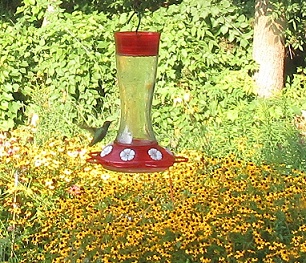
Every spring I look at the hummingbird migration map and around the beginning of April put out a feeder hoping that a few of them will take notice and stop in my backyard. The idea is to offer them plenty of reasons to stay through the summer and fall, so let’s see what hummingbirds need to be happy in our backyards.

Food and water

Contrary to common belief the main part of a hummingbird diet is not made of nectar, but of insects. Hummingbirds are voracious eaters of all kind of small insects, from spiders and small flies to aphids and 80% of their diet is made up of them. Nectar is important especially in early spring when the availability of insects is still limited. If we use pesticides to get rid of spiders, ants, or even mosquitoes in the yard we deprive hummingbirds of their main source of food and, even worse, we may poison them.

The best thing is to provide them with nectar-rich flowers and insect attracting plants from spring to fall. A shallow bird bath can provide water access. From what I see in my backyard, hummingbirds like to go to a variety of plants. Here are some plants that provide nectar and/or insects, these are mostly for the Midwest, please check native plants in your area:

Spring: Aquilegia Canadensis (columbine), Geranium Maculatum (wild geranium), Penstemon digitalis (foxglove penstemon), Diervilla Lonicera (dwarf honeysuckle)

Summer: Lobelia Cardinalis (cardinal flower), Silene Regia (royal catchfly), Monarda Fistulosa (wild bergamot or Monarda Didyma if you are on the East Coast), any native Liatris (for example Liatris Spicata), native Hibiscus if you are in the native range.

  • Fall: Chelone Glabra (turtlehead), Lobelia Siphilitica (blue lobelia), any of the goldenrod (for example Solidago Speciosa).
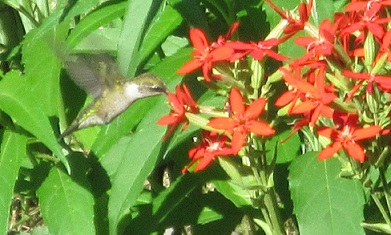
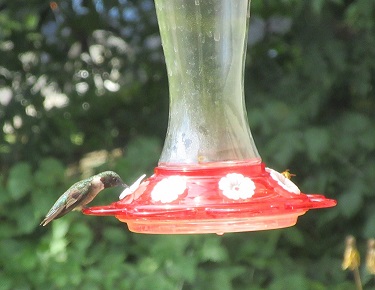
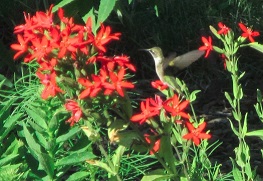
A hummingbird visits the Royal Catchfly (Silene Regia) in summer
Shelter

Hummingbirds are not exempt from predators. For this reason a habitat rich with tall grasses, tall prairie flowers, and shrubs near the feeder provides a better way for the hummingbird to avoid hunters.

Tall grasses, shrubs, and trees offer nearby shelter to the little hummingbird
Nesting

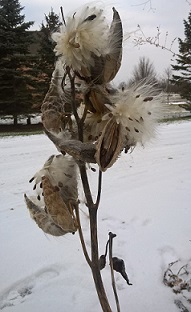
Hummingbirds use spiderwebs and possibly fluffy material to build their nest. The fluffy material is provided for example by dandelion and milkweed. If you eliminate spiders from the backyard you eliminate essential elements for the survival of hummingbirds. Similarly leaving an untidy backyard over the winter with grasses and twigs and possibly dandelions in spring will provide material for nest building. Additionally, tall trees provide a place where to position the nest.

The fluffy cotton-like material produced by milkweed is used for nests.
Feeder

In addition to to a variety of native plants a feeder is a good way to provide easy access to nectar and to attract hummingbirds near your window where you can see them often. I love watching them come and go and I know that, as I observe them, they observe me. They observe me when I go to replenish the nectar and they come to look inside the window when I am in the kitchen.

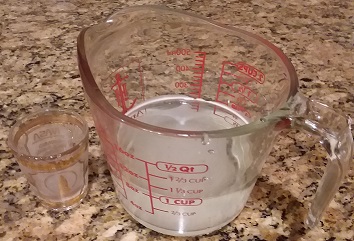
Preparing nectar is quite simple: 1 part of sugar to 4 parts of water is enough. I warm up the water and dissolve the sugar until the solution is clear.

One small glass of sugar and 4 small glasses of water make about 1 cup of nectar

Because the sugary solution can be outside only for 2-3 days before it becomes old and dirty I put out only what is necessary for a few days in order to avoid wasting sugar. Every 2-3 days I rinse the feeder and replenish the nectar. Approximately once a week I empty the feeder entirely and wash it well to eliminate sugar residue. Keeping the feeder clean will also reduce ants that can sometime become a nuisance.

Insects such as wasps and ants will use the feeder.

If you are considering native and sustainable gardening I hope this post was useful to see how planting native grasses and trees, avoiding pesticides, leaving grasses, twigs and seed heads in the yard through the winter, helps hummingbirds find a welcoming backyard in spring.

The YouChoose App provides several links to resources to get you started with sustainable gardening. It also provides links to native plants in specific regions. You can download it from Google Play or through the link on the right.

If you liked this post please share it!
Identification and removal of invasive plants

Welcome to YouChoose, a blog about individual climate action. This week I would like to talk about invasive plants and how to remove them from our backyards.

In a previous post we reviewed the reasons why it is important to remove invasive plants from our backyard. Here we’ll review removal techniques. Again we’ll focus on buckthorn, honeysuckle, and garlic mustard.

These removal techniques worked for me, keeping in mind that I had a very bad infestation of a large area.  Removing invasive plants is not an easy task, it is physically tiring, frustrating, and it requires patience. Additionally it is never finished, because, until the unwanted persist in the area, new ones will always appear. However with time the task becomes routine maintenance. Winter, early spring and late fall are the best times to do this job.

Garlic mustard (alliaria petiolata) removal techniques.

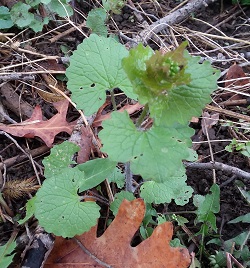
Garlic mustard is probably the easiest to remove. I went from having a large infestation to almost nothing very quickly. The fact that it has a two-year lifecycle works to our advantage because removing the plants before they bloom helps to reduce the population quickly. I was able to remove by pulling. For very large areas spraying with a herbicide may be necessary, however, for backyard-size areas, pulling should be a preferred technique. The population went down in about two seasons. Now I survey the area in spring and remove what I see coming up. Because garlic mustard self-seeds abundantly it is important to dispose of the pulled plants if they have flowers.

A small garlic mustard plant can be removed before it blooms

Buckthorn (Rhamnus cathartica) removal techniques.

Warning: As the name suggests buckthorn trees have very long and sharp spines. When working with developed plants it is important to use gloves and eye protection.

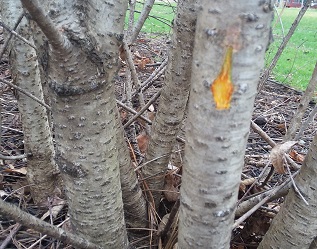
I had a large buckthorn infestation in one section of the yard. Working in winter or very early spring helps because leafless branches are easier to handle. Buckthorn can be recognized in winter by shaving off a small amount of the tree bark to expose what is immediately under. Buckthorn is of a very bright orange color.

Buckthorn has a bright orange color right under the tree bark

Smaller plants (up to 1.5 inches in diameter) can be easily removed by eradicating them with a digging shovel. I was able to remove many younger plants this way. It is a very labor-intensive task so it can be done little by little.

Here are small plants removed by digging. It took me about 1 hour for this amount.

Medium plants (2-3 inch in diameter) were removed with a small chainsaw that even I could handle. For the bigger plants I had to call the help of a professional tree service.

Whether you or a professional do the cutting part, after the tree is cut it is necessary to brush the stump with herbicide such as 19% Glyphosate. This will prevent regrowth.  Warning: 19% Glyphosate is found in commonly used Roundup. Despite their extensive availability herbicides should be used with extreme care and should go only on the interested area. Do not spray it as it increases the probability of inhaling it. You can use a brush to cover the stump.

Cutting the adult buckthorn tree is only the beginning of the battle. Buckthorn trees produce thousands of seeds that will generate small new plants for a few seasons after. It is therefore important to monitor the area and continuously remove the young plants. This is an easier task, monitoring the site a few times in a year will be enough to keep up with the regrowth.

Honeysuckle (Lonicera family) removal techniques

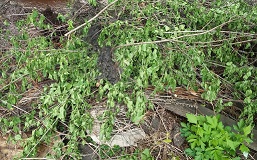
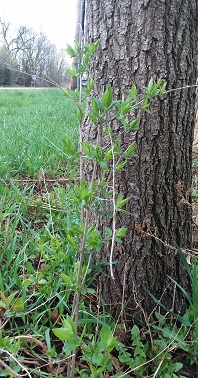
Once the buckthorn was gone the honeysuckle became more aggressive and was the second target of my battle against invasive plants. I was able to remove the younger plants with a digging shovel. However, the infestation was very bad, and it took two years of spring and summer working to achieve results. The few large plants were removed by a professional service, once the larger plants were cut it was necessary to brush the stump with 19% Glyphosate to prevent regrowth. New growths are now uprooted periodically as they emerge. Early spring and late fall are good months for honeysuckle removal as the plants are easily identifiable.

This small honeysuckle is easily removed by uprooting it

Once you have removed these invasive species from your yard, you can help our Earth by replacing them with native species that provide food and shelter to many creatures.

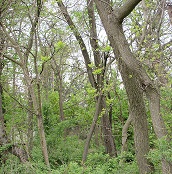
The buckthorn-free wooded area
Here is a list of alternatives to buckthorn
  • Dogwood (Cornus rugosa, Cornus alterifolia)
  • Serviceberry (Amelancher arborea, Amelanchier laevis)
  • Elderberry (Sambucus Canadensis)
  • Nannyberry (Viburnum lentago)
  • Chokeberry (Aronia melanocarpia)
  • Spice Bush (Lindera Benzoin)
  • Sumac (Rhus Glabra, Rhus Aromatica and similar)

The YouChoose App provides several great links to resources on native plants. If you have an android phone you can download the app from Google Play using the link on the right.

Do you want to share your experience? Send me an email at info@choosesustainable.org