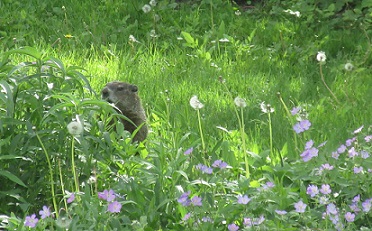
Meet my groundhog neighbor

Welcome to ChooseSustainable.org a blog about individual climate action and sustainable choices. This week I wanted to seize on this groundhog day celebration to introduce you to my gentle, albeit hungry, resident groundhog.

A nice article on these extremely shy animals can be found at this Lake County forest preserve page: https://lakecountynature.com/2020/02/01/get-to-know-groundhogs/

Plan to start a native garden to support local wildlife and get a thank you hand-painted bookmark! See what’s available here.

Every spring I hope to catch a sight of my resident groundhog and in a few months you may see one too, a large beaver-like guest feeding in your yard. They come out at the end of April to feast on dandelions and emerging plants. Some years I don’t see them, some years I have had two at the same time.
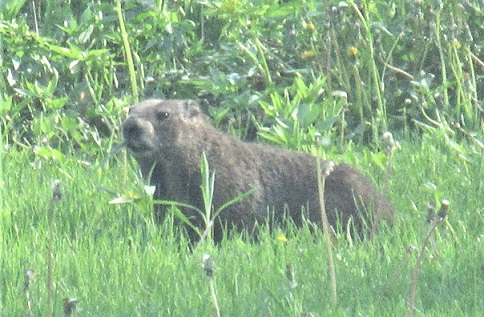
Groundhog feeding on dandelions

Groundhogs are among the many inhabitants of our land who are thankful for the small twigs and dry leaves left on the ground from the previous winter, one more reason not to obsess with fall cleaning.

A groundhog collects twigs and dry leaves in early spring

As many of you probably know, groundhogs are large rodents, true hibernators that emerge in spring and again hibernate in fall. They dig large underground chambers that can be also used by other animals once abandoned. To my amazement, for all their weight, they are extremely fast and skilled tree climbers.

This is the entrance of the groundhog’s burrow in my yard. It is located in a quiet wooded area

When they emerge from hibernation they are very hungry and will eat whatever green they find around. My resident groundhog is very fond of golden alexander and other native plants, but it also happily eats dandelions.
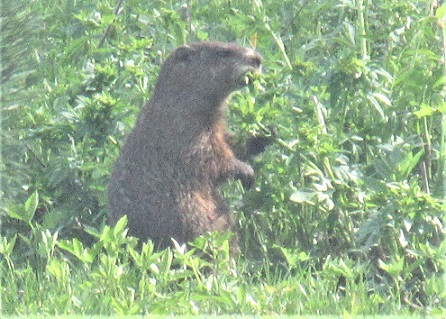
Golden alexander is very much appreciated

Groundhogs are often regarded as ‘pests’ because they might eat our precious garden plants and occasionally we hear of disturbing events regarding homeowners poisoning groundhogs, chipmunks, and beavers in their backyards. I can understand that voracious eaters can create problems for farmers, however for us suburban dwellers the ‘damage’ they may cause is minimal. ‘Our‘ property was theirs before we arrived and they only eat to survive, not to cause damage on purpose. The groundhog in my yard eats voraciously in early spring, but already in summer its activity subsides to nothing. When we say ‘I love wildlife but just not in my yard‘, we need to remember that as we expand the suburban landscape, we chip away more and more land. What is not our yard becomes somebody else’s yard. We need to abandon the absurd aesthetic impositions of traditional suburban landscape and make our backyard friendly to wildlife so that our arrival doesn’t dislodge other inhabitants.

This blog is about reminding us that we are all guests on this Earth and our lives are better when guided by kindness and compassion towards all life. I encourage you to welcome groundhogs to your backyard, they have their place in the ecosystem. Plant in abundance so that plants can serve their true purpose which is to feed and shelter the local wildlife. If really you can’t tolerate having a groundhog in your backyard, please try to humanely encourage it to move. Here is a link to the Humane Society website with some tips on how to humanely dislodge a groundhog.

https://www.humanesociety.org/resources/what-do-about-woodchucks
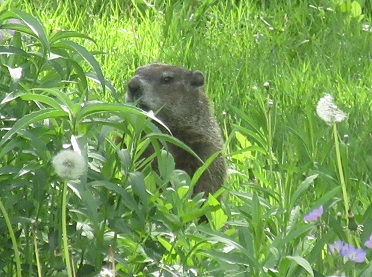
Thank you for letting me live in your backyard. I always bring the good news that spring has arrived at last!!

Happy groundhog day!

Would you like to talk about wildlife in your backyard? Please send me your post at info@choosesustainable.org

If you liked this post please share it!
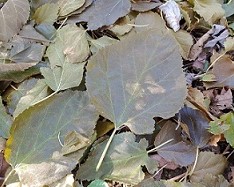
This gold is not for fools

Welcome to YouChoose, a blog where we explore ways of living sustainably. This week I would like to talk about one of my preferred times of the years: the time when leaves fall.

In winter a whole ecosystem lives beneath a carpet of leaves

There is something magic about standing under a shower of gold leaflets on a fall day. It always makes me think of enchanted forests where trees with precious glittering leaves grow. What? You may say, fallen leaves mean spending my afternoon collecting them, bagging them and trashing them, or spending money for a service.

If that is how you feel about leaves, I hope you will change your mind after reading this post. Leaves are a precious gift that our Earth gives us in fall and takes back in spring. I used to do exactly that, collect them and dispose them at the curb side as unwanted “garden waste”. No more. Here is what I learned about leaves and why it is so important to keep and reuse them.

Leaves are an essential component of the ecosystem. They improve the soil, keep the moisture, and provide essential living quarters for insects, amphibians, turtles and others to survive the harsh winter. Have you ever wondered where the fireflies go during the cold months? Their larvae overwinter in the fallen leaves and rotting wood. Keeping the leaves in your yard will ensure a wonderful display of fireflies in summer. I have seen that in my own backyard. Other species that rely on fallen leaves are several butterflies and almost all moths. Many non-migratory birds search for food in the fallen leaves during winter and rely on the emerging insects in spring. Removing and trashing leaves is an unsustainable practice that does great harm to biodiversity. Do you need more reasons to keep the leaves in your yard? Here are a few more.

It will save you money

This is a lose-lose situation. We pay somebody to come and pick up our leaves in fall and then in spring we pay somebody to bring them back into our yard in the shape of mulch. All we have to do is to utilize our leaves to achieve the same results for free. I started using my backyard leaves 2 years ago and I will discuss in future posts what worked and what didn’t work.

If you are really worried about your lawn suffering under the leaves you can select an area of your yard where you can collect all your leaves and let them stay there until spring. By then they will be ready to be distributed around trees or on planted areas.

You can keep a small portion of the yard to collect leaves
It will save you work

If you have a wooded area in your yard you can leave the fallen leaves where they are. No need to do any work. They will provide beautiful colors and habitat under the snow cover. On the lawn I like to spend one hour on a beautiful fall afternoon raking leaves, however a blower will also do if you can stand the noise. I usually collect a many as I can and move them, but also leave some where they are. Some suggest to shred the leaves to make them break down faster, however in my opinion this should really be the last option. Shredding the leaves will likely destroy the caterpillars and other bugs sheltering in them.

I hope this fall you will decide to stop mowing, blowing, shredding, bagging, hauling, and just enjoy all the treasures that our Earth provides for us.

The YouChoose App provides several great links to resources on native plants and sustainable gardening. If you have an android phone you can download the app from Google Play or using the link on the right.

Do you want to share your experience? Send me an email at info@choosesustainable.org

If you liked this post please share it!
Identification and removal of invasive plants

Welcome to YouChoose, a blog about individual climate action. This week I would like to talk about invasive plants and how to remove them from our backyards.

In a previous post we reviewed the reasons why it is important to remove invasive plants from our backyard. Here we’ll review removal techniques. Again we’ll focus on buckthorn, honeysuckle, and garlic mustard.

These removal techniques worked for me, keeping in mind that I had a very bad infestation of a large area.  Removing invasive plants is not an easy task, it is physically tiring, frustrating, and it requires patience. Additionally it is never finished, because, until the unwanted persist in the area, new ones will always appear. However with time the task becomes routine maintenance. Winter, early spring and late fall are the best times to do this job.

Garlic mustard (alliaria petiolata) removal techniques.

Garlic mustard is probably the easiest to remove. I went from having a large infestation to almost nothing very quickly. The fact that it has a two-year lifecycle works to our advantage because removing the plants before they bloom helps to reduce the population quickly. I was able to remove by pulling. For very large areas spraying with a herbicide may be necessary, however, for backyard-size areas, pulling should be a preferred technique. The population went down in about two seasons. Now I survey the area in spring and remove what I see coming up. Because garlic mustard self-seeds abundantly it is important to dispose of the pulled plants if they have flowers.

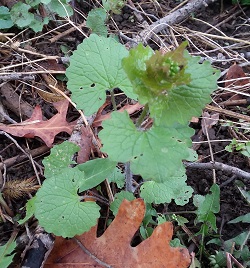
A small garlic mustard plant can be removed before it blooms

Buckthorn (Rhamnus cathartica) removal techniques.

Warning: As the name suggests buckthorn trees have very long and sharp spines. When working with developed plants it is important to use gloves and eye protection.

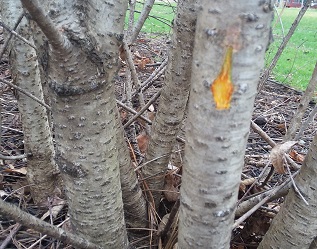
I had a large buckthorn infestation in one section of the yard. Working in winter or very early spring helps because leafless branches are easier to handle. Buckthorn can be recognized in winter by shaving off a small amount of the tree bark to expose what is immediately under. Buckthorn is of a very bright orange color.

Buckthorn has a bright orange color right under the tree bark

Smaller plants (up to 1.5 inches in diameter) can be easily removed by eradicating them with a digging shovel. I was able to remove many younger plants this way. It is a very labor-intensive task so it can be done little by little.

Here are small plants removed by digging. It took me about 1 hour for this amount.

Medium plants (2-3 inch in diameter) were removed with a small chainsaw that even I could handle. For the bigger plants I had to call the help of a professional tree service.

Whether you or a professional do the cutting part, after the tree is cut it is necessary to brush the stump with herbicide such as 19% Glyphosate. This will prevent regrowth.  Warning: 19% Glyphosate is found in commonly used Roundup. Despite their extensive availability herbicides should be used with extreme care and should go only on the interested area. Do not spray it as it increases the probability of inhaling it. You can use a brush to cover the stump.

Cutting the adult buckthorn tree is only the beginning of the battle. Buckthorn trees produce thousands of seeds that will generate small new plants for a few seasons after. It is therefore important to monitor the area and continuously remove the young plants. This is an easier task, monitoring the site a few times in a year will be enough to keep up with the regrowth.

Honeysuckle (Lonicera family) removal techniques

Once the buckthorn was gone the honeysuckle became more aggressive and was the second target of my battle against invasive plants. I was able to remove the younger plants with a digging shovel. However, the infestation was very bad, and it took two years of spring and summer working to achieve results. The few large plants were removed by a professional service, once the larger plants were cut it was necessary to brush the stump with 19% Glyphosate to prevent regrowth. New growths are now uprooted periodically as they emerge. Early spring and late fall are good months for honeysuckle removal as the plants are easily identifiable.

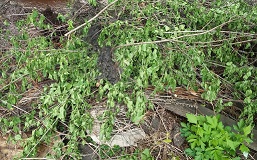
This small honeysuckle is easily removed by uprooting it

Once you have removed these invasive species from your yard, you can help our Earth by replacing them with native species that provide food and shelter to many creatures.

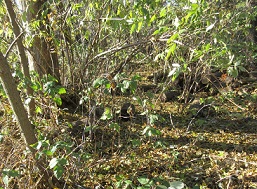
The buckthorn-free wooded area
Here is a list of alternatives to buckthorn
  • Dogwood (Cornus rugosa, Cornus alterifolia)
  • Serviceberry (Amelancher arborea, Amelanchier laevis)
  • Elderberry (Sambucus Canadensis)
  • Nannyberry (Viburnum lentago)
  • Chokeberry (Aronia melanocarpia)
  • Spice Bush (Lindera Benzoin)
  • Sumac (Rhus Glabra, Rhus Aromatica and similar)

The YouChoose App provides several great links to resources on native plants. If you have an android phone you can download the app from Google Play using the link on the right.

Do you want to share your experience? Send me an email at info@choosesustainable.org

Why we should remove invasive plants

Welcome to YouChoose, a blog about individual climate action. This week I would like to talk about invasive plants and why we should remove them from our backyards.

In this post we’ll focus on buckthorn, honeysuckle, and garlic mustard, of which I have extensive experience, however this same argument can apply to other invasive plants in other regions.

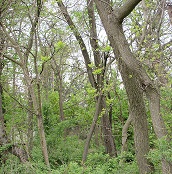
Because my property borders with a neighboring subdivision, one side of the yard was left wooded presumably as a delimiter between the subdivisions. The area was infested with buckthorn, honeysuckle, and garlic mustard. These plants had created a thick border between the two properties. Honestly I wasn’t aware of their devastating effects on the native oaks. For this reason I left them unchecked for many years, thinking that they provided a nice thick screening, until I realized that I was contributing to the destruction of Illinois ecosystem.

After the offenders were removed other plants could grow, such as the elderberry that still provides a nice screening between the properties in addition to having a high value for wildlife.

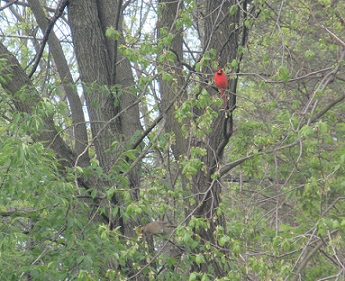
A couple of red cardinals enjoys the buckthorn-free wooded area in the backyard. Can you spot the female?

Unfortunately my yard was nothing exceptional, I see a lot of buckthorn left between backyards and between backyards and roads. Therefore, let’s first review here the reasons why it is important that we do our part and remove these plants.

Garlic mustard (alliaria petiolata)
Here is a small garlic mustard plant in early spring.

Garlic mustard is an aggressive invasive herb imported from Eurasia. It has a two-year lifecycle and it spreads aggressively in wooded area. It can quickly occupy large areas of a forest and it does not allow other native plants to germinate. For these reasons it is responsible for the decline in population of many woodland species.

Buckthorn (Rhamnus cathartica)
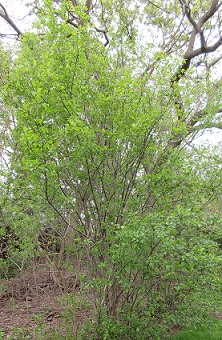
Buckthorn plant

Buckthorn is an aggressive shrub originating from Europe. It quickly spreads in shaded areas. Leaves are developed early in the season and they last until late fall, thereby casting a shade that doesn’t allow sunshine to reach the younger oaks. The emergence of early leaves impacts the bloom of spring ephemerals. In addition these plants grow densely, reducing the growth and survival of native shrubs and trees.

Buckthorn affects the chemical composition of the soil making it inhospitable to other plants. The plant produces thousands of seeds that are also spread to remote areas by birds. The larger impact is the destruction of oak forests and the entire ecosystem that depends on them.

Honeysuckle (Lonicera family)
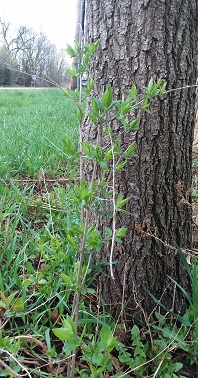
Honeysuckle plant

Just like buckthorn honeysuckle is a fast- growing shrub or vine from Eurasia. It has a devastating effect on the forests of the Midwest because it spreads quickly, grows leaves early and doesn’t allow other plants to emerge. I have first-hand experience of the infesting capability of this plant which is in my opinion worse than that of buckthorn.

Other regions may have different invasive species, however their impact on the ecosystem is similar. Wherever you are, you should research whether invasive plants are present in your yard. If you do have them, but are hesitant (as I was) to remove them because you like the screening or the look they provide, I strongly encourage you to go ahead and replace them with native shrubs. The damages produced by these foreign species far outweigh the few advantages that they may procure.

By removing these invasive species from your yard, you will be doing a great service to the ecosystem and to our Earth and by replacing them with native species you will provide food and shelter to many creatures.

Here is a list of alternatives to buckthorn
  • Dogwood (Cornus rugosa, Cornus alterifolia)
  • Serviceberry (Amelancher arborea, Amelanchier laevis)
  • Elderberry (Sambucus Canadensis)
  • Nannyberry (Viburnum lentago)
  • Chokeberry (Aronia melanocarpia)
  • Spice Bush (Lindera Benzoin)
  • Sumac (Rhus Glabra, Rhus Aromatica and similar)

The YouChoose App provides several great links to resources on native plants. If you have an android phone you can download the app from Google Play using the link on the right.

 In the next post we’ll discuss identification and removal techniques.

Do you want to share your experience? Send me an email at info@choosesustainable.org