Posts

Living without palm oil: You can do it!

Welcome to YouChoose, a blog about individual climate action. We talked in previous posts about the importance of reducing the demand for palm oil. This week I would like to talk about food products that are more likely to contain palm oil.

It is a fact that, unless we stop buying, companies will keep deforesting. Avoiding palm oil is one of the actions we can take to stop deforestation. You will hear all kind of reasons why palm oil is actually good for the planet and how avoiding palm oil will do more harm than good. Don’t fall for the greenwashing. The skyrocketing demand for the cheap oil is fueled not by any necessity, but by an increase in demand for junk and fast food. The big conglomerates responsible for deforestation are also the biggest producers of junk food. Their palm oil suppliers are linked to human right violations, intimidation, and destruction of indigenous community. For this reason reducing the amount of junk and packaged food that we purchase is a fundamental step to invert the trend. When we purchase food containing or prepared with palm oil we are contributing to deforestation. Unfortunately there is no nice way to put this. Read here from Palm Oil Detectives how “sustainable palm oil” doesn’t really exist. It is just something invented to make consumers feel good and enable the continuous destruction of the rain forest.

Here is a list of foods where you are likely to find palm oil. Keep this in mind next time you go to the grocery store. I assure you that, after eliminating palm oil, my life hasn’t changed much, but my health and wallet may have actually improved.

  • Doughnuts: Fast food chains use palm oil for frying. I used to like doughnuts, but stopped buying them entirely and never looked back.
  • Candies: Almost all chocolate candies and bars in grocery stores contain palm oil. I used to buy some for my daughter when she was a kid or for Halloween. After realizing what I was doing, I stopped entirely purchasing them and lived happily everafter. I also noticed that, when I explained to my daughter the reason for it, she agreed and never asked for them anymore.
  • PopCorn: Please read the ingredients in microwave-ready popcorn packages and you will discover that all of them are made with palm oil.
  • Chocolate spreads: Products such as hazelnut spreads and sometime peanut butter spreads list palm oil among their ingredients.
  • Fast food, fried items, and hamburgers: Major fast food chains use palm oil for frying, especially in Asia, but also in the US. I know this is a little bit hard but limiting fast food as much as possible is important and not that depriving. It may actually be good for us.
  • Crackers, cereals, cookies, pancake mixes, soups, bread products: I read ingredients carefully and find palm oil in all these items. I invite you to do the same and look for available alternatives. There are few brands that don’t use palm oil.
  • Bakery products in grocery stores: A large percent of baked good in US grocery stores contains palm oil. In the grocery store where I shop, palm oil is found in almost all baked goods. I encourage you to check it out next time you shop and look for alternatives.
  • Frozen meals, ice creams, frozen waffles, and pancakes: Palm oil in ice cream? There are things I wouldn’t buy even if they were good for the environment.

Please share this post and do your part advocating a stop to palm oil consumption.

Comments? Send me an email at info@choosesustainable.org
World water day 2023 (and what we can do)

Welcome to YouChoose, a blog about individual climate action.

The UN 2023 water conference was held last month in NY. Water scarcity may very well become the most important side effect of climate change and deforestation. The link between deforestation and drought has been illustrated in a recent Nature article : Smith, C., Baker, J.C.A. & Spracklen, D.V.: Tropical deforestation causes large reductions in observed precipitation, Nature 615, 270–275 (2023). You can read the article HERE.

Part of the UN conference outcome was the announcement of the largest river and wetland restoration initiative in history, proposed by the governments of Colombia, the Democratic Republic of Congo, Ecuador, Gabon, Mexico and Zambia. If you want to know more about the freshwater challenge and the importance of freshwater read about it on the WWF web page.

How about the US? Do you know that about half of the original wetland of the US has been destroyed and about 30% of the endangered species in this country live in wetland areas? The loss or degradation of wetlands puts entire ecosystems at risk. Read HERE, from the Xerces Society, on the importance of wetlands for biodiversity. One big threat to wetlands comes from pesticide use for agriculture and gardening. As homeowners we need to stop using chemicals in our lawns and gardens, especially herbicides and systemic pesticides. In our quest for the perfect lawn we introduce in the environment and in the water toxic chemicals that are deadly for pollinators and aquatic life.

Check out here from the Xerces society a list of deadly products easily available on the shelves of home improvement stores. Lawn fertilizers are just as bad. These products are marketed with catchy names such as “Green Light”, “Shrub Protect”, “Weed ‘n feed” but underneath the friendly and flowery packages are extremely toxic chemical that destroy the ecosystem. Please spread the word with your neighbors and encourage them to stop using chemical products in the backyard!

Keep the pressure on! Do your part to end deforestation by boycotting products that are the main drivers of destruction: cattle and livestock industry (which also drives conversion of forests to soy plantations), palm oil, timber from old growth forests and endangered trees.

If you liked this post please share it!

Actions and News: March 21 was international day of forests

Welcome to YouChoose, a blog about individual climate action.

Forests support the very existence of our planet. They sustain biodiversity, provide us with much needed precipitation, clean air, water, and so much more. Deforestation is an existential threat to our planet.

Read here in the UN page the meaning of this day and why is vital that we stop deforestation and restore what was destroyed.

Keep the pressure on! Think about how much forests mean to you and do your part to end deforestation by boycotting products that are the main drivers of destruction: cattle and livestock industry (which also drives conversion of forests to soy plantations), palm oil, timber from old growth forests and endangered trees.

Do you want to meet one of the many forgotten victims of deforestation? Get to know one of the most endangered primates in this article from the Palm Oil Detectives.

If you liked this post please share it!

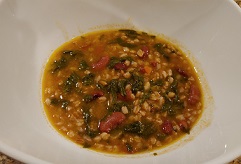
Farro and spinach soup

Reduce meat consumption by switching to a diverse, plant-based diet. This delicious recipe is based on farro, one ancient grain that, after being forgotten for sometime, is making a comeback. Farro was extremely popular in ancient Rome, and a staple food for the Roman legions. I use pearled farro that cooks faster, especially after soaking.

Farro can be used as a side dish, in salads, and I am discovering that it can be used as an alternative to rice.

Sustainability tips:

Organic farro is a sustainable crop that can be part of a diverse diet. Spinach can be loaded with pesticide therefore organic better. Remember that supporting organic and sustainable produce goes a long way to reduce harmful pesticide use. I also suggest to avoid produce in plastic bags and to bring your own reusable bags to help reduce the amount of plastic dispersed in the environment. I can send you free cotton grocery and produce bags entirely upcycled from old fabric. Just contact me if you need any.

Useful things to have ready

Rinse and soak the farro and kidney beans together for about 7 hours. Notice that it is not necessary to soak the pearled farro for so long, but soaking will reduce the cooking time and give a creamy consistency to the final dish. A great thing about this recipe is that it can be made as a soup or as a risotto-style dish.

Soak farro and beans overnight or for ~ 7 hours

Preparation time: about 30 minutes

Ingredients (3-4 people)

  • 2 fistful of soaked farro per person
  • 1 bunch of spinach (frozen spinach also works)
  • 2-3 fistful of red kidney beans (soaked with farro for about 7 hours)
  • 1 chopped tomato (I peel it but is not necessary)
  • half onion (if small) or 1/4 (if large) chopped in small pieces
  • 1 garlic clove-mashed
  • Crushed red chili
  • 1 carrot
  • 2-3 spoons of olive oil
  • 1 tablespoons of tomato paste (or tomato sauce)
  • Salt

Procedure

  • Wash the spinach carefully and chop them.
  • Wash and peel the carrot and tomato
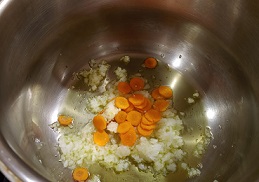
  • In a pressure cooker heat the oil, add chopped onion, mashed garlic, carrots, crushed chili, and cook for a few minutes on medium heat.
Add onion, garlic, and carrot to the hot oil
  • Add tomatoes, tomato paste, and spinach and let cook for 5 minutes
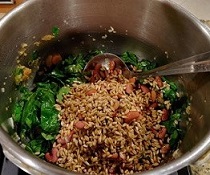
  • Add drained and rinsed farro and kidney beans
Add spinach, farro, and beans
  • For a soup add enough water to exceed the level of farro, for a risotto-like consistency add enough water to just cover the farro.
  • Close the lid and pressure cook for about 15 minutes from when it starts whistling.
  • Let the steam out and check consistency. You may need more time depending on the type of cooker and desired consistency.

Enjoy!

Help reduce meat consumption! If you have a vegetarian recipe you would like to share please email me at info@choosesustainable.org and I’ll post it on this blog.

Still undecided? Read here about the destructive impact of the meat industry on forests.

The YouChoose App contains links and information about sustainable food choices with a searchable database of common food items.

Actions and News: Tell the Biden administration to stop deep sea mining

Welcome to YouChoose, a blog about individual climate action.

The 28th Session of the International Seabed Authority started on March 7th in Jamaica. If you don’t know what this is you are probably not alone. Unfortunately these are the entities that regulate the future of our oceans based on commercial interests. We need to show that we are aware of what is happening and we have an opinion.

Keep the pressure on!

Click HERE to sign the Greenpeace petition and tell the Biden administration to ban deep sea mining.

If you liked this post please share it!

Actions and News: Please urge Congress to reintroduce the Recovering America’s Wildlife Act (RAWA)

Welcome to YouChoose, a blog about individual climate action.

Do you know that the great American prairies are among the most endangered ecosystem on Earth? Less than 1% of them are left!

Last year there was great hope that Congress would pass legislation to help the recovery of America’s wildlife and biodiversity. Unfortunately that didn’t happen. There is a chance to urge lawmakers to reintroduce the bill and people’s support is the biggest voice we have to make ourselves heard.

Please add your name to the Nature Conservancy petition and urge Congress to reintroduce the Recovering America’s wildlife Act.

https://preserve.nature.org/page/86239/action/1

Please share this post and keep the pressure on!

Actions and News: Agreement reached at the UN conference on marine biodiversity

Welcome to YouChoose, a blog about individual climate action.

An agreement was reached at the UN Fifth Intergovernmental Conference, or IGC5, to protect Oceans’ biodiversity.

Thank you to all who signed the petition. Below is the link to Greenpeace press release.

Historic UN Ocean Treaty agreed

Keep the pressure on!

Stop buying fish from grocery stores that disregard basic environmental and human right protections. Click HERE to sign the Greenpeace petition to US giant grocery store chains to stop selling tuna linked to environmental destruction.

Do you want to know where your grocery store stands in the tuna scorecard? Check out here the Greenpeace report to find out. You need to place your cursor on the image and advance the pages at the bottom of the image. The report scorecard is on page 4. Think of this report next time you want to buy tuna!

If you liked this post please share it!

Is this a key to sustainable EVs?

Welcome to YouChoose, a blog about sustainable living. In this post I wanted to share some information about batteries and electric vehicles.

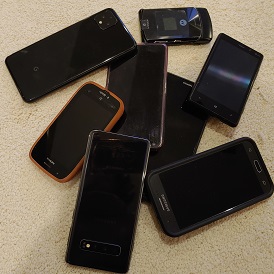
If you have a lot of old cell phones in your home you may be interested in this Argonne National Laboratory OutLoud lecture on battery recycling. It contains very useful information on how batteries from cell phones can provide useful material to make new batteries. It takes less than 200 old phones to make a new EV battery! It is a good incentive for all of us to find out where the nearest battery recycling facility is located and drop off the old batteries cluttering our drawers.

Below is the link:

If you liked this post please share it!

Actions and News: UN conference on marine biodiversity resumes in NY

Welcome to YouChoose, a blog about individual climate action.

The UN Fifth Intergovernmental Conference, or IGC5, to protect Oceans’ biodiversity is underway in New York.

https://www.un.org/bbnj/

Here is a WWF article that explains why it is important that we protect oceans from destruction. Click on the link below to go the WWF article:

https://wwf.panda.org/wwf_news/?7704966/high-seas-treaty-2023

Grocery stores are largely responsible for relying on supply chains that disregard the environment as well as human rights.

What can we do?

We can stop buying fish from grocery stores that disregard basic environmental and human right protections. Click HERE to sign the Greenpeace petition to US giant grocery store chains to stop selling tuna linked to environmental destruction.

Do you want to know where your grocery store stands in the tuna scorecard? Check out here the Greenpeace report to find out. You need to place your cursor on the image and advance the pages at the bottom of the image. The report scorecard is on page 4. Think of this report next time you want to buy tuna!

If you liked this post please share it!

Meet my groundhog neighbor

Welcome to ChooseSustainable.org a blog about individual climate action and sustainable choices. This week I wanted to seize on this groundhog day celebration to introduce you to my gentle, albeit hungry, resident groundhog.

A nice article on these extremely shy animals can be found at this Lake County forest preserve page: https://lakecountynature.com/2020/02/01/get-to-know-groundhogs/

Plan to start a native garden to support local wildlife and get a thank you hand-painted bookmark! See what’s available here.

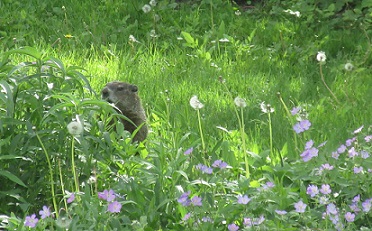
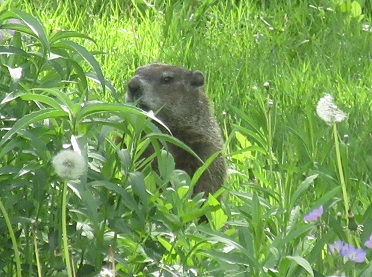
Every spring I hope to catch a sight of my resident groundhog and in a few months you may see one too, a large beaver-like guest feeding in your yard. They come out at the end of April to feast on dandelions and emerging plants. Some years I don’t see them, some years I have had two at the same time.

Groundhog feeding on dandelions

Groundhogs are among the many inhabitants of our land who are thankful for the small twigs and dry leaves left on the ground from the previous winter, one more reason not to obsess with fall cleaning.

A groundhog collects twigs and dry leaves in early spring

As many of you probably know, groundhogs are large rodents, true hibernators that emerge in spring and again hibernate in fall. They dig large underground chambers that can be also used by other animals once abandoned. To my amazement, for all their weight, they are extremely fast and skilled tree climbers.

This is the entrance of the groundhog’s burrow in my yard. It is located in a quiet wooded area

When they emerge from hibernation they are very hungry and will eat whatever green they find around. My resident groundhog is very fond of golden alexander and other native plants, but it also happily eats dandelions.

Golden alexander is very much appreciated

Groundhogs are often regarded as ‘pests’ because they might eat our precious garden plants and occasionally we hear of disturbing events regarding homeowners poisoning groundhogs, chipmunks, and beavers in their backyards. I can understand that voracious eaters can create problems for farmers, however for us suburban dwellers the ‘damage’ they may cause is minimal. ‘Our‘ property was theirs before we arrived and they only eat to survive, not to cause damage on purpose. The groundhog in my yard eats voraciously in early spring, but already in summer its activity subsides to nothing. When we say ‘I love wildlife but just not in my yard‘, we need to remember that as we expand the suburban landscape, we chip away more and more land. What is not our yard becomes somebody else’s yard. We need to abandon the absurd aesthetic impositions of traditional suburban landscape and make our backyard friendly to wildlife so that our arrival doesn’t dislodge other inhabitants.

This blog is about reminding us that we are all guests on this Earth and our lives are better when guided by kindness and compassion towards all life. I encourage you to welcome groundhogs to your backyard, they have their place in the ecosystem. Plant in abundance so that plants can serve their true purpose which is to feed and shelter the local wildlife. If really you can’t tolerate having a groundhog in your backyard, please try to humanely encourage it to move. Here is a link to the Humane Society website with some tips on how to humanely dislodge a groundhog.

https://www.humanesociety.org/resources/what-do-about-woodchucks

Thank you for letting me live in your backyard. I always bring the good news that spring has arrived at last!!

Happy groundhog day!

Would you like to talk about wildlife in your backyard? Please send me your post at info@choosesustainable.org

If you liked this post please share it!