Posts

Melanthium virginicum (Bunchflower)

Welcome to ChooseSustainable.org a blog about sustainable living. In this series of short posts I present a native plant to encourage everybody to abandon our traditional way of gardening (basically a continuous fight against nature) and engage in sustainable gardening practices that nurture the ecosystem, sustain wildlife and foster biodiversity.

In this post I present a rare flowering plant of ephemeral beauty, that will reward your patience with a few weeks of enchanting blooms: Melanthium virginicum (bunchflower).

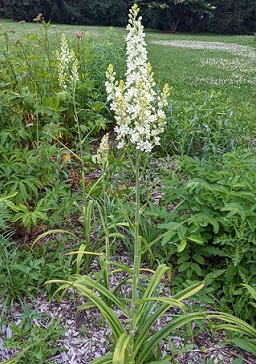
Bunchflower prefers rain gardens and moist conditions

Quick facts:

  • Zones:5-9
  • Bloom time: Summer (June-July)
  • Sun: Full, partial
  • Soil Moisture: Medium, Wet
  • Aggressive: No
  • Front yard: YES
  • Height: about 5 feet
  • Status: Endangered in Illinois and several other states
  • Maintenance: LOW
  • Wildlife value: Medium

Wildlife connection: This plant attracts many small insects, including small flies, and small beetles. The plant is toxic to mammals.

It is hard to imagine that something of such a beauty can be at risk of extinction, but in fact this plant went from being threatened to endangered in the past five years. Melanthium virginicum is a slow growing plant, it will require patience, and occasional discouragement but it will come through providing an exceptional addition to the garden.

I planted eight bare roots in early spring about seven years ago. I still remember watching the light green leaves sprout in spring to quickly wilt and disappear by end of summer. The next spring they came back, briefly and again became brown and disappeared. I thought the experiment had failed, but then I saw them coming back and becoming more visible and persistent year after year. It took about six years to get the first plant to bloom. This year almost all the plants bloomed in mid July!

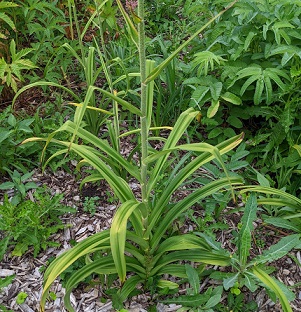
The plants develop with leaves at the base that look like those of lilies. Through the years the leaves become more abundant.

The leaves are at their best in early summer and become yellow in late summer

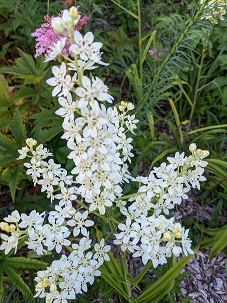
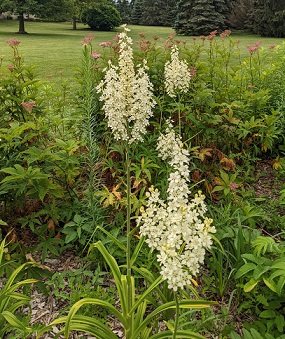
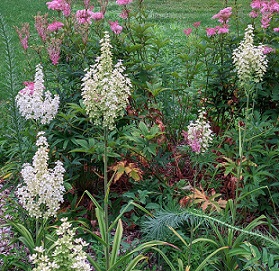
Flowers start out greenish early in the season and expand in summer with each plant developing one large bloom composed of small white flowers. Planting at least six or seven plants will provide a better effect than having just one.

Planting six or seven plants provides a nice full bloom

Melanthium virginicum loves to be in a rain garden or an area where water accumulates and quickly is absorbed in the ground. For this reason it goes very well with the Queen of the prairie (Filipendula rubra) another threatened wetland species that I’ll describe in a future post.

Bunchflower (in the foreground) and queen of the prairie (in the background) make a great white/pink mix of unusual blooms in early summer.

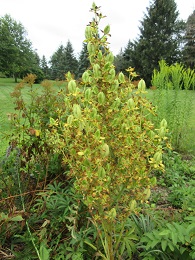
Although the bloom doesn’t last for too long, the plant still adds interest to the garden with its green seed pods that persist until early September.

After bloom is over the plant still looks interesting.

If you are a patient gardener and have a section in your yard that you are considering for a rain garden Melanthium virginicum makes a fantastic addition together with the Queen of the prairie and, for example, some ornamental grasses that help water soak underground. You will also sustain biodiversity by planting a species that is on the brink of disappearing. You can’t go wrong!

Would you like to talk about a native plant in your backyard? Please send me your post at info@choosesustainable.org

If you liked this post please share it!

A hot summer

Welcome to YouChoose, a blog about sustainable living. In this post I wanted to share a few reflections about recent heat waves.

This year, like every year, I was in Southern Europe for about 2 months and found myself in the middle of one of the hottest summers on record. This is the second year in a row that I find myself in such a situation over there. I grew up there and I am old enough to remember that summers used to be hot, especially in August, but generally pleasant in June and July. Lately the heat has become unsustainable from the beginning of June until September. The extreme heat was compounded by a drought and extended wildfires. The situation was such that, perhaps for the first time, climate change was perceived by everybody as a real and incumbent crisis. The reality of warming is becoming apparent to everybody.

Deforestation plays a major role in accelerating climate change. Globally, until now, tropical forests have acted as carbon sinks, sequestering large amounts of carbon dioxide. Today, emissions caused by the process of deforestation and land conversion to agriculture are starting to exceed the forest carbon sequestration. Forests are now becoming carbon sources instead of carbon sinks. . This in addition to land degradation, loss of biodiversity, and change in rainfall patterns.

Please read this very interesting article in NOAA’s research news:

https://research.noaa.gov/article/ArtMID/587/ArticleID/2778/Deforestation-warming-flip-part-of-Amazon-forest-from-carbon-sink-to-source

The contribution of deforestation to climate change includes (1) emissions from deforestation, (2) emissions associated with land use (i.e. cattle farming, soy plantation) and (3) reduced amount of carbon sequestration due to the loss of canopy. Industrial agriculture is responsible for the largest part of deforestation with the products of deforestation coming to our grocery cart and our kitchen. It is imperative that we become conscious buyer and learn which products are driving deforestation.

What can we do as consumers:

  • Reducing (or eliminating) meat and dairy consumption is the single most important step we can take to stop deforestation
  • Eliminate palm oil from the shopping cart
  • Purchase certified sustainable coffee and chocolate
  • If choosing to consume meat, choose grass-fed, soy-free products.
  • Although soy for human consumption constitutes an infinitesimal part of the global soy production, it is important, when using soy-based products to make sure they are sourced from sustainable agriculture.
  • Be vocal and participate in campaigns. Demand that governments and companies act to stop deforestation.

What are you waiting then? Be part of the movement to stop deforestation. Can’t go wrong!

The YouChoose app provides several links and information on products and cosmetics ingredients that are unsustainable and bad for the environment.

Send me your experience at info@choosesustainable.org and I’ll add it to this blog.

If you liked this post please share it!

Dry split peas fritters

This is a simple recipe with few sustainable ingredients. It is quick and it also makes a delicious snack. It can also be served with a side of fresh cucumber and tomato salad.

Sustainability tips:

Green peas is a sustainable crop, especially if grown organically. Like all legumes peas don’t degrade the soil and are drought tolerant. Supporting organic and sustainable produce goes a long way to reduce harmful pesticide use and to help non destructive agriculture. Proteins in peas can be a valid alternative to planet destroying meat.

Useful things to have ready

Soak green peas for at least 8 hours before using.

Preparation time: 8 hours to soak the dry peas, 20 minutes to prepare.

Ingredients (3-4 people)

  • Dry green peas (2 fistful per person)
  • Two tablespoon of onions chopped in small pieces
  • 1 garlic clove mashed (optional)
  • 1/2 teaspoon salt (or to taste)
  • Red chili (optional)
  • Parsley (1 small bunch)
  • Bread crumbs
  • One tablespoon of vegetable oil to fry
  • One table spoon of olive oil

Procedure

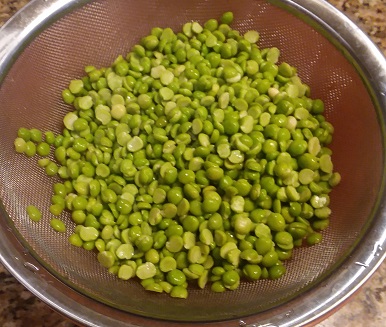
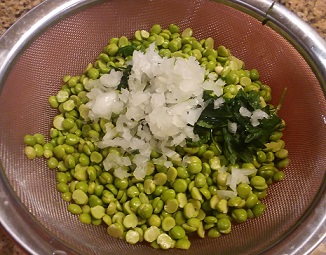
  • Rinse the dry peas and soak for at least 8 hrs in water.
Soaked dry peas
  • Chop the onions and garlic in small pieces (or mash the garlic)
  • In a food processor add green peas, garlic, onions, parsley, salt, olive oil
Ingredients ready for food processor
  • Blend to produce a dense, smooth mix. If you do have a modern food processor this should come relatively easy. I have a very old blender so I need to add a little water to the mix.
  • Refrigerate for about 1 hour to make the mix dense
  • Make small patties and coat them with bread crumbs
Coat the patties with bread crumbs
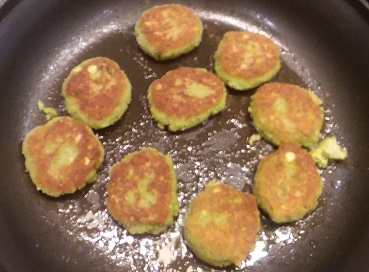
  • Fry in little oil or you can try to bake them (I never tried)
Fry in little oil

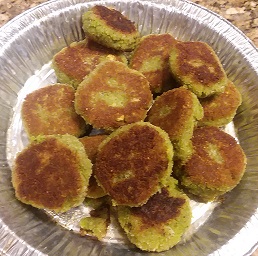
They make a nice appetizer, snack, or a main course with a side of salad

Dry peas fritters make a nice snack

Help reduce meat consumption! If you have a vegetarian recipe you would like to share please email me at info@choosesustainable.org and I’ll post it on this blog.If you like this recipe please share it!

Top ten plants for pollinators

Welcome to ChooseSustainable.org a blog about sustainable living. Planting season is here! If you are thinking of starting a native garden you may be interested in 10 easy and guaranteed success blooming plants that have very high value for pollinators and birds. These plants do very well in the central and East US and they are all currently present in my backyard. Even if you have a small yard, or even a balcony, you can still do your part and recreate a small piece of prairie. I’ll feature them one by one in single posts, for now here is a quick reference sorted by bloom time.

Geranium maculatum (April-June)

Easy to grow from seeds, it forms a blooming ground cover from spring to early summer and maintains nice foliage until late fall. Important food source for early bees and pollinators. Common name: wild geranium.

Asclepias in many varieties (june-july)

I love this. It blooms around late June, flowers are extremely showy and fragrant. This is one of the most prized plants of my garden. Everything of this plant has value, from leaves to flowers to the pods that contain seeds. It is the host plant of the imperiled monarch butterfly and moths. Make sure to plant the varieties native to your region and to give it its own space, I noticed that it doesn’t like to be crowded. Common names of varieties include: Swamp milkweed, common milkweed, butterfly weed, showy milkweed, and more…

Echinaceas and Rudbeckia (july-October)

I include here many species of coneflowers including Ratibida pinnata and brown eyed susan. These are easy from seeds and have very high value for pollinators and birds that will feed on seeds through fall and winter. Different varieties bloom all the way to October. Host plant of several checkerspot butterflies and moths. Common names include: Purple coneflower, yellow coneflowers, black eyed susan, brown eyed susan.

Monarda fistulosa, didyma (july-august)

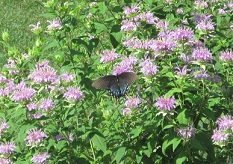
There is a reason why another name for this plant is “bee balm”. When it blooms in my yard it is surrounded by bumblebees and other pollinators from morning to evening. The leaves are very aromatic but be careful, it is quite exuberant, it may get out of hand! Host plant of several moths. Common names: bee balm, wild bergamot.

Eutrochium purpureum (july-august)

This plant is very attractive to bumblebees and butterflies. It takes a few years to establish and I noticed that it suffers in prolonged droughts. It is a host plant for several moths. Common name: Joe Pye Weed.

Silene regia (July-August)

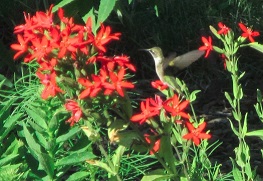
Although this may not be the most common plant, I included it here because I noticed that it is one of the preferred foraging grounds for hummingbirds. Besides it is a red rarity among prairie flowers and it is listed as endangered in several states. It is very slow to establish and I have been trying to grow the population in my yard with mixed success, but it is definitely worth a try! Common name: Royal catchfly.

Liatris varieties (August – September)

With their purple spikes Liatris in many varieties attract a large variety of bees, butterflies and moths. The bloom lasts until early fall and it seems to me that the plant can be propagated through seeds quite easily. I have tried them this year for the first time, I’ll know more in a few months. The plant itself is very attractive, and is the host plant for several moths. I hope to post a better pick in a future post. Common names include: blazing stars, gay-feather.

Helianthus varieties (August-October)

There is no summer without sunflowers. Heliantus plants come in many varieties with beauty and boldness as their common factor. I have the variety Helianthus grosseserratus (sawtooth sunflower) that was chosen based on its high wildlife value and it was entirely grown from seeds. This native variety that I have requires some space, but there are better behaved native varieties. Common name: Sunflowers

asteraceae varieties (september-october)

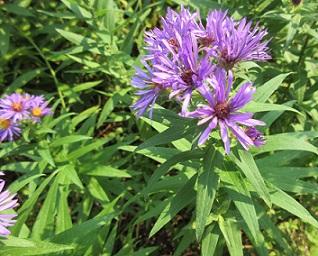
The family includes many asters that in fall, when everything else is done blooming, keep bees and butterflies happy a little longer. Asters of the genus “symphotrichum” are used as host plants of 100 species of moths and butterflies. I grew my New England aster from seeds and small plants. They both did very well and they expanded considerably. In addition I have a few heath asters that came up on their own. Asters come in great varieties, some do well in sun, others in shade, the important thing is to let them thrive in your garden, birds will thank you too. Common names: New England aster, heath aster, Georgia aster, smooth aster and many many more. Just make sure that you plant the variety native to your area.

solidago varieties (september-october)

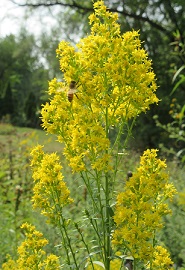
This is another extremely important fall plant for a large number of insects, including caterpillars. It provides food for migrating monarchs and winter seeds for birds. I planted the solidago speciosa, but I am planning to expand my population next year with more varieties. I do get a lot of Canadian goldenrod which I remove selectively, I leave some in specific location and remove what becomes overwhelming. Common name: Goldenrod in many varieties.

I hope this brief overview of top ten plants helped out. If you try any let me know how it goes.


The YouChoose App provides several links to resources to get you started with sustainable gardening. It also provides links to native plants in specific regions. You can download it from Google Play or through the link on the right. Please make sure to purchase native flowers from nurseries that don’t use neonicotinoids.

Would you like to talk about a native plant in your backyard? Please send me your post at info@choosesustainable.org

If you liked this post please share it!

A few reasons to give up dish soap

Welcome to YouChoose, a blog where we explore ways of living sustainably. This week I would like to talk about living without dish soap.

You may think it is ridiculous to write post about such a trivial topic, however this is one small step that goes a long way in reducing plastic pollution and reducing deforestation due to palm oil demand. I have been living without a specialized dish soap for some time since I came to the realization that I didn’t need one. Here are a few reasons to give up dish soap:

  • Liquid soap comes in a plastic bottle that ends up in a landfill or in the ocean
  • Some dish soaps contain petroleum based ingredients
  • Almost all commonly available dish soaps contain products derived from palm oil

Fortunately there are alternatives to big brand dish soap and I invite everybody to take the time to explore palm oil free and plastic free products for the dishes suitable for our own specific needs. On my end I tried a few solutions and settled for a simple olive oil soap bar.

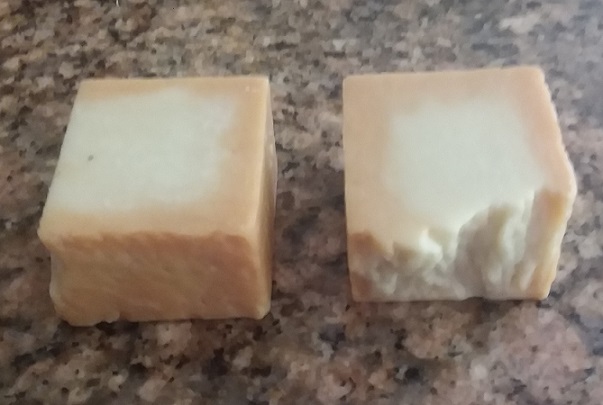
A basic 100% olive oil soap bar

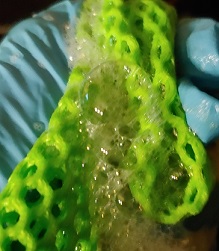
The bar comes in a paper box, just rub the bar on the dish cloth and you will get a nice foam that works really well even with oily pots and pans and doesn’t leave any residue on glass. Soap de Marseille is also effective, however most of it, these days, is unfortunately produced with palm oil instead of olive oil, so one needs to be careful to find the traditional one made with olive oil.

Another advantage of olive oil soap bars is that they are hard and last a long time without disintegrating under water.

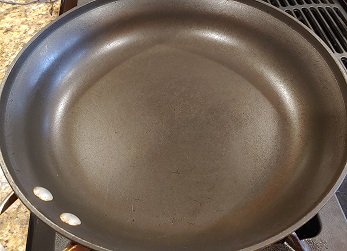
You don’t have to give up clean dishes by giving up liquid dish soap

What are you waiting then? Eliminate something you don’t need, reduce plastic pollution, and reduce deforestation all in a small step. Can’t go wrong!

The YouChoose app provides several links and information on products and cosmetics ingredients that are unsustainable and bad for the environment.

Send me your experience at info@choosesustainable.org and I’ll add it to this blog.

If you liked this post please share it!

A healing garden

Welcome to ChooseSustainable.org where we explore ways of living sustainably.

To celebrate this year’s Earth Day I want to say a few words about a different approach to gardening, a gardening that is a way of healing ourselves and our Earth.

Our yard becomes a source of stress when we feel pressure to keep up with societal norms. In a stressful garden there is excessive mowing, there is a continuous rush to pick up every single straw, to remove every fallen leaves, to cut down immediately less than perfect plants. The garden is loaded with tons of chemicals to fertilize the lawn, remove weeds, kill grubs, kill weeds before they emerge, kill bugs, kill moles, kill opossums… see the long list of killing? In many cases these creatures get a death sentence for digging our perfect lawn, or for ruining our perfect roses. A stressful garden deprives countless living creatures of their lives, food and shelter, disrupts the food chain and contaminates the soil and the water with poison.

Gardening becomes healing when it is good for the Earth and therefore for us. I think it would be nice to make gardening not only about what we like, but about what is good for everybody, respecting the existence of other species even if their presence disrupts our idea of what should be a perfect landscape.

Here are some common yard “problems” and why they are really not problems at all.

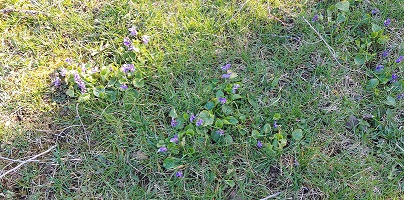
Violets on a lawn may appear unsightly but they are important host plants for the fritillary butterfly. Choose what is good for the Earth, choose not to kill them.

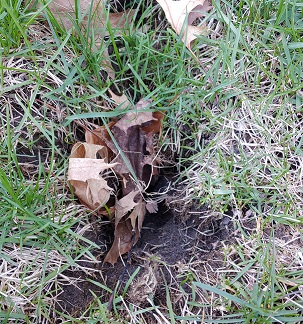
A small hole in the lawn may not be our ideal for a perfect landscape, but some creature with its meaning and role in the ecosystem is living there. Choose what is good for the Earth, choose not to kill it.

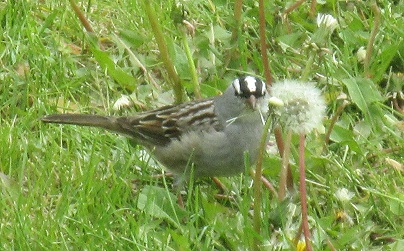
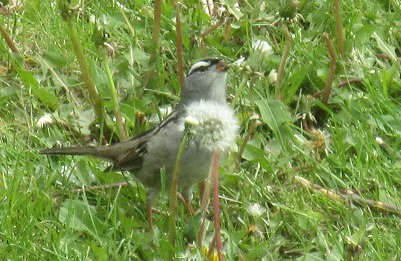
Dandelions and perfect lawns don’t go together, but bees and birds such as this white-crowned sparrow rely on them as early food source. Choose what is good for the Earth, choose not to kill them.

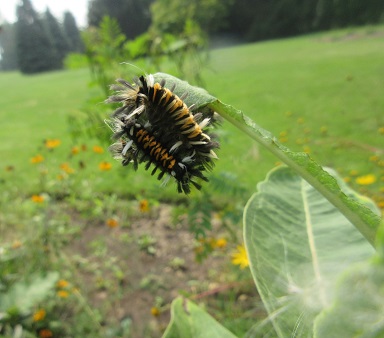
I know nobody likes to have their plants devoured by strange bugs, but several species may feed on the same plant. These moth caterpillars are also meant to feed on milkweed. Choose what is good for the Earth, choose not to kill them.

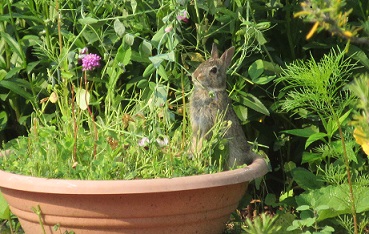
Some visitors may enjoy our attempt at planting annuals. They are hungry too!! Let them stay!

Next time we think of using herbicides or pesticides on our plants or lawn let’s ask ourselves: Is this really necessary? Am I just acquiescing to an unsustainable aesthetic canon? I hope we’ll think about this and place the spray bottle back on the shelf where it belongs.


The YouChoose App provides several links to resources to get you started with sustainable gardening. It also provides links to native plants in specific regions. You can download it from Google Play or through the link on the right. Please make sure to purchase native flowers from nurseries that don’t use neonicotinoids.

Would you like to talk about a native plant in your backyard? Please send me your post at info@choosesustainable.org

If you liked this post please share it!

United Nations resolution on plastic

Welcome to YouChoose, a blog where we explore ways of living sustainably. This week I wanted to bring to your attention the recent UN resolution on curbing plastic pollution.

This past month United Nations representatives from 175 countries signed a pledge to come up by 2024 with an agreement to end plastic pollution. Even if the plan doesn’t materialize by then this is still good news. It means that single use plastic is finally becoming a global issue to be dealt with.

We all know the devastating effects of plastic on land and marine wildlife. However, it is still nearly impossible for us to complete one trip to any store without coming out with plastic items in our cart. And I am not one that is oblivious to the problem. I have eliminated plastic shopping bags, produce bags, plastic water bottles, single use utensils, and glasses. And yet, every week I still manage to collect what I consider a large amount of plastic to recycle.

It does feel like an uphill battle and it can be frustrating, so we can be tempted to give up. Although it is true that we can’t eliminate all plastic from our lives, we may be surprised to know that there are just a few items that disproportionately constitute the vast majority of the pollution. And these few items we can really do without. Food wrappers, beverage bottles, bottle caps, grocery bags, straws, take out containers, cups, and plates make a substantial component of ocean pollution. Just eliminating bottles and plastic bags would go a long way.

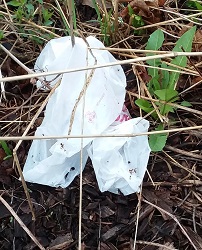
Recycling is not the solution because just as it takes energy to make things, it also takes energy to recycle them. Additionally, plastic bags can easily escape from the facilities where they are collected. I do see many plastic bags flying around where I live (I’m sure you do too) and we can easily multiply that by millions to imagine how many bags are dispersed in the environment every day. Even with our best intentions it is difficult to make sure that our bags end up where they are supposed to go.

If you want to add your voice there is a Greenpeace action to call on elected officials to take action on plastic pollution:

https://engage.us.greenpeace.org/HUlucLmSFE-JF181Aa3-pA2?utm_source=website&utm_medium=blog&utm_campaign=ppp_blog&sourceid=1009130&_ga=2.182390183.1246355678.1649607004-2069384434.1649458050

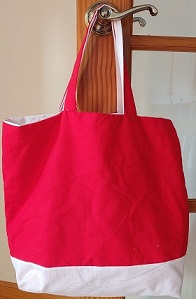
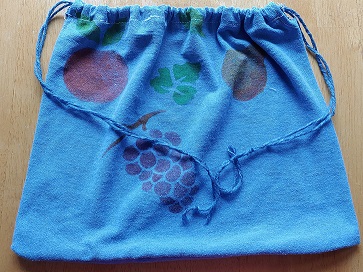
While we wait for actions at a government level we can also make plastic reduction a priority. You can start taking reusable bags with you, you don’t even have to buy them. They are easily made from old clothes and fabric. There are plenty of tutorial on the internet on how to make reusable bags. Do you have old shirts at home but don’t have a sewing machine? Don’t trash them, send them to me and I will send you back reusable shopping and produce bags.

Old T-shirts can be used to make reusable drawstring produce bags

With enough fabric from old tablecloths, curtains or sheets one can make reusable shopping bags

Here is some useful information on plastic pollution:

https://oceanservice.noaa.gov/hazards/marinedebris/plastics-in-the-ocean.html

More on the UN resolution can be found at:

https://news.un.org/en/story/2022/03/111314

Spread the word! If you found this information useful, please share this post.

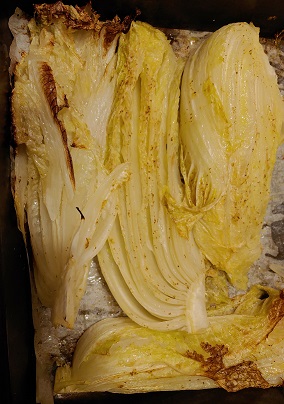
Roasted Napa cabbage

This recipe is very simple and I definitely recommend it if you have never tried Napa cabbage. It makes a delicious side dish that goes very well with vegetarian burgers or even rice. Like all other cabbage variety Napa cabbage is a food low on calories and high in health benefits.

Sustainability tips:

Cabbage is a sustainable crop, especially if grown organically. If you grow your own vegetables I think this cabbage is also fairly easy to grow at home. If you purchase vegetables supporting organic and sustainable produce goes a long way to reduce harmful pesticide use. I also suggest to avoid produce in plastic bags and to bring your own reusable bags to help reduce the amount of plastic dispersed in the environment.

How to clean and cut Napa cabbage

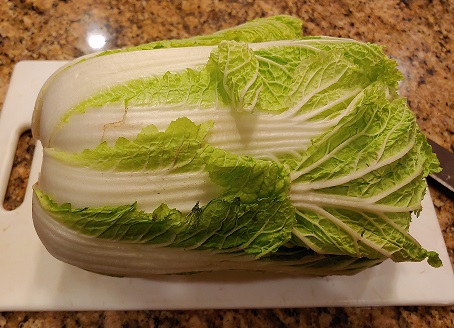
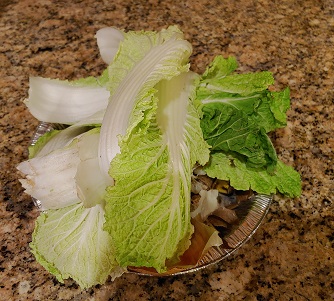
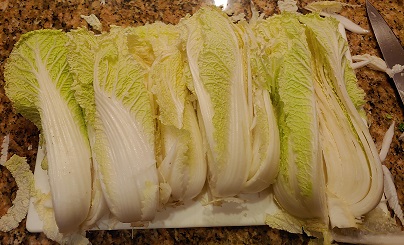
Napa cabbage is quite large, and almost all of it, except for the hardest part can be used. It is enough to remove the outer layer of leaves, cut the cabbage in fourths or eights by the length (4 or 8 pieces depending on the size) and rinse under running water. If you compost, make this a zero waste recipe, don’t trash the leaves of the cabbage, they make excellent compost material.

Preparation time: about 30 minutes

Ingredients (3-4 people)

  • 1 Napa cabbage
  • 3 garlic cloves
  • 1 tablespoon of Dijon mustard
  • 1/2 glass of olive oil
  • Juice of half lemon
  • salt

Procedure

  • Preheat oven at 420 F (~220 C)
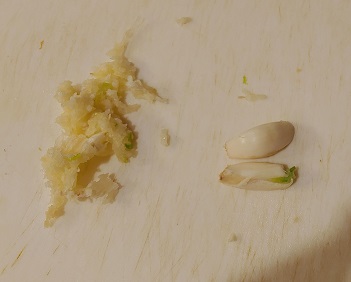
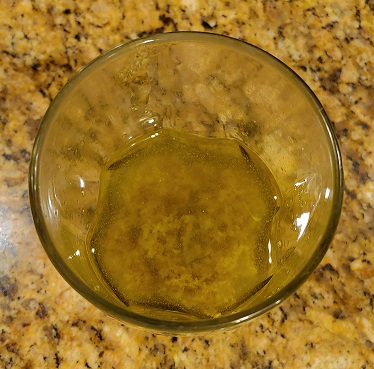
  • Combine Dijon mustard, mashed garlic, lemon juice and and olive oil
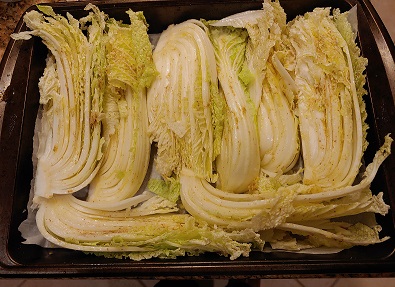
  • Place the cabbage in an oven pan and brush all sides with the oil
  • Add salt
  • Place in the oven for about 20 minutes
  • Once the cabbage is roasted pull it out of the oven and let cool for a few minutes
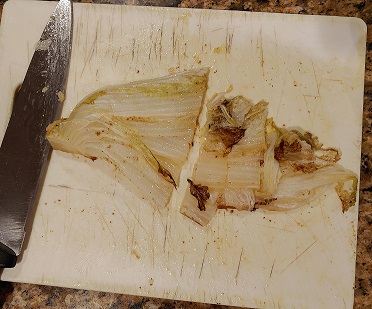
  • The end part of the leaves may still be hard so it is better to remove the end part and slice the tender leaves.
  • Your cabbage is ready to eat!

Help reduce meat consumption! If you have a vegetarian recipe you would like to share please email me at info@choosesustainable.org and I’ll post it on this blog.

If you like this recipe please share it!

The YouChoose App contains links and information about sustainable food choices with a searchable database of common food items.

Food for thoughts: The rise of SUVs

Welcome to YouChoose, a blog where we explore ways of living sustainably. This week I wanted to discuss an interesting article I read in the September 2021 issue of the IEEE Spectrum magazine.

The article [1] details how SUVs in the US and across the world are the sector responsible for the second largest increase in global CO2 emissions after the power sector. The increase is larger than that from heavy industry, aviation, and trucks. According to the article it is very possible that, if the trend continues, the increased emissions from SUVs will more than offset the carbon reduction due to electric vehicles.
I was especially struck by this particular article because it condenses in a certain way the very problem at the core of the climate crisis. Even after all the talking about reducing emissions, global warming, and polar ice melt, when we actually have the opportunity to exercise the power of choice and make a difference we still choose the most polluting and most energy consuming car, the one that contributes the most to the crisis. It is almost a global denial, a disconnect between what we see as a global problem and how we perceive our role in it. After all there is always somebody else to blame.

If we look around in parking lots we’ll get an idea of the magnitude of the problem

This is not about being good or bad, it is more about human behavior. People who purchase SUVs are not the bad people to shame and similarly those who purchase electric cars are not the good ones who get to moralize. In my opinion this trend tells us more about how difficult it is for us to settle for less when we can have more. It also tells us that the climate crisis is somewhere in our minds, but when it intersects our everyday choices other factors take priority: making a statement about our wealth, keeping up with the rest of the crowd, wanting a larger space or the latest gadget that car makers never fail to add to newer models.

At the end of the day it is really about personal choices. Perhaps the only way to break the circle is the hard path of learning to want less and consume less, not for the purpose of making a statement or because we have to do it, but because it is what makes us happy.


For those interested, a recent article on this topic can be found on the International Energy Agency (IEA) page:

IEA (2021), Carbon emissions fell across all sectors in 2020 except for one – SUVs, IEA, Paris https://www.iea.org/commentaries/carbon-emissions-fell-across-all-sectors-in-2020-except-for-one-suvs

[1] Smil, V. : “SUV’s ascendant,” IEEE Spectrum, September issue, pp. 22-23, 2021

Geranium Maculatum (Wild geranium)

Welcome to ChooseSustainable.org a blog about individual climate action. In this series of short posts I present a native plant to encourage everybody to abandon our traditional way of gardening (basically a continuous fight against nature) and engage in sustainable gardening practices that nurture the ecosystem, sustain wildlife and foster biodiversity.

In this post I’ll talk about a spring perennial that is very easy to grow: Geranium Maculatum (Wild geranium).

Quick facts:

  • Zones:3-8
  • Bloom time: Spring (April-June)
  • Sun: Part shade to sun
  • Soil Moisture: Medium
  • Aggressive: Moderate
  • Front yard: YES
  • Height: 10”-12”
  • Status: OK
  • Maintenance: LOW
  • Wildlife value: High

Wildlife connection: The flowers attract many types of bees, bumblebees, flies, and butterflies. The leaves are also attractive to many insects that use them for their larvae. The caterpillars of several moths feed on the plant. The foliage and seeds provide food for small animals including chipmunks.

I just realized that is already time to start planning for spring planting. For this reason this week I’ll present this very easy plant that can be started from seeds. Don’t be fooled by the fact that the plant is adaptable and easy to grow. Like all early blooming flowers wild geranium is very important for bees and other insects during a time when there aren’t too many other flowers around.

Wild geranium forms a thick ground cover in early spring

You have probably seen this plant in wooded areas at some forest preserve, however it does quite well also in full sun. In the garden it spreads readily, forming a thick ground cover. The flowers last from May to June and the leaves persist through the summer and change color to a dark purple in fall. I let the plant spread freely because it is actually a great ground cover that doesn’t allow weeds to take over the mulched areas. It took me a while to realize this fact, but now I have decided to harness the power of fast spreading native ground covers into a weed control mechanism. I’ll talk more about this in a future post.

The nice thing about wild geranium is that after the bloom is over it tolerates the tall prairie plants around it and therefore can be planted in the same place as taller summer blooming plants.

Wild geranium can be planted together with Columbine (Aquilegia Canadensis) that blooms at about the same time.

I started my geraniums from seeds but also planted a few small plants. Both methods were successful. Of course seeds allow to cover more but they take at least one extra season to fully develop. For this reason a mixed approach worked best for me. If you have the planting area ready, now is a good time to sow the seeds outside as soon as the snow has melted as they require about two months of cold to germinate.

The pink bloom of Geranium Maculatum lasts for more than a month

If you have an area in your yard where you have room for a ground cover, geranium maculatum is a great choice, especially if you are new to native gardening, I hope you will consider it, and please look for the full botanical name (geranium maculatum) before purchasing to avoid cultivars.


The YouChoose App provides several links to resources to get you started with sustainable gardening. It also provides links to native plants in specific regions. You can download it from Google Play or through the link on the right. Please make sure to purchase native flowers from nurseries that don’t use neonicotinoids.

Would you like to talk about a native plant in your backyard? Please send me your post at info@choosesustainable.org

If you liked this post please share it!