Welcome to ChooseSustainable.org a blog about individual climate action. In this series of short posts I present a native plant to encourage everybody to abandon our traditional way of gardening (basically a continuous fight against nature) and engage in sustainable gardening practices that nurture the ecosystem, sustain wildlife and foster biodiversity. I show the plants in a garden setting to dispel the myths depicting them as weedy and unsuitable for gardens.
In this post I talk about a hardy blooming tree that I like very much: Catalpa speciosa (Northern catalpa). This tree is adaptable, resilient, fast growing and it makes great choice to replace invasive buckthorn at the edge of your property.
Quick facts:
- Zones:4-6
- Bloom time: Spring (May-June)
- Sun: Sun
- Soil Moisture: Medium dry to medium wet
- Aggressive: No
- Front yard: YES
- Height: 50-70 feet or 15-20 m
- Status: OK
- Maintenance: LOW
- Wildlife value: Medium
Wildlife connection: The large flowers attract bumblebees and various types of bees. I also see moths and great insect activity on the leaves.
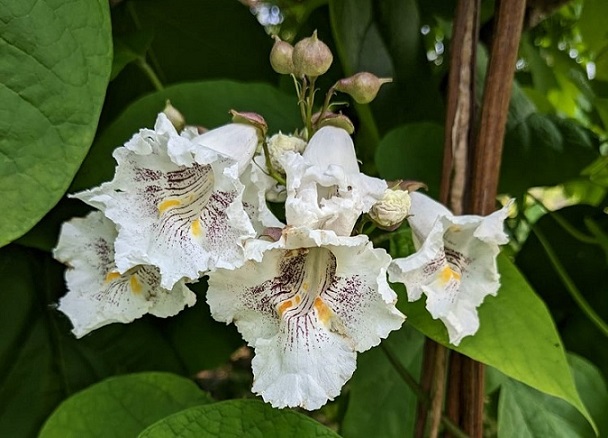
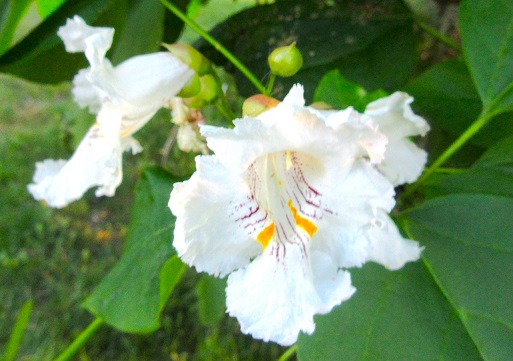
Catalpa is one of the few trees at these latitudes that produce large flowers. The leaves are also large and heart shaped. In this sense it is quite unusual and easy recognizable, you may even see it growing on the edges of roads depending on where you live. The plant blooms in Spring, around mid May and the bloom lasts about a month. The tubular flowers are easily recognizable from their markings.
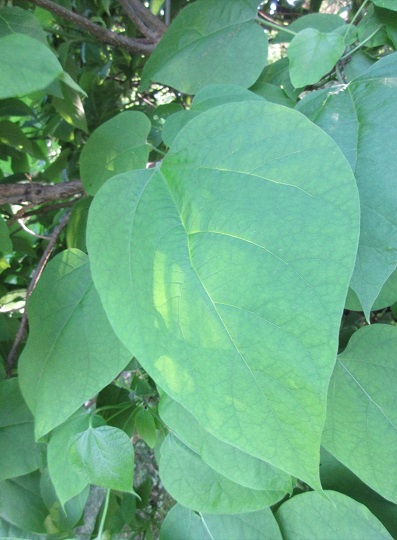
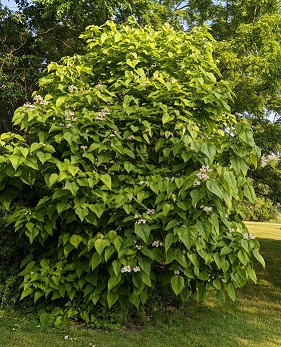
If provided with enough room, the plant expands producing new small trees. This is a desirable feature if one wants to use the tree at the edge of a property. For this reason, although the value to wildlife is limited, this plant can still be considered important as a fast growing alternative to foreign species for screening.
Catalpa can also be shaped as a tree and it can occupy a nice prominent place in the middle of the yard. I have 2 catalpas in my yard, one is left as a shrub and one shaped as a tree.
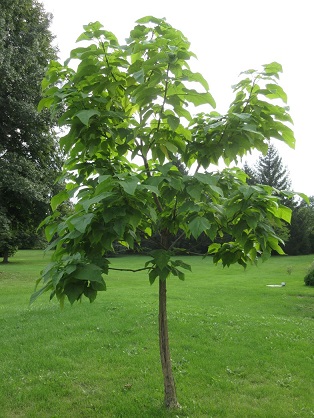
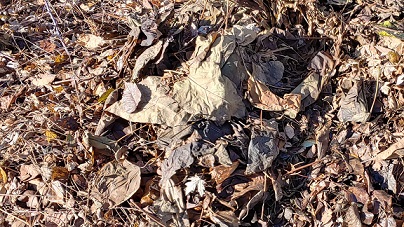
Catalpa has a reputation for being weedy and for producing a lot of litter in fall. This can also be considered a plus. I collect the large fallen leaves and add them to the leaf compost pile. They do compost very easily, and are not a problem at all.
I hope you will consider Northern catalpa for your garden, especially as an alternative to buckthorn. Every native plant you add brings back a piece of ecosystem that is vital to biodiversity.
Would you like to talk about a native plant in your backyard? Please send me your post at info@choosesustainable.org
If you liked this post please share it!
 You Choose